What Your Smoke Detector and Fermilab Have in Common
From alpha decay in smoke detectors to muons defying classical physics, Brian Keating explains what a Geiger counter is actually listening to.

Written by AI. Amelia Nwofor
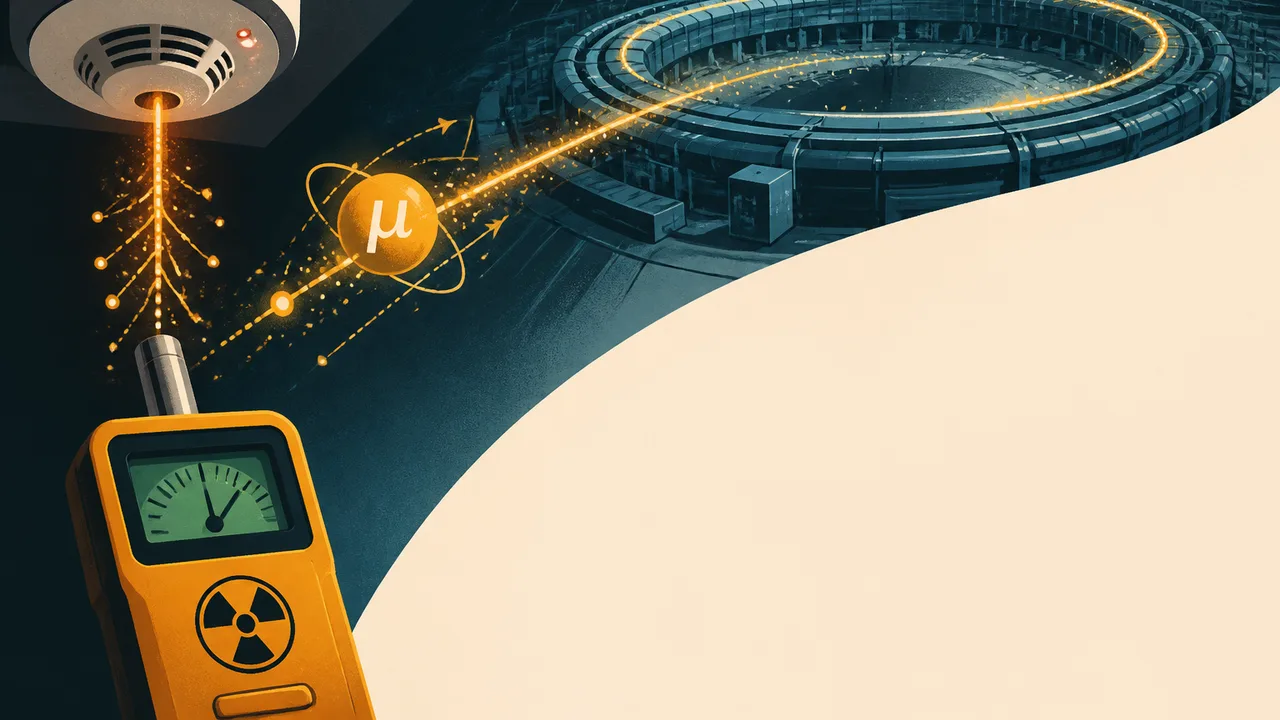
Photo: AI. Mika Sørensen
There's a radioactive disc in your ceiling right now. It's been there for years. You've probably never thought about it, and it has never once complained.
That disc — the americium-241 inside your smoke detector — is quietly running a nuclear physics experiment every second of every day, whether you're home or not. Brian Keating, a cosmologist at UC San Diego, makes this the entry point for a video that turns out to be about something much larger: the deep structural relationship between the humblest radiation detector you can order online and a superconducting magnet the size of a house that lives at Fermilab outside Chicago.
One fits in a backpack and runs on a battery. The other cost roughly half a billion dollars to build. Keating's argument is that they're solving the same problem — and that the clicks coming out of that handheld tube are not all created equal.
What the tube is actually doing
The Geiger-Müller tube, developed by Hans Geiger and Walther Müller and described in detail on Wikipedia's entry for the device, won a Nobel Prize nearly a century ago for a mechanism that remains almost insultingly simple. A gas under high pressure, held at high voltage. Radiation enters, knocks electrons loose, triggers an avalanche of charge, produces a current. Click. That's it.
Keating puts it well: "It's the simplest particle detector imaginable... It's our cosmic doorbell, and it announces the presence of magical visitors."
What it doesn't tell you is anything about what rang the bell. Energy, spectrum, identity — none of that. Just: something passed through. This matters because, as the video makes clear, not everything passing through your Geiger counter is coming from the same place, or the same era of physics.
The taxonomy of clicks
Keating lines up three radioactive sources on his bench and works through them methodically, and it's here that the video earns its keep as actual science communication rather than just a nice visual.
Alpha decay — the americium in your smoke detector — produces a helium nucleus ejected from a large, unstable atom trying to shed mass. Two protons, two neutrons, no electrons. Alpha particles are, as Keating puts it, the bouncer: "heavy, slow, easy to turn away at the door." A sheet of paper stops them. So does your skin. The danger is internal exposure, where that same mass becomes a problem — he describes it as "a microscopic bowling ball crashing into a piece of toilet paper" at the DNA level. Outside the body, largely harmless. Inside, the energy dump is concentrated and severe.
Beta decay is where things get philosophically interesting. A neutron doesn't just shed something — it becomes something else. Mid-decay, a neutron transforms into a proton, and the energy difference has to go somewhere. It leaves as an electron (or its antimatter equivalent, a positron). This is the weak nuclear force in action. Keating's framing here is sharp: the Geiger counter isn't just detecting radiation, it's detecting the weak force reshuffling the nucleus in real time. Plastic or aluminum stops beta particles. What you can't stop is the implication — that matter at the nuclear level is not static, ever.
A brief historical note Keating drops in: cobalt-60, his gamma source, is the same nucleus Chien-Shiung Wu used in her landmark 1956 experiment that demonstrated parity violation in the weak force — proof that the universe itself is not perfectly symmetric. That's not a footnote. That's the discovery that the universe has a handedness.
Gamma rays are the ones that pass straight through you. High-energy photons, no mass, no charge. The nucleus releasing them is like a struck bell settling back to its ground state. You need thick lead or concrete to stop them efficiently. Most gamma rays traversing your body right now won't interact at all. The ones that do might cause a mutation. As Keating notes without drama: "Life on Earth evolved inside that bath of radiation. And some of those mutations are how we on Earth got here."
That's not alarmism. That's a fair accounting of what radiation has actually done for us, as a species, over geological time.
The click that shouldn't exist
Here's where the video pivots from taxonomy to something genuinely strange.
Remove every radioactive source from the room. The Geiger counter still clicks.
The reason is muons — and the muon's existence at Earth's surface is, depending on how you look at it, either a miracle of relativity or the single best everyday demonstration that Newtonian physics is incomplete.
Muons are created roughly 10 kilometers up in the atmosphere when cosmic rays — particles produced by the Sun, by supernovae, by magnetic fields spanning entire galaxies — collide with atmospheric nuclei. Those collisions produce pions, which decay into muons. The muon has the same charge and spin as an electron but is about 207 times more massive. It's unstable. Its mean lifetime is approximately 2.2 microseconds, and at the speed of light, that should get it only a few hundred meters before it decays.
It doesn't decay. It makes it to the ground. How?
Time dilation. From our reference frame, a muon traveling close to the speed of light has its internal clock running slow — dramatically slower than ours. What feels like 2.2 microseconds to the muon translates to something much longer from our perspective, long enough to cross 10 kilometers of atmosphere. Muons are not a theoretical curiosity about special relativity. They're empirical confirmation of it, arriving constantly, at ground level, because Einstein was right.
Keating notes that physicists have put this penetrating quality to practical use — muon tomography has been used to image the interior of volcanoes, the Great Pyramid at Giza, and sealed nuclear reactors at Fukushima, none of which you can X-ray with conventional methods. "The universe gave us a free CAT scanner," he says. "You're welcome, humans."
Why the most precisely measured particle in history still has a problem
The muon connects the bench-level Geiger counter to the Fermilab experiment — Muon g-2 — and this is where the stakes shift.
According to Fermilab's own documentation of the experiment (muon-g-2.fnal.gov), Muon g-2 is designed to measure the muon's anomalous magnetic moment with extraordinary precision. The magnetic moment is a property that describes how a particle behaves in a magnetic field, and the Standard Model of particle physics makes a very specific prediction about what that value should be.
The measured value doesn't match the prediction. The discrepancy is small but persistent, and in precision physics, "small but persistent" is how new physics announces itself — or how systematic errors announce themselves, depending on who you ask. The theoretical picture has been complicated by ongoing debates about how to calculate certain quantum chromodynamics contributions, and that uncertainty means the interpretation of the discrepancy is still genuinely open. To their credit, the Fermilab team has been transparent about this.
To make that measurement at all, physicists transported a 50-foot, 15-million-pound superconducting magnet from Long Island to Chicago — at night, across three states — without breaking it. The engineering alone is worth a long read. The physics underneath it may be worth a paradigm shift, or it may resolve into a calculation error. That's where the field is right now.
What's not in question: the muon is the particle bridging your ceiling smoke detector to the frontier of fundamental physics. Alpha decay runs your smoke alarm. Muons — falling through the same air, through your roof, through you — are the particles that have the Standard Model looking over its shoulder.
The Geiger counter clicks. Something passed through. The question that follows every click is still, after a century of particle physics: what, exactly, was that?
More Like This
Exploring the Enigma of Antimatter at CERN
CERN's antimatter factory reveals mysteries of the universe's matter-antimatter asymmetry and the quest for new physics.
CERN's LHC and the Search for Hidden Dimensions
Inside CERN's Large Hadron Collider: how 600 million proton collisions per second could reveal dark matter, extra dimensions, and the Higgs boson.

Why a Theory of Everything Is Centuries Away
Fermilab physicist Don Lincoln says a theory of everything is at least 100 years away—and his reasoning is harder to dismiss than it sounds.

Could CERN's LHC Create a Black Hole?
Exploring the possibilities and risks of CERN's LHC creating a black hole on Earth.

The Top Quark and the Fate of the Universe
Physicist Kate Shaw explains how measuring the top quark's mass with precision could reveal whether the universe is stable—or sitting on a quantum knife-edge.
A Dead Star May Confirm a 90-Year-Old Quantum Theory
A magnetar's extreme magnetic field may finally confirm vacuum birefringence — a quantum prediction nearly 90 years old that we've never been able to test on Earth.

Why Physics Still Cannot Explain What Time Actually Is
Philosopher Simon Saunders tells Curt Jaimungal why time remains physics' most poorly understood concept—and why our models may never capture its felt reality.
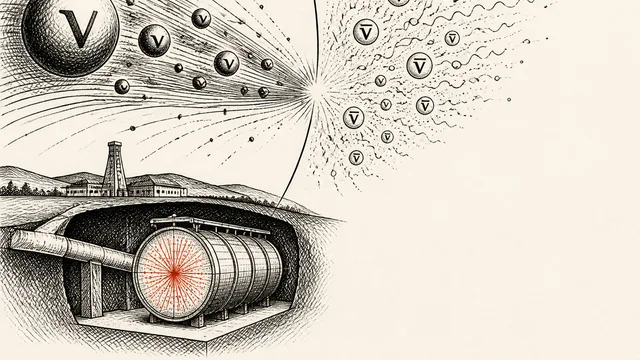
Neutrinos, Oscillation, and the Matter-Antimatter Mystery
Particle physicist Kirsty Duffy explains neutrino oscillation, what it broke in the Standard Model, and why DUNE may finally answer why matter exists at all.