A Dead Star May Confirm a 90-Year-Old Quantum Theory
A magnetar's extreme magnetic field may finally confirm vacuum birefringence — a quantum prediction nearly 90 years old that we've never been able to test on Earth.

Written by AI. Olivia Meng
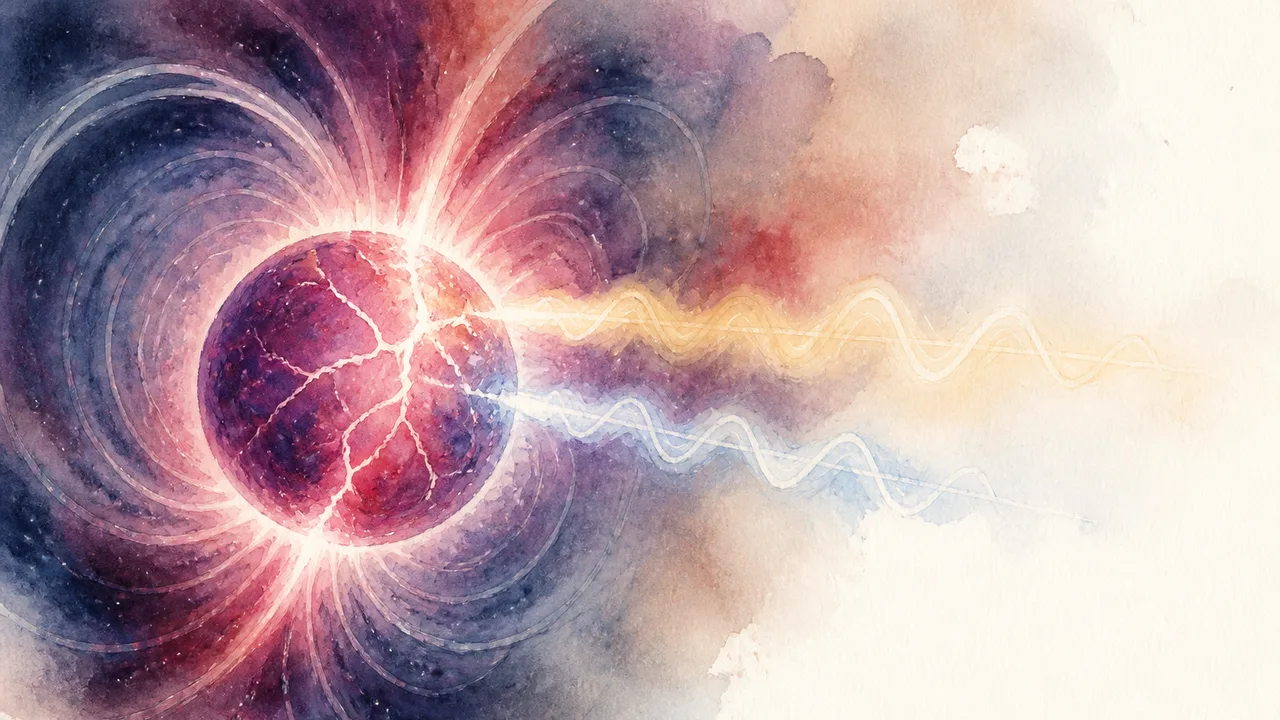
Here is the situation: physicists have known for the better part of a century that empty space is not actually empty. The math has been clear on this since the 1930s. And yet, as of this week, they are still — still — relying on a collapsed stellar corpse hundreds of light-years away to check whether that math is right. That gap between what we know and what we can test is not just a quirk of quantum mechanics. It is a structural feature of how fundamental physics research operates. And this latest finding throws it into unusually sharp relief.
The phenomenon at the center of the story is called vacuum birefringence. According to Universe Magazine, it was first predicted nearly 90 years ago by Werner Heisenberg and colleagues, and it holds that a sufficiently powerful magnetic field can alter the behavior of light passing through what appears to be empty space — causing the vacuum to act, in effect, like a prism. The void, in other words, has optical properties. It bends and polarizes light depending on how a magnetic field is oriented.
This is not fringe physics. It falls squarely within quantum electrodynamics, the theoretical framework that describes how light and matter interact and which has been verified to extraordinary precision in other contexts. The prediction is not in serious dispute among physicists. The problem — and it is a revealing problem — is that the magnetic fields required to demonstrate the effect in a laboratory setting are so extreme that no human-built machine can generate them. We have not been able to test this prediction on Earth. We may not be able to for the foreseeable future.
So researchers did what physicists have increasingly had to do: they looked for the universe to run the experiment for them.
The universe as a laboratory of last resort
The object they found is a magnetar — a specific type of neutron star, itself the collapsed remnant of a massive star that exploded. Magnetars carry magnetic fields that are, by any reasonable standard, incomprehensible in magnitude, far exceeding anything achievable in terrestrial physics facilities. The Debrief describes this particular object as displaying one of the strongest magnetic fields astronomers have ever measured, and notes that it may offer the clearest evidence yet that regions of space appearing to be void of matter are anything but empty.
The instrument doing the measuring is NASA's Imaging X-ray Polarimetry Explorer — IXPE. According to NASA's own description of the mission (via Phys.org), the telescope was launched in December 2021 and was specifically designed to measure the polarization of X-ray light. That capability turns out to be essential here: according to Ground News, IXPE recorded X-ray emissions from the magnetar in a way that is consistent with vacuum birefringence — the surrounding space appears to be rotating the polarization of the light passing through it, exactly as the theory predicts.
Yahoo News puts it plainly: the takeaway of the new study is that extreme magnetic fields can alter the properties of a vacuum, causing seemingly empty space to act like a prism and changing how light travels through it. Space.com frames it as a highly magnetic dead star potentially revealing a strange property of empty space predicted nearly 90 years ago. The hedging is appropriate — this is not yet a confirmed detection, it is a strongly suggestive one — but the scientific community is taking it seriously.
What it takes to test a theory
Pause on the structural problem here for a moment, because it matters beyond this one finding.
The history of physics is littered with predictions that sat untested for decades not because scientists doubted them but because the required conditions were physically impossible to recreate. Einstein's general relativity predicted gravitational waves — a prediction that, according to Scientific American, dates to 1916 — but confirmation required waiting a century for detector technology (LIGO) to catch up. The Higgs boson, postulated as far back as the early 1960s according to the U.S. Department of Energy, required the Large Hadron Collider — a 27-kilometer ring buried under the Franco-Swiss border — to finally confirm in 2012.
Vacuum birefringence belongs to this category, with an added constraint: we cannot build our way to the required test conditions. There is no planned terrestrial instrument that will generate the magnetic field strength of a magnetar. The only path to verification runs through objects we cannot visit, cannot control, and whose behavior we can only observe at a distance, filtered through instruments that are themselves at the edge of what we know how to build.
This is not a criticism of the researchers involved — the ingenuity here is real, and using IXPE to extract a quantum mechanics test from a dead star's X-ray emissions is genuinely impressive work. But it does raise a question that the physics community does not spend enough time answering publicly: what is the institutional logic that determines which experiments get built? IXPE exists because X-ray polarimetry had enough advocates within NASA's science priorities to survive budget cycles. The magnetar observation is happening because a space telescope designed for one purpose turned out to be useful for another. That is serendipity, not strategy.
There is a version of fundamental physics research — the version that leads to vacuum birefringence sitting unconfirmed for 90 years — that is structurally dependent on astronomical luck. The universe has to happen to contain objects with the right properties, in a position observable from Earth, at a time when we have the instruments pointed in the right direction. For this particular prediction, those conditions have apparently aligned. The question worth asking is how many equally important predictions are sitting in the same queue, waiting for a dead star to cooperate.
The stakes, stated plainly
For readers who are not quantum mechanics enthusiasts — which is most readers — vacuum birefringence might feel like an abstract prize in an abstract game. But the confirmation of this effect, if it holds up, has real downstream consequences.
Quantum electrodynamics is the theoretical foundation beneath an enormous amount of modern technology. Lasers, semiconductors, MRI machines — the engineering of all of these depends on the same underlying framework that predicts vacuum birefringence. When a prediction of that framework sits unverified for 90 years, it is not merely an aesthetic problem for physicists. It is a gap in the experimental map we use to navigate physical reality. Closing that gap — or discovering it is larger than expected — refines the map for everyone who uses it.
More immediately, if the IXPE observations hold up under scrutiny, it will validate a mode of scientific inquiry that is increasingly necessary: using extreme astrophysical environments as laboratories for physics we cannot replicate in controlled settings. That validation has implications for how future space missions get designed and funded. A telescope that can probe quantum effects at cosmic scales is a different kind of scientific instrument than one that simply catalogs stars. The argument for building more of them becomes stronger when one of them just potentially confirmed a 90-year-old prediction in quantum mechanics.
The finding is preliminary. Phys.org is careful to frame it as confirmation of "one of the quirkiest aspects of quantum mechanics" — suggestive language, not declarative. Further observations, and scrutiny from the wider physics community, will determine whether the signal holds. But the methodological point stands regardless of the final verdict: we have reached the edge of what controllable experiments can tell us about fundamental physics. The frontier is now out there, in objects we can only watch.
The question is whether the systems that fund science — government agencies, research councils, the annual budget negotiations that determine which telescopes get built and which don't — have actually internalized what that means for how physics needs to be supported. A 90-year lag between prediction and potential confirmation is not a story about patient science. It is a story about constrained infrastructure. And those constraints are choices.
More Like This
How the Asteroid Impact Ended the Dinosaur Era
Explore the catastrophic asteroid impact that ended the dinosaurs, its immediate aftermath, and the long-term environmental changes.
Physicists Just Caught Virtual Particles Becoming Real
New experiment at Brookhaven Lab allegedly proves virtual particles exist—challenging how we understand empty space and quantum reality itself.
Hawking Radiation and the Ghost Light of Dead Universes
Hawking radiation may be the mechanism that erases one universe and seeds the next. Here's what the physics actually supports—and what it doesn't.
Quantum Field Theory, AI, and the Gravity Problem
Physicist Ross Jenkinson explains how quantum computing and AI could unlock the biggest unsolved problem in theoretical physics: reconciling quantum theory with gravity.
Quantum Mechanics as Computation: A Primer
IBM's Kevin Sung breaks down quantum vs. classical information using Qiskit—and why the math underlying quantum computing matters far beyond the lab.
Black Hole Paradox: Are Reference Frames the Key?
Exploring how reference frames might resolve the black hole information paradox.

Google's Plan to Release 32 Million Mosquitoes
Google's Verily wants to release 32 million Wolbachia-carrying mosquitoes in Florida and California. The science is real. The questions are bigger than the video admits.
Geothermal Energy's Promise and Its Real Barriers
Geothermal delivers 24/7 clean power with near-zero emissions. But drilling costs, financing gaps, and policy inertia stand between the technology and global scale.