Lyndon Johnson's Great Society and Vietnam's Trust Crisis
Lyndon Johnson expanded civil rights, health care and anti-poverty programs while escalating Vietnam. How did those choices reshape federal power and public trust?

Written by AI. Sofia Ramirez
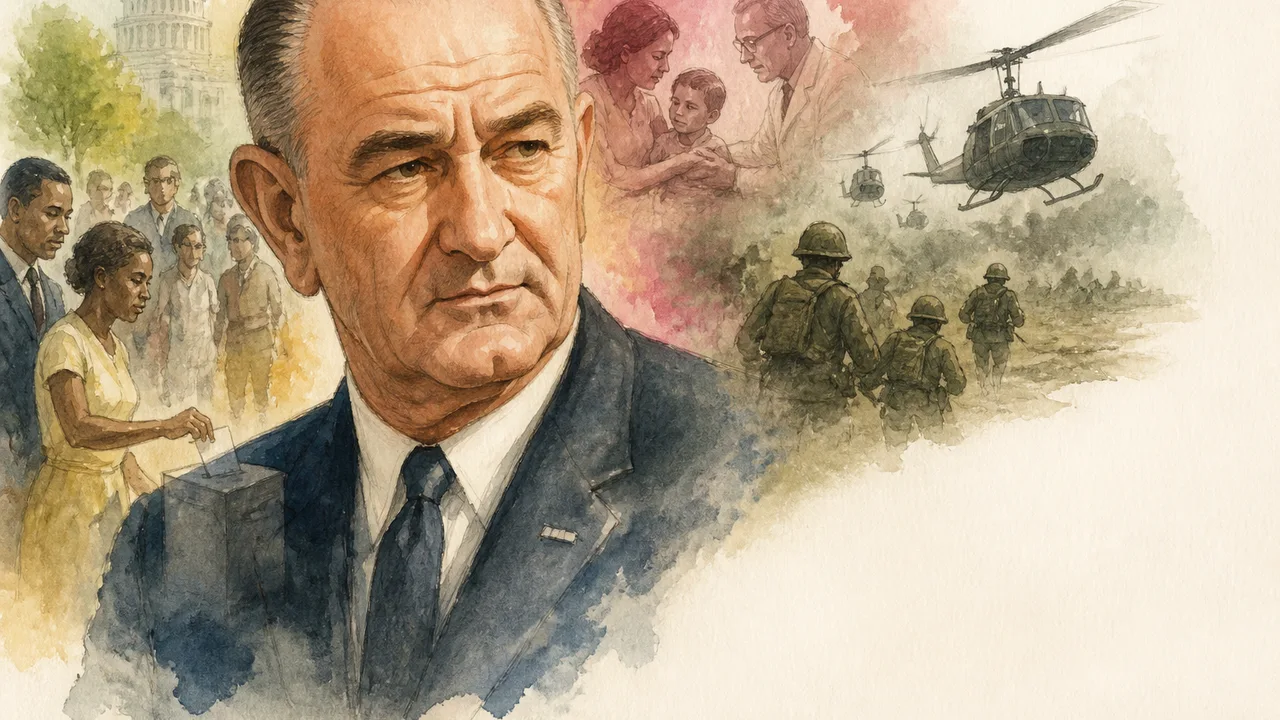
In 1965, Congress passed the Voting Rights Act while Lyndon Johnson’s administration expanded the American war in Vietnam. A voter facing exclusion at home and a family awaiting news from overseas could encounter the same presidency in profoundly different ways. Johnson’s record cannot be understood by choosing one of those experiences and treating the other as a footnote.
His administration helped change who could vote, who could obtain health coverage and what Washington would do about poverty. It also deepened a war whose expanding demands collided with the administration’s assurances about its course.
Who Made the Great Society Possible
Johnson had an unusual command of Congress, and he used it. The Civil Rights Act of 1964 and Voting Rights Act of 1965 stand among the central achievements of his presidency. The first attacked segregation in public accommodations and discrimination in employment. The second gave the federal government stronger means to confront barriers to Black voting. These laws changed the rules that governed ordinary life, from access to a restaurant to access to a ballot.
A president can sign a law; he cannot manufacture decades of organizing that make it possible. Black activists had spent years challenging exclusion, building local organizations and forcing the country to confront violence and discrimination. Their pressure helped make federal inaction untenable. Johnson’s political skill was consequential because he put presidential authority behind demands that people outside the White House had already made impossible to ignore.
That account gives the legislation its full scale. A voting-rights statute mattered because local officials could obstruct people trying to vote. A ban on discrimination mattered because employers and businesses could decide who got a job or service. The people who stood to benefit had also carried much of the risk of pressing for change.
Johnson’s Great Society reached beyond civil rights. His administration advanced Medicare and Medicaid, federal education spending and anti-poverty programs. Those efforts rested on an ambitious proposition: national government could help secure access to health care, schooling and economic opportunity that local institutions and private markets had failed to provide evenly. The programs differed in design and reach, but each made Washington more present in decisions that once depended heavily on a family’s income or circumstances.
The strongest case for Johnson’s domestic record begins there. Legislation gave reform a durability that a sympathetic speech could not. It created federal responsibilities people could invoke after the political moment that produced them had passed. The strongest caution belongs alongside it: a statute does not administer itself. How well a promise reaches a patient, student, worker or voter depends on the institutions carrying it out and the power of people able to demand compliance.
The Authority to Escalate
Vietnam followed a different path through Washington. After reported attacks in the Gulf of Tonkin in 1964, Congress passed a resolution giving Johnson broad authority to respond. The circumstances surrounding the reported second attack became deeply disputed. The resolution’s political consequence was clear: it gave the administration room to widen U.S. military action without a formal declaration of war.
Johnson then increased the American commitment, including the deployment of combat troops in 1965. His presidency is heavily criticized for escalating the war in Vietnam. That judgment concerns more than the eventual outcome. It concerns the decisions that enlarged the conflict and the claims made to sustain public support while those decisions accumulated.
A president making the case for intervention could argue that abandoning a U.S. commitment carried risks for allies and for American credibility abroad. That was a serious argument, and it helped give escalation a rationale beyond any single battlefield development. Yet each increase in the commitment raised the cost of changing course. Broad congressional authorization also gave legislators less occasion to cast a fresh, explicit vote on each enlargement of the war. The machinery of consent looked different from the debate over a civil-rights bill whose provisions and purpose Congress had to confront directly.
The widening gap between official assurances and the war’s course became a credibility crisis. When leaders ask people to accept mounting sacrifice while speaking confidently about progress, the public has to judge claims it cannot easily test for itself. Battlefield developments made that confidence harder to maintain. By 1968, the war consumed much of Johnson’s attention and muted the impact of his domestic achievements. That did not erase the laws. It narrowed the political space in which his administration could carry their ambitions forward.
Two Uses of Federal Power
It is tempting to tell Johnson’s story as a contest for resources: money and attention went to Vietnam instead of poverty and education. But it is only part of the picture. Congress, local administrators and the people meant to benefit from a program all shape what happens after a bill becomes law. The war did not cause every limit of the Great Society, just as ending it would not have settled every dispute over federal spending or racial equality.
The sharper comparison concerns how power was justified. At home, Johnson used federal authority to confront entrenched barriers that states and local institutions had permitted or enforced. Abroad, his administration relied on broad authorization as it expanded a military commitment whose costs became harder to reconcile with public assurances. Both choices enlarged the federal government’s role. They placed different demands on democratic consent.
That contrast also complicates the idea of a single “Johnson legacy.” For an older person seeking medical care, Medicare could be the consequential fact of his presidency. For a Black citizen trying to exercise the vote, federal enforcement could change the terms of a confrontation with local power. For someone living through the Vietnam War, the defining question could be why the government’s description of the conflict seemed so distant from its course. None of those perspectives requires the others to disappear.
Historical memory often gives presidents more room than it gives the people who had to live under their decisions. The Great Society becomes a story of Johnson’s legislative mastery; the war becomes a story of Johnson’s failed judgment. His skill and his decisions deserve scrutiny. So do the Black organizers whose work pressed a government to act, the people who depended on its new programs and those asked to bear the costs of escalation.
Johnson’s presidency leaves a demanding question for any government that promises ambitious change. Can it build durable public protections while giving people an account of its military choices that remains credible as the costs rise? The Civil Rights Act and Voting Rights Act show what federal power can accomplish when organized people force an opening. Vietnam shows how quickly trust can fray when a government asks for consent while its assurances outrun events.
More Like This
Douglas MacArthur and the People He Left Behind
MacArthur is remembered as a military legend. But what about the veterans he gassed, the soldiers he abandoned, and the Japanese citizens who built a new democracy?
California's Hidden Underground: Caves, Tunnels, and Buried History
From a buried Gold Rush city to survival tunnels built by Chinese immigrants, California's underground holds layers of geology, history, and forgotten infrastructure.
Medieval England: How Peasants and Guilds Shaped Society
A new documentary traces medieval England's social divide through two real families—one peasant, one guild merchant—and the starkly different worlds they inhabited.
How the Continental Congress Named the United States in 1776
On September 9, 1776, Congress swapped 'United Colonies' for 'United States.' The name left the country's whole structure deliberately unresolved. Here's how.

How Japan Industrialized in the 19th Century
Japan's Meiji-era industrialization combined state investment, free markets, zaibatsu corporations, and labor exploitation into a development model still visible today.
Roosevelt's 1936 Peace Promise: What He Really Meant
In 1936, FDR ran on "peace" — but he meant three different things by it. Unpacking that word reveals a political strategy still worth examining today.