Lucy and the Blurry Origins of Humanity
Lucy the fossil was supposed to define when humans began. Decades of new evidence suggest that moment never existed — and the definition of "human" is still unsettled.

Written by AI. Amelia Nwofor
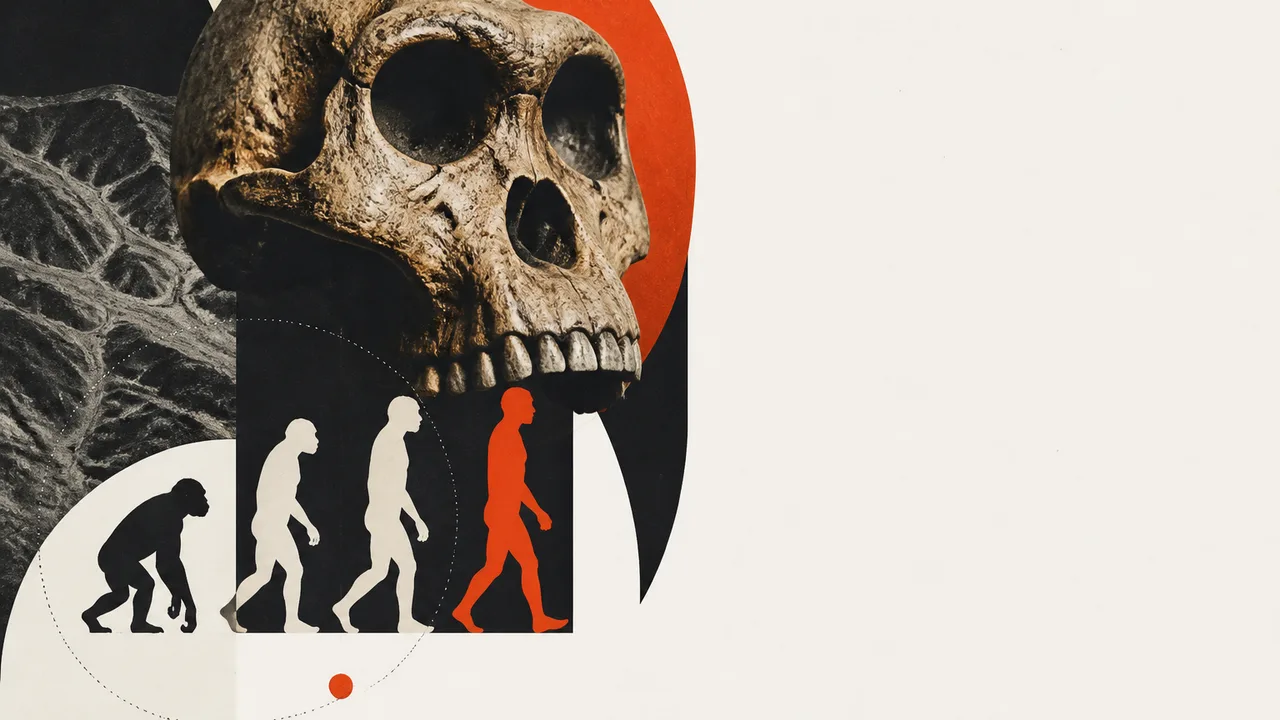
Photo: AI. Ondine Ferretti
In November 1974, Donald Johanson glanced over his right shoulder at a parched hillside in Ethiopia and spotted a small fragment of ancient bone. That involuntary look changed the trajectory of paleoanthropology. As Johanson later recalled: "If I'd looked to my left, I would have missed her. And my life would have been incredibly different."
The her in question was Lucy — a 3.2-million-year-old partial skeleton belonging to the species Australopithecus afarensis, recovered at roughly 40% completeness, which is extraordinary for a hominin of that age. Johanson and his student Tom Gray had stumbled onto what would become the most famous fossil in the history of human evolution research: arm bones, lower jaw, skull fragments, pelvis, femur, tibia. Enough to reconstruct a body. Enough, everyone hoped, to reconstruct a lineage.
For a while, Lucy delivered on that promise. She was ancient enough — and different enough from recognizable humans — to serve as a plausible starting point for our evolution, while similar enough in key respects to make that evolutionary path feel navigable. Johanson and colleagues argued it wasn't inconceivable to evolve a tall, big-brained human from a creature like afarensis. Lucy was, as the video from New Scientist puts it, "potentially a grandmother of humanity."
That framing held for decades. Now, it's fraying.
The Body We Misread
Part of the problem was methodological. Lucy herself was, even within her own species, unusually short — about a meter tall. When researchers examined the wider pool of afarensis fossils recovered across Ethiopia, height variation within the species turned out to be substantial. Some individuals reached roughly 165 cm, a height that would be unremarkable today. The lesson is one every science journalist should tattoo somewhere visible: a single specimen, however famous, is a data point, not a population.
Johanson himself was emphatic about what the fossils clarified on one long-contested question: "There was a major debate among anthropologists as to whether or not we stood up first and then brains grew or we had larger brains and then moved out of the forests onto the savannas and then began walking upright. And this shows us very clearly that upright bipedalism, upright walking, precedes brain expansion." That much is now settled. Afarensis was bipedal well before its brain approached anything like human scale — around one-third the volume of ours.
But the story gets more complicated from there, and more interesting.
What Lucy's Hands Suggest
Some researchers have argued that the hand proportions of afarensis were surprisingly humanlike — that the species may have had the manual dexterity for precise grip and object manipulation. That's a contested claim; not all paleoanthropologists accept it. But it becomes considerably harder to dismiss alongside a separate strand of archaeological evidence.
A 2010 study published in Nature by McPherron and colleagues reported 3.39-million-year-old animal bones recovered at Dikika, Ethiopia, bearing what appeared to be stone-tool cut marks — marks consistent with a hominin using a sharp edge to strip meat from bone. The bones came from antelope-like animals. If the interpretation holds, it would push evidence of meat-processing back to Lucy's era, well before the species traditionally credited with inventing tool use.
That "if" is doing a lot of work. The finding remains genuinely controversial. Some researchers attribute those marks to crocodile activity, not stone tools. The debate hasn't resolved. What's worth noting is that the controversy itself is scientifically healthy — this is what it looks like when a field takes evidence seriously rather than forcing it to fit a prior narrative.
The implications, if the Dikika evidence does reflect tool use, are significant enough to be mildly embarrassing for the naming conventions of later hominins. Homo habilis — "handy man" — and Homo erectus — named for upright locomotion — would both be scooped by afarensis on their defining traits by hundreds of thousands of years.
The Gap That Should Worry Us
Between approximately 2.9 and 1.9 million years ago, the fossil record goes quiet. This is precisely the window when researchers believe the transition to recognizably human body plans was occurring. On one end of the gap: Lucy, with fingers dangling near her knees, a cone-shaped ribcage, and a brain one-third the size of ours. On the other end: Nariokotome Boy, a Homo erectus skeleton discovered near Lake Turkana about a decade after Lucy, roughly 1.5 to 1.6 million years old, with a brain around 880 cubic centimeters — about two-thirds of a modern human's — and a body that reads, unmistakably, as human.
How did that transition happen? The honest answer is that we don't know, because the fossils covering that interval are sparse. For years, some researchers posited an "evolutionary package" — a rapid, bundled set of biological changes that produced the first humans in a relatively short window. The appeal of that framing is obvious: it gives you a line to draw.
But evidence like the Dikika cut marks has made the "rapid burst" hypothesis harder to sustain. If afarensis was already engaging in meat-processing behavior, then the behavioral innovations long associated with early Homo didn't appear suddenly. They may have been accumulating, incrementally, for far longer. The line keeps moving.
The Definition Problem Nobody Has Solved
Here's the part of this story that doesn't get enough attention in popular coverage: there is no agreed formal definition of what makes a species "human."
There's no consensus definition of Homo sapiens that distinguishes it cleanly from archaic humans. And there's no agreed definition of the Homo genus — the category that's supposed to encompass all humans. This isn't a gap that's close to being filled. Scientists actively disagree about the right framework.
One camp favors a phylogenetic approach: define humans based on the lineage that split from the ancestors of Paranthropus. Under this view, whatever descended from that branching point is human, full stop. Simple, but it creates an immediate problem — right after a split, the populations on each diverging path are biologically indistinguishable. You can't meaningfully separate them. The line appears on a diagram, not in the bones.
Another camp takes a morphological and behavioral approach, insisting we should only call something human once it demonstrably exhibits the biological markers we associate with humanity. Under this stricter view, Homo erectus — Nariokotome Boy's species — is the earliest genuine human. Homo habilis, conventionally regarded as the first human species, doesn't make the cut. That conclusion sits poorly with many researchers, which is part of why the debate persists.
Taxonomy is supposed to impose order on biological reality. What it's revealing here is that biological reality didn't leave a convenient seam.
What Lucy Actually Gave Us
Johanson described what he wanted most from the fossil record: "Actual skulls. That's how we all identify each other. We don't look at someone's knee and say, 'Oh, how nice to see you, Gladys.' Skulls have all the clues about who we are."
Lucy's skull, even reconstructed, is instructive precisely because of how ape-like it is — the projecting face, the low forehead — set against a skeleton that was already walking upright. That combination was clarifying in 1974 and remains clarifying now, just not in the way the original narrative promised.
What Lucy and the broader afarensis fossil assemblage actually delivered wasn't a tidy origin story. They delivered better questions. They forced the field to confront how many of the behaviors we thought defined humanity — tool use, meat-eating, manual dexterity — may have predated the first species we label human. They revealed how much the gap in the fossil record had been quietly papered over with assumptions about dramatic, rapid transformation. And they surfaced a definitional crisis that taxonomy alone cannot resolve.
There is no crisp moment when the first human appeared. Evolution doesn't work in moments. What the fossil record offers is a gradient — Lucy clearly different from Nariokotome Boy, as different as red is from orange in a rainbow, but with no line anyone can point to where one becomes the other.
The boundary between human and non-human ancestor may be, in the end, a line we drew. The question worth sitting with is what that tells us about the lines we're still drawing.
More Like This
Homo Erectus Survived 1.9 Million Years. We've Managed 300,000.
Homo erectus outlasted us by six to one. A new look at the fossil record asks whether our big brains are an advantage—or a liability with a slow fuse.
What Spinosaurus Tells Us About Dinosaur Science
Dr. Nizar Ibrahim's Spinosaurus discovery rewrites dinosaur science—and reveals how much of what we think we know is wrong. Here's what the fossil record actually shows.
Ghost DNA Found in All Humans From Unknown Ancestors
New genetic research has detected an unidentified 'ghost' population in the DNA of every living human — a people with no name, no bones, and no recorded history.
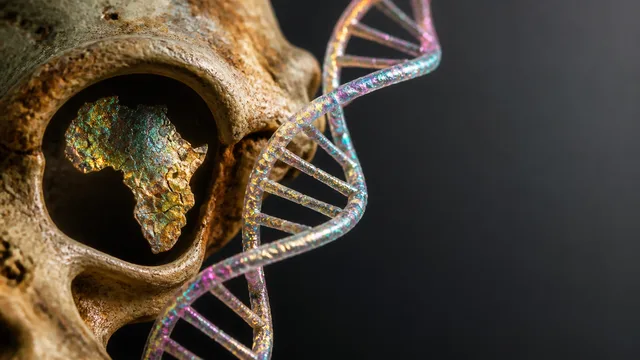
Where Did Humans Actually Come From in Africa?
We know humans came from Africa—but where exactly? New genomic research points to Southern Africa as the crucible of modern Homo sapiens. Here's what the evidence says.
The Most Sensitive Dark Matter Detector Might Find Nothing
LUX-ZEPLIN sits a kilometer underground, waiting for dark matter. But success might look like silence—and that would tell us something huge.

Why Light Beams Seem to End: Physics Explained
Discover why searchlight beams appear to stop and how physics and atmospheric conditions contribute to this phenomenon.
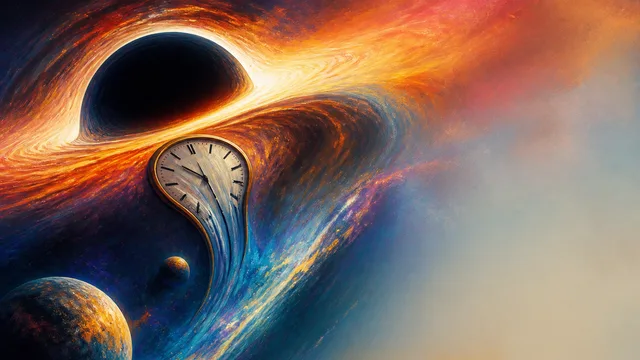
Gravity's Strangest Effects, From Time to Cosmic Voids
From gravitational time dilation to the Dipole Repeller and LIGO's detections, here's what gravity actually does—and what it still can't explain.
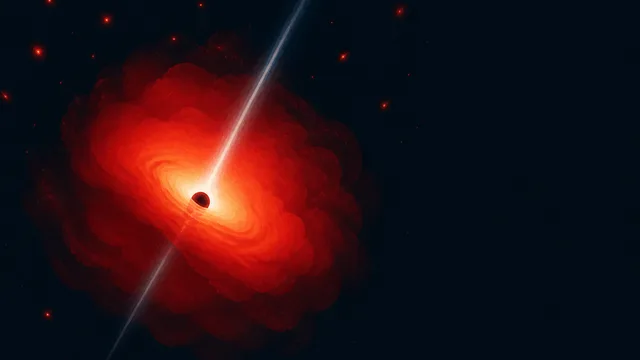
JWST's Little Red Dots May Be Cocooned Black Holes
New JWST spectral data on a single "little red dot" galaxy offers the strongest case yet that they're supermassive black holes wrapped in dense gas cocoons.