Lost Gertrude Abercrombie Painting Returns to View
A Gertrude Abercrombie painting priced at $30 at a Michigan estate sale sold for a reported $1.3 million, renewing questions about provenance and access.

Written by AI. Sofia Ramirez
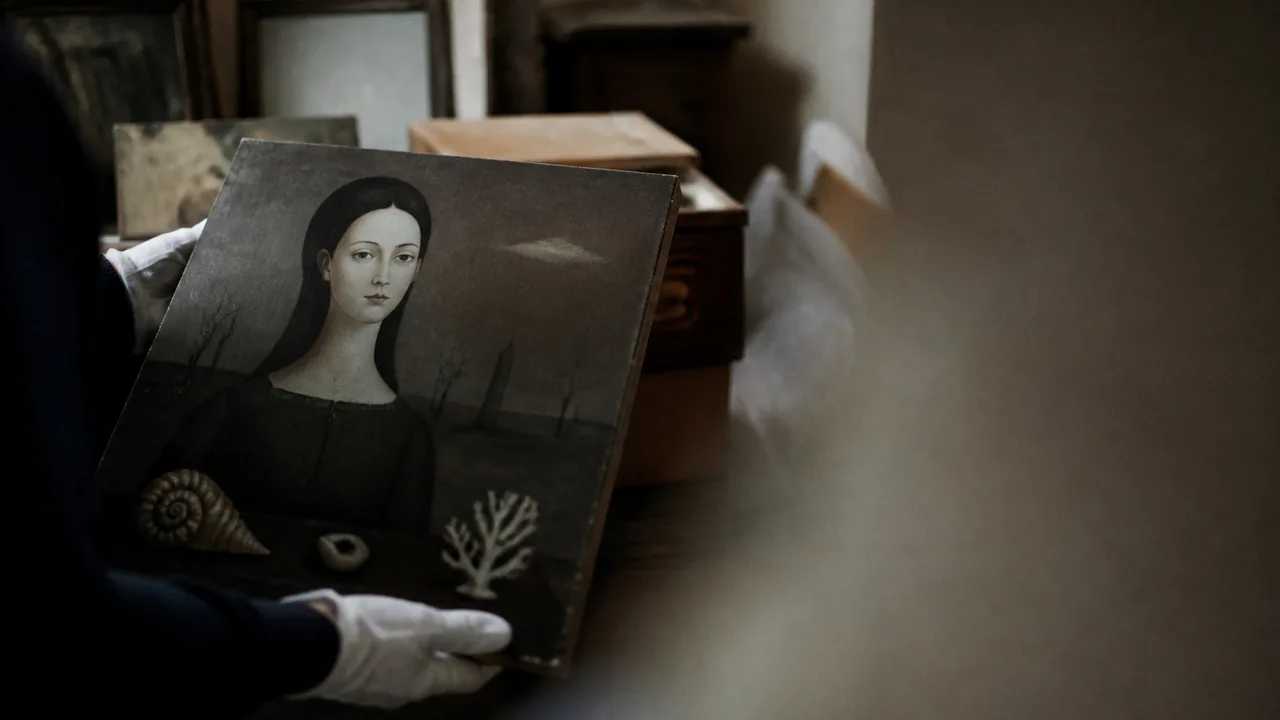
A painting identified as Gertrude Abercrombie’s 1951 work Alderman Merriam’s Shells turned up with a $30 price tag at a Michigan estate sale in 2025. Before its auction, reports put its potential price at $250,000. Its later reported auction price was $1.3 million.
Those numbers offer an irresistible story about a bargain. They also mark three different moments in the life of one object: a household sale, a specialist assessment and an auction. At each stop, people had a different idea of what they were looking at. The sale brought a little-known Abercrombie painting back into public view, where it can be identified, studied and argued over. The million-dollar figure may get readers to the painting; it cannot do that work for them.
Abercrombie was a Chicago artist associated with surrealism. She made carefully arranged images whose spare, enigmatic worlds ask viewers to pay attention to what sits next to what. Alderman Merriam’s Shells now brings a further set of questions into focus. The route from Abercrombie’s studio to the Michigan estate sale remains unclear, as does the documentation behind the work’s identification. Those gaps leave room for research, rather than a tidy tale in which the final bid explains everything that came before.
What a Price Tag Can Tell Us
An estate sale has a practical job. Someone must sort and price possessions so they can move out of a home. A painting may arrive on a table or wall alongside objects whose owners knew their daily place but never recorded their history for strangers. The $30 tag tells us what someone asked for this work at that sale. It does not tell us what Abercrombie thought of it, how earlier owners valued it or what paperwork accompanied it over the decades.
The jump to a six-figure pre-sale expectation required a different set of judgments. Auction specialists sell to an audience that may recognize an artist’s name, compare works and bid competitively. The subsequent $1.3 million figure records the outcome of that contest. It should not be treated as the amount someone earned by finding the painting: a sale price alone says nothing about fees, expenses or who received the proceeds.
Even setting those questions aside, auction results answer a narrow question: what bidders were willing to pay under those conditions. A price can draw attention to an overlooked work, encourage owners to examine what they have and prompt institutions to revisit an artist’s record. It cannot supply a missing chain of ownership or settle the meaning of a painting. The bidder who wanted it most and the researcher who can explain it best are doing different jobs.
That separation becomes easy to lose when a discovery comes packaged as a multiplication problem. Thirty dollars to $1.3 million is a startling ratio. It is also a poor description of the years during which Alderman Merriam’s Shells stayed outside wider art-historical discussion. A work can survive physically while the knowledge needed to place it becomes scattered across households, labels, photographs and memories.
The Paper Trail Behind a Rediscovery
Provenance is the record of where an artwork has been and who held it. For Alderman Merriam’s Shells, that means asking how it left Abercrombie’s hands and reached Michigan. Did owners keep correspondence, receipts or photographs? Was the work recorded under the same title throughout its life? Did anyone know what it was before the estate sale? These are research questions, not clues to a mystery with an ending already written.
Documentation matters to people beyond the next buyer. A curator deciding whether to exhibit a painting needs confidence in its identification and a way to explain that judgment to visitors. A scholar comparing Abercrombie’s works needs dates, images and ownership records to test an interpretation. Families who lived with an artwork may hold knowledge absent from a sales listing, even if they never thought to call it provenance. Each group can know something the others do not.
There is a temptation to make the estate-sale price stand for everyone’s failure to recognize art. That asks a household transaction to carry too much blame. Families do not ordinarily maintain museum catalogues. Estate-sale workers have to make decisions across many objects, often without a painting’s history at hand. Specialists can examine a work through networks and reference material that an earlier owner or seller may never have had reason to use. The useful question is how those kinds of knowledge meet once a painting reappears.
Identification can also change what people seek. A title connects an object to a body of work; a date places it within an artist’s career. Alderman Merriam’s Shells invites attention to Abercrombie’s choices in 1951, rather than to an anonymous painting on an estate-sale wall. Its title suggests a named figure and shells, but a title alone cannot tell us who Merriam was or what Abercrombie intended. Close study of the work, alongside documented context, can take that inquiry further.
A Public Return with Private Limits
An auction gives a painting a brief, intense period of visibility. It receives a name, a description and an audience beyond the household where it had rested. After a sale, the buyer determines much of its next chapter. Public view could mean a future exhibition or an image that researchers can consult. It does not follow automatically from a high price, and neither does permanent public access.
That tension sits at the center of many rediscoveries. Private ownership can preserve a work for decades; it can also make study depend on an owner’s interest in sharing it. Museums can offer access and sustained research, yet they, too, must choose what to collect and display. Auction houses bring expertise and attention to objects entering the market, while their purpose is to sell them. Each institution has a role, and none can substitute entirely for a documented history that other people can examine.
Abercrombie’s Chicago connection gives this case a local dimension. An artist’s work can travel far from the city where she made it, then reenter conversation through an estate sale in another state. The people who kept that work along the way become part of its history, even when their names never appear beside the artist’s on a gallery wall. An ownership trail, if reconstructed, would describe more than transfers of property. It would show the homes and decisions through which one painting survived.
The $30 tag will probably remain the easiest detail to remember. The $1.3 million sale raises questions about who can see Alderman Merriam’s Shells and what its reappearance can help us learn about Abercrombie’s work.
More Like This
Douglas MacArthur and the People He Left Behind
MacArthur is remembered as a military legend. But what about the veterans he gassed, the soldiers he abandoned, and the Japanese citizens who built a new democracy?
California's Hidden Underground: Caves, Tunnels, and Buried History
From a buried Gold Rush city to survival tunnels built by Chinese immigrants, California's underground holds layers of geology, history, and forgotten infrastructure.
Medieval England: How Peasants and Guilds Shaped Society
A new documentary traces medieval England's social divide through two real families—one peasant, one guild merchant—and the starkly different worlds they inhabited.

How the Continental Congress Named the United States in 1776
On September 9, 1776, Congress swapped 'United Colonies' for 'United States.' The name left the country's whole structure deliberately unresolved. Here's how.

The Spanish Civil War at 90: What the Coup Unleashed
On July 17, 1936, a military coup fractured Spain and drew the world in. What the Spanish Civil War's 90th anniversary still asks of us.

Egypt's New Delta Project: Green Miracle or Mirage?
Egypt is engineering a new Nile in the desert. But satellite data, groundwater depletion, and a troubling history raise urgent questions about who this is really for.