The Labor Market Is Sturdier Than the Gloom Suggests, For Now
Sentiment surveys are dour, but employment data tells a more complicated story. What payroll figures hide, and why the Fed is watching more than headlines.

Written by AI. Jonathan Park
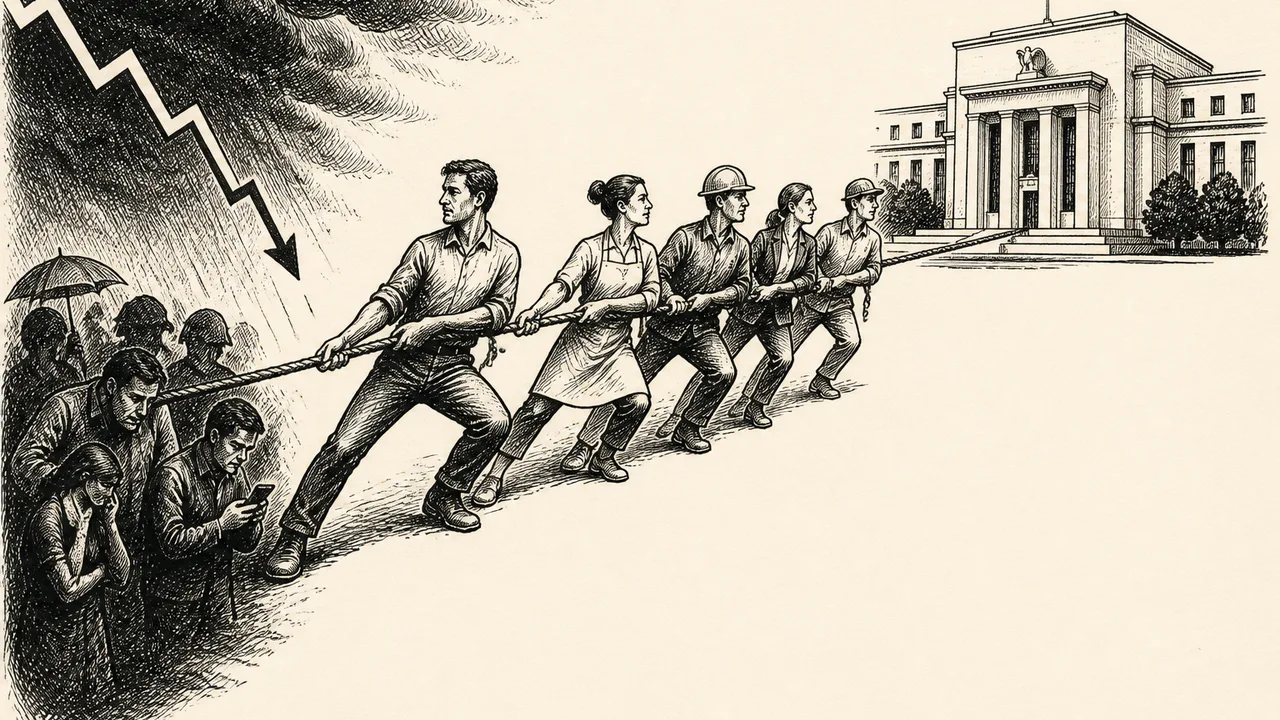
American consumers say the economy is bad. The payrolls data says something closer to: fine, mostly.
That gap between mood and measurement has become the central tension in the economic narrative this year. Seeking Alpha argues that complaints about household finances remain widespread while the employment data that actually determines whether people can pay their bills tells a calmer story. The argument deserves a fair hearing, and it deserves a close inspection, because "okay" and "healthy" are different diagnoses with different policy consequences.
The Case for Resilience
Start with the strongest version of the upbeat reading. The U.S. labor market entered 2026 having already absorbed an aggressive rate-hiking cycle, a regional banking scare, and waves of AI-driven restructuring talk, and it still produced job gains. When the May jobs report landed, it blew past forecasts, and Fortune reported that the surprise may have been too strong for markets' own good, since bond yields rose on the prospect that a hot labor market gives the Federal Reserve less reason to cut (Fortune).
That is the core logic: employment is the foundation under consumption, and consumption is roughly two-thirds of GDP. A labor market that keeps adding jobs, even modestly, keeps paychecks flowing, keeps defaults contained, and gives the Fed room to be patient. Morning Brew framed its contribution to the debate as "surprising good news about the job market," reflecting the same dissonance between expectation and data (Morning Brew).
What Sentiment Gets Wrong, and Right
Why do so many people feel worse than the data? A few explanations compete, and they are not mutually exclusive.
The first is price level. Inflation has cooled from its peaks, but the price level is permanently higher. Wages that grew faster than prices for a stretch now roughly track them, which means households are running in place. Running in place feels bad even when the treadmill is working.
The second is partisanship and media environment. Consumer sentiment has become a heavily filtered signal, and research going back decades shows partisans report dramatically worse conditions when the opposing party holds power. Sentiment, in short, is a survey, not a ledger.
The third explanation is the one sentiment-skeptics underweight: sentiment surveys may be leading, not lagging. People do not experience aggregate payroll numbers; they experience their own hours, their own hiring freezes, their own job searches taking longer. If the labor market is loosening at the edges, the mood could be the early read on a deterioration the payroll data has not yet confirmed.
The Counterpoint Arrives on Schedule
The record since spring complicates the cheerful version. The U.S. shed 23,000 jobs in July 2026, a decline that stunned forecasters who expected continued gains, per our prior coverage of July jobs decline. A single month proves little; revisions and one-off shocks distort every payrolls print. But a negative print three months after a blowout positive one is the signature of a labor market that has stopped trending and started wobbling.
That wobble matters because of how labor markets typically loosen. Employers rarely fire in waves at first. They cut job postings, slow backfills, and trim hours. Aggregate employment can hold steady for months while the ground underneath it shifts: fewer openings for new entrants, longer spells of unemployment for those laid off, cooling wage growth for those still employed. A labor market can be "okay" on payrolls and still be getting harder to enter, which lands hardest on recent graduates, career switchers, and workers in rate-sensitive sectors like construction and logistics.
Why This Split Decision Matters for the Fed
The Federal Reserve's mandate covers both sides of this argument: maximum employment and price stability. If labor markets were clearly cracking, rapid rate cuts would be the obvious response. If they are sturdy while inflation stays above target, rapid cuts are the obvious mistake.
The May report, per Fortune's account, showed exactly this bind: strong hiring pushed yields higher because investors understood that a robust labor market argues for patience on easing. The Fed now finds itself parsing a data series that flipped sign within a quarter. Its least-bad option is to treat the trend, not any single month, as the signal, which means waiting through more prints and more revisions before committing to a path.
For workers, the implication is more personal. Wage growth cooling from very hot to merely average is a macroecators' footnote and a household's budget problem. For investors, the implication is about dispersion: sectors and regions can deteriorate while index-level employment looks fine, and equity markets that price only the aggregate tend to discover the dispersion late.
How to Read the Next Report Like an Analyst
The headline payroll number is the least informative figure in the release. Here is what carries more signal:
- Participation rate: Are people entering the workforce, or exiting in discouragement? Rising participation alongside stable unemployment is a sign of demand, not decay.
- Unemployment duration: The median weeks unemployed is the single best early-warning indicator. Rising duration means layoffs are outpacing reabsorption.
- Wage growth composition: Broad wage gains signal tightness; gains concentrated in a few sectors signal rotation.
- Full-time vs. part-time split: A labor market that swaps full-time hours for part-time ones can hold its headline while households lose income.
- Revisions: In 2026's environment of declining survey response rates, the initial print is a draft. The revision three months later is the sentence.
The honest reading of the current evidence is that both camps hold a piece of the truth. The labor market has been sturdier than the mood, as Seeking Alpha argues, and the mood may be catching up to something the data is only beginning to show, as July's negative print suggests. Between those two claims sits the Fed, the markets, and roughly 170 million workers, all waiting for the next monthly draft to see which version firms up.
The question worth holding onto: if people keep saying the economy is bad while the payrolls keep saying it is fine, which one revises first?
More Like This

USMCA Won't Be Renewed: What Annual Reviews Mean
The Trump administration has blocked USMCA's 16-year renewal, opting for annual reviews. Here's what that means for trade, business, and North America.

Warsh's Jackson Hole Caution Has a Price Tag for Workers
Fed Chair Kevin Warsh left Jackson Hole without committing to cuts or hikes. For athletes and workers in inflation-squeezed industries, that ambiguity is its own answer.
Bill Ackman's Art of Finding Invisible Money
Explore Bill Ackman's strategy of finding hidden value in companies, beyond standard metrics.

How APL Turned an NBA Ban Into a Brand Identity
APL's NJ Falk breaks down the six storytelling threads behind one of e-commerce's most unlikely brand-building moves—starting with an NBA ban.

Fed's Inflation Signals Are Pointing in Two Directions
Headline inflation stays stubbornly above the Fed's 2% target while trimmed mean indicators hit multi-year lows. What does Kevin Warsh do with that?

China Embraces AI While America Frets
China's public is broadly optimistic about AI while Americans grow wary. The Economist's editors ask how long that gap can hold—and what breaks first.

AI Company Logos All Look Alike. Here's What That Reveals
AI companies keep designing the same circular, gradient logo. Is it groupthink, strategic mimicry, or something more revealing about the industry itself?

France Sold Its Nuclear Turbine Crown Jewel to GE
How France sold the world's most powerful nuclear steam turbine to GE in 2015, then spent years engineering a buyback — and what it cost everyone involved.