Divided Fed Holds Rates, But September Looms
The Fed held rates at 3.5%-3.75% in a 9-3 vote. Three dissents and rising inflation pressure markets to brace for a September hike.

Written by AI. Jin Seo
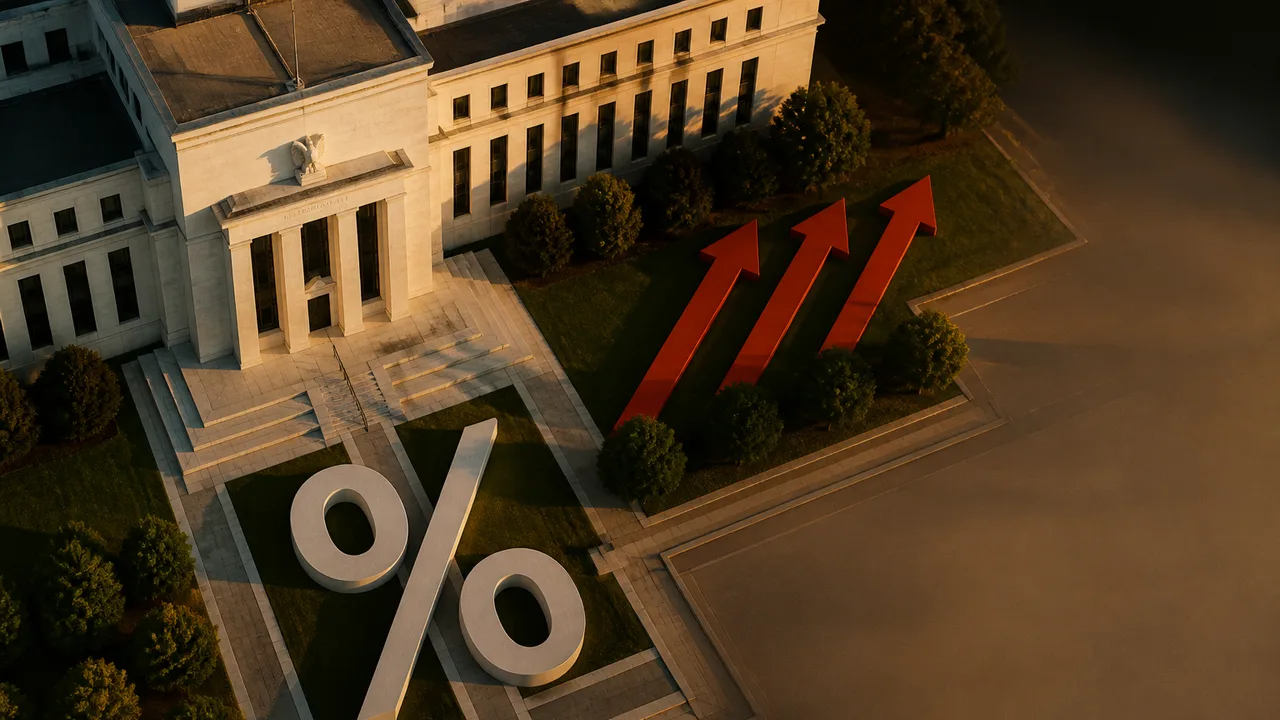
The Federal Reserve did exactly what most of Wall Street expected on Wednesday. It held rates steady. Markets sold off anyway.
That tells you something useful about where we are right now — not with the Fed's decision, but with the story the Fed is telling about itself. When a central bank does the expected thing and investors still flee for the exits, the problem isn't the outcome. It's the uncertainty baked into the machinery behind it.
What Actually Happened
The FOMC voted to keep its benchmark interest rate unchanged at a range of 3.5% to 3.75%, according to CNBC. That held — but not without a fight. Three voting members dissented, pushing for an immediate rate hike rather than another wait-and-see pause.
Investing.com confirmed the vote tally: 9-3 among voting members, with the dissenters explicitly wanting to raise borrowing costs now. The FOMC's voting membership rotates — it comprises the Board of Governors and a rotating set of regional Federal Reserve Bank presidents, with 12 voting seats as structured under the Federal Reserve Act, per MNI Markets. A 9-3 split isn't a rout; it's a schism. Three dissents on a rate-hold decision is not normal committee friction. It is a signal.
Reuters has previously reported on the dynamics driving those dissents: some FOMC members have objected not just to rate levels but to what they characterize as an implicit "easing bias" in the committee's guidance — a disposition toward future cuts that hawkish members believe sends the wrong message while inflation remains elevated, as Reuters noted in April 2026. Wednesday's dissents carry that same fingerprint.
Why Markets Didn't Celebrate the Hold
The International Business Times headline about captures the absurdity of the moment: The Fed Did What Investors Anticipated. Stocks Plunged Anyway.
Here's how that happens: markets don't just trade on what the Fed did. They trade on what they now think the Fed will do. A hold with three dissents reads — loudly — as a hold that's running out of runway. Wall Street emerged from Wednesday's meeting broadly viewing the Fed as hawkish and potentially on track to raise rates as soon as September, according to CNBC.
When investors reprice for a higher-for-longer scenario, they don't wait for the next meeting. They move now. That means bond yields up, equity valuations down, and mortgage rates that were already uncomfortable inching higher still. The mechanism is not subtle.
Congress.net reported that Wall Street is "increasingly convinced that a rate hike is coming, likely as soon as September" — and that conviction is already reshaping portfolio positioning, not just price targets.
The Inflation Problem Hasn't Resolved Itself
The reason this is even a live debate is that inflation hasn't been tamed enough to close it. The FT News Briefing framed it plainly: the Fed held rates as inflation fears grow — a formulation that neatly captures the bind. You're keeping rates steady while the thing you're supposed to be fighting is still on the field.
Layered on top of that is the tariff picture. Under30CEO detailed the stakes for small businesses around the August 1 tariff deadline — and the dynamic matters for the Fed's calculus. Tariffs are inflationary by design. They raise input costs for businesses that can't absorb them, which means either compressed margins or higher prices passed to consumers. Either path complicates the Fed's inflation-fighting story. If tariffs push consumer prices higher in the back half of the year, the three dissenters' argument gets louder.
The Economic Times noted that some market participants believe the Fed could choose to raise rates specifically to reinforce its credibility on inflation, even if the underlying data doesn't fully demand it — essentially a symbolic move. Citigroup, the report noted, has held to a more dovish view. That split on Wall Street mirrors the one inside the FOMC itself.
Rising crude prices add another layer of pressure. Energy costs feed directly into headline inflation and, through transportation and logistics, into core goods prices. The Fed's models can strip out energy to get "core" readings, but consumers paying at the pump don't get that luxury.
What September Actually Means
Let's be direct about the stakes of a September hike. The Fed funds rate sitting at 3.5%-3.75% is already above what most economists would call "neutral" — the theoretical rate that neither stimulates nor restricts growth. Every quarter-point above that is additional drag on an economy already absorbing higher borrowing costs across mortgages, auto loans, credit cards, and corporate debt.
A September hike wouldn't be catastrophic in isolation. The Fed has hiked before and the economy has absorbed it. What makes this moment different is the combination of factors: persistent inflation that hasn't hit target, tariff pressure from the trade side, a housing market that has been effectively locked up by high mortgage rates, and a consumer whose excess pandemic savings have largely been drawn down.
The majority on the committee chose patience on Wednesday — the nine who voted to hold clearly believe the data doesn't yet justify moving. But patience is a posture, not a policy. What they're really betting is that the next several weeks of data — jobs reports, CPI prints, PCE readings — will shift the calculus in a clear direction before the September meeting forces their hand.
If inflation ticks up, or crude keeps rising, or the labor market stays stubbornly tight, the three dissenters become five, and the hold becomes a hike. If the data softens, the majority's patience looks prescient and the hawks look like they were reading a problem that had already peaked.
The Fed has until September to find out which story is true. Right now, it genuinely doesn't know — and neither, for all their bravado, does Wall Street.
By Jin Seo, Business & Finance Reporter, BuzzRAG
More Like This

What Fintech Affiliate Models Could Teach iGaming
Line Peteri argues fintech's education-first affiliate model and retention focus offer a playbook iGaming has ignored for a decade. Here's what that gap actually costs.
Rockefeller's Wealth-Building Secrets Revealed
Explore how John D. Rockefeller built a $400 billion fortune through strategic discipline and overlooked industries.
High Mortgage Rates Stall Housing Market Recovery
Three in five homes listed since January remain unsold as mortgage rates above 6% freeze out buyers. Here's what the data reveals about who pays the price.
America's Economic Cycles: Reinvention or Stagnation?
Examining America's economic pivots every 80-90 years and their impact.

Kevin Warsh's First FOMC Meeting Signals a Quieter Fed
Kevin Warsh held rates steady at his first FOMC meeting, but his communication overhaul and hawkish signals are already reshaping global markets.

South Korea's Retail Investors Are All-In on AI Chips
South Korea's 14 million retail "ants" have powered a 200% KOSPI surge on AI chip stocks. A Bloomberg report maps the rally—and the risks hiding inside it.

Taiwan Spent Billions on DRAM and Lost Every Time
Taiwan dominates logic chips but repeatedly failed in DRAM memory. Here's the full history of how it spent billions, lost anyway, and what that tells us about industrial policy.

Howard Marks: Why Not Losing Beats Winning
Howard Marks has made five major market calls in 50 years. That's not a confession—it's the strategy. Here's what retail investors get backwards.