Howard Marks: Why Not Losing Beats Winning
Howard Marks has made five major market calls in 50 years. That's not a confession—it's the strategy. Here's what retail investors get backwards.

Written by AI. Jin Seo

Photo: AI. Hayden Cross
There's a particular kind of investor who checks their portfolio seventeen times a day, has a strong opinion about where the Nasdaq is heading by Q3, and has been predicting a crash for somewhere between six months and four years. They are almost certainly losing money. Howard Marks has spent five decades explaining why, and the explanation is uncomfortable precisely because it implicates almost everyone.
Marks co-founded Oaktree Capital and has navigated enough market cycles to have opinions worth hearing. In a recent interview, he distilled those decades into something that sounds simple until you sit with it: "We sometimes know what's going to happen, but we never know when. And anybody who says this is the time, or this is not the time, is talking through their hat."
That's not modesty. That's a structural argument about what markets are.
The Gap Between "Overpriced" and "About to Fall"
The piece of Marks's thinking that most retail investors skip past is the one that costs them the most money. Identifying an overvalued asset, he argues, is a meaningfully different skill from knowing when that asset will correct. The market can be wrong for a very long time, and being right about the diagnosis while wrong about the timeline is—financially speaking—identical to being wrong.
The case study Marks reaches for is Julian Robertson, who ran Tiger Management with a track record that made him one of the most respected hedge fund managers of his generation—25% annual returns over two decades. In 1998, Robertson concluded that tech stocks were absurdly overvalued. He was correct. The companies he was looking at were burning cash without profits, trading at multiples that only made sense if you squinted hard enough and believed hard enough. So he shorted them.
Then he waited. And waited. Tech stocks didn't crash—they rallied. For two more years. Robertson watched $21 billion become $6.5 billion. Tiger Management shut down in March 2000, six days before the Nasdaq peaked.
He was right about the bubble. He was right about the fundamentals. He was just early enough that it didn't matter.
This is the scenario Marks is describing when he invokes Keynes: "The market can remain irrational longer than you can remain solvent." The Keynes quote gets passed around so frequently that it risks becoming wallpaper, but Robertson's story is what it actually looks like in practice. A $15 billion loss. A fund shuttered days before vindication. Being right is not a sufficient condition for surviving.
Five Calls in Fifty Years
Here's the number that reframes everything else Marks says: five. In half a century of investing, he has made approximately five major market calls. His son Andrew—who collaborated with him on his book Mastering the Market Cycle—pointed this out with the particular affection of someone who has watched their parent work for a long time: the calls were good, Andrew told him, because there were only five of them.
Marks's own math on this is worth following. His career has spanned roughly 20,000 working days. If he had tried to call the market 5,000 times across those days, he estimates he'd have been right about 50% of the time—coin-flip territory. The rarity of the calls is not a limitation. It is the strategy.
The S&P 500 data reinforces this. From 1993 to 2022, the index posted positive annual returns 23 out of 30 years. The perennial crash-caller—fully committed, never wavering—would have been wrong 77% of the time. And when they stepped aside to avoid the losses they were predicting, they'd have sat out the rallies too.
The numbers on sitting out are particularly merciless. A study of the Toronto Stock Exchange from 1986 to 2024 found that $10,000 left untouched grew to roughly $241,000. Miss just the ten best trading days across those 38 years—ten days out of roughly 9,500—and you end up with about $113,000. Less than half the return, from missing ten days you probably couldn't have predicted in advance anyway.
The Defense-First Framework
Given that market timing is largely a losing proposition, Marks argues for something that sounds almost passive but isn't: play great defense.
The distinction he draws—in a 2024 memo he titled Fewer Losers or More Winners—is that investors generally have to choose a bias. Aggressive investors go hunting for more winners. Defensive investors work to eliminate losers. Few investors have the skill to do both consistently, and Marks is candid about which camp he occupies and recommends.
The pension fund anecdote he tells is the clearest illustration of why this works. A fund manager ran a corporate equity portfolio for 14 years. In every single year, their performance ranked somewhere between the 27th and 47th percentile. Never spectacular. Never catastrophic. A reliable B-minus, year after year. Ask anyone where 14 consecutive second-quartile years lands you in the long-term rankings and most people will guess somewhere in the middle. The actual answer: top 4%.
The math isn't magic. While this fund was reliably mediocre on an annual basis, its competitors were occasionally great—and occasionally terrible. The terrible years are what compound against you. A 50% loss requires a 100% gain just to get back to where you started. Meanwhile, the fund that never has the terrible year keeps compounding, slowly, boringly, devastatingly effectively.
Marks describes his own version of this with a line he apparently dropped at a Financial Times lunch: "Eating in this restaurant is like investing at Oaktree. Always good, sometimes great, never terrible." He's not claiming the top table. He's claiming consistency, and suggesting that consistency—maintained across enough time—beats brilliance punctuated by disasters.
What This Doesn't Say
It's worth being precise about what Marks is and isn't arguing, because the defense-first framework gets misread in two directions.
It isn't a case for pure passivity. Oaktree's bread and butter is distressed debt—assets that are risky by definition. The argument isn't that you should avoid risk. It's that you should price risk correctly, demand a margin of safety, and walk away when the risk-reward math stops making sense. There's a difference between a portfolio that avoids all volatility and a portfolio managed by someone who knows what they're actually buying.
It also isn't an argument against contrarianism—it's an argument for selective contrarianism. Marks explicitly distinguishes between the reflexive contrarian who sells when others buy and buys when others sell (a strategy he says will lead to bankruptcy quickly) and the investor who does the slower work: what does the consensus believe, what do I believe, why do each of us believe it, and which of us is probably right? That last question requires genuine analysis, not just a disposition toward disagreement.
The implication is that most market calls aren't wrong because the analysis is bad. They're wrong because the analyst hasn't fully reckoned with the gap between "this will eventually be true" and "this will be true soon enough to matter."
The Question That Lingers
Marks's framework is coherent, well-supported by data, and has clearly worked for him. But it raises a question he doesn't fully answer: if the market is right 77% of the time and the best days are unpredictable, what does "taking the temperature of the market" actually add for the investor who isn't running a $180 billion fund with a team of analysts?
The honest answer might be: less than we'd like. The defense-first argument points strongly toward broad, diversified exposure held through volatility—which isn't a particularly active strategy, and probably shouldn't be. What Marks offers isn't a trading system. It's a disposition. Stop trying to be the person who calls the top. Stop moving in and out based on macro predictions you're not actually equipped to make. Own quality. Don't blow up.
That the billionaire's advice ultimately rhymes with "buy the index and don't touch it" is either reassuring or deflating, depending on how you came to this.
More Like This
Rockefeller's Wealth-Building Secrets Revealed
Explore how John D. Rockefeller built a $400 billion fortune through strategic discipline and overlooked industries.
Bill Ackman's Art of Finding Invisible Money
Explore Bill Ackman's strategy of finding hidden value in companies, beyond standard metrics.

Lloyd Blankfein's Risk Rules Work on Main Street Too
Lloyd Blankfein's frameworks on crisis management, contingency planning, and AI risk translate directly to small business — if you know where to look.
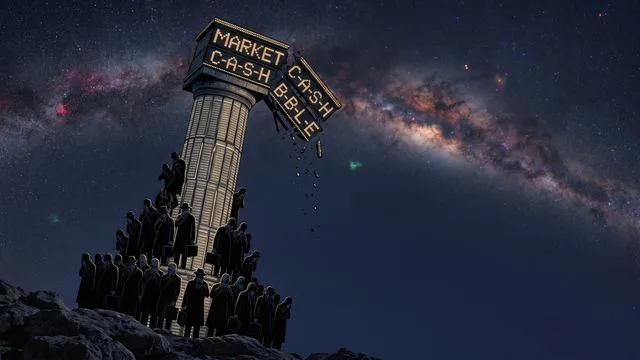
Wall Street Knew the Crash Was Coming. Saying So Got You Fired.
Jeremy Grantham's famous poll revealed 398 analysts knew the dot-com crash was guaranteed. A 2003 study shows why none of them said so publicly: accuracy cost careers.

How to Hire for Roles You've Never Done
Ryan Deiss paid a $200K CFO who was really a bookkeeper. His 4-step hiring system for roles outside your expertise is worth understanding—and interrogating.
AI Agents Are Accelerating—But Nobody Agrees What That Means
New benchmarks show AI coding agents tripling capabilities in months. Researchers urge caution. Investors price in economic collapse. Welcome to 2026.

How Climbing the Investing Ladder Costs You Ownership
From a $100 index fund to managing billions as a pension CIO, each rung of the investing ladder hands you more money to move and less of it to keep.

What Fintech Affiliate Models Could Teach iGaming
Line Peteri argues fintech's education-first affiliate model and retention focus offer a playbook iGaming has ignored for a decade. Here's what that gap actually costs.