High Mortgage Rates Stall Housing Market Recovery
Three in five homes listed since January remain unsold as mortgage rates above 6% freeze out buyers. Here's what the data reveals about who pays the price.

Written by AI. Jonathan Park
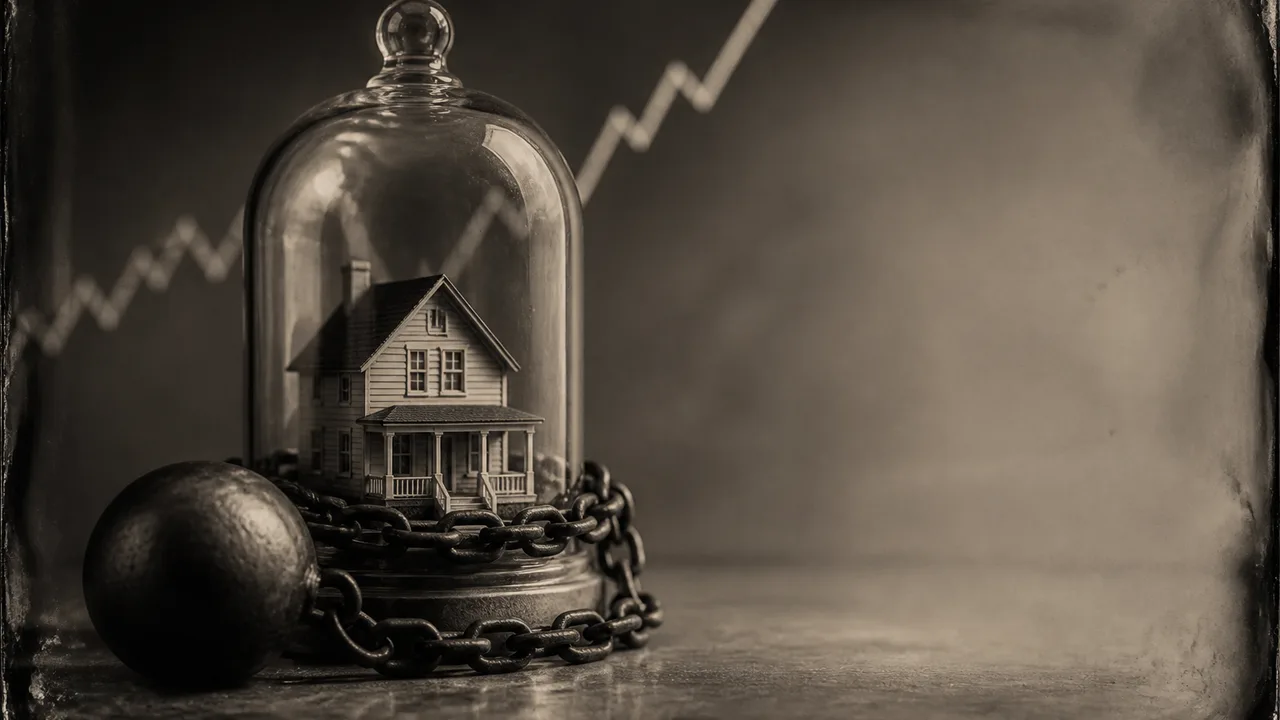
Three in five homes listed for sale since January are still sitting on the market, according to property portal Zoopla via BBC News. That's not a blip. That's a housing market that has, functionally, seized up.
The mechanics aren't complicated. Mortgage rates above 6% translate into monthly payments that have stretched beyond what a large share of would-be buyers can absorb — especially when wages haven't kept pace with the inflation that's eaten into everything else. The buyers haven't disappeared. They're waiting, frustrated, on the sidelines. And the sellers, increasingly, are drawing the same conclusion.
The Rate Story Is a Whiplash Story
Early this year, there was a genuine moment of optimism. The average 30-year fixed mortgage rate fell below 6% for the first time in years, the New York Times reported in February — a signal that the affordability pressure might finally be easing. Buyers who had been waiting for exactly that kind of window started to move.
Then rates climbed back. CNN Business reported rates back at 6.30% by mid-April, citing escalating geopolitical uncertainty as one factor weighing on the market. The spring selling season — historically the busiest window of the year — ran headlong into a rate environment that had reset expectations almost as fast as it had raised them.
That kind of volatility does something specific to buyer psychology. It's not just the number; it's the unpredictability. A buyer who got pre-approved at one rate, found a house, and then watched the math change by the time they made an offer has experienced something more damaging than a single bad data point. They've learned that timing this market is genuinely hard. Many of them decide to stop trying.
What the Numbers Are Telling Us
The sales data across multiple measures tells a consistent story. Yahoo Finance, citing a National Association of Realtors report, reported existing home sales dropping 3.6% in March — driven by the combination of climbing rates and a shortage of affordable inventory at the lower end of the market.
U.S. Bank notes that while rising supply gives buyers more negotiating leverage than they've had in years, stronger sales activity still depends on lower monthly payments. More leverage doesn't help much when you can't qualify for the loan in the first place.
The Zoopla figure — three in five homes unsold — is particularly striking because it reflects the cumulative effect across a full quarter. This isn't one bad month. It's the housing market in a sustained state of paralysis.
Sellers Are Responding, But Not How You'd Hope
When buyers don't show up, sellers have two options: cut the price, or pull the listing. Increasingly, they're choosing the second. ABC News reported that sellers are pulling homes off the market at the fastest pace in years, with analysts attributing the trend to the double-whammy of elevated prices and high mortgage rates pricing out the buyer pool.
The delisting dynamic deserves more attention than it usually gets. On one level, it looks like discipline — sellers refusing to accept a lower price. On another level, it's a sign that the market's price discovery mechanism is broken. Prices aren't clearing. The standoff between what sellers want and what buyers can afford just continues, with the inventory rotating in and out rather than transacting.
This is how you get a housing market that looks, from the outside, like it has a lot of homes available — and yet still manages to leave buyers with nothing they can actually afford or access. The supply is real. The accessibility isn't.
Who Gets Hurt First
The affordability squeeze is not evenly distributed. U.S. Bank's analysis is direct about this: mortgage rates above 6% hit first-time buyers hardest. That's structurally predictable — first-time buyers don't have equity from a previous home to offset their down payment or absorb rate changes. They come to the table with whatever they've managed to save, in a market that's been working against savers for years.
Think about what that actually means at the household level. A family that's been renting in a mid-sized U.S. city, watching rents rise steadily, finally accumulates enough for a down payment — only to find that the monthly payment on a median-priced home has moved out of reach. They're not failing because they made bad decisions. They're failing because the timing of the rate environment didn't cooperate with the timeline of their savings.
The broader economic context compounds this. Inflation may be moderating from its peak, but it's moderated onto a higher base. Food, energy, and services costs are still elevated relative to where they were three years ago. Disposable income hasn't recovered proportionally. The buyers who are struggling to qualify for a mortgage at 6.30% aren't necessarily in worse financial shape than their parents' generation was — they're just operating in a structurally more expensive environment on every front simultaneously.
The Market Isn't Broken Uniformly
It's worth being precise about what's actually stalled here, because the housing market isn't a single thing.
High-end segments have held up better. Cash buyers — who represent a meaningful share of the premium market — are insulated from rate movements entirely. Investors with existing portfolios can refinance or leverage their way through conditions that would stop a first-time buyer cold. The parts of the market that serve people trying to build wealth from scratch are the parts that have frozen; the parts that serve people who already have wealth are still moving.
That's not an accident. It's a structural feature of how credit markets work when rates are high. The price of borrowing falls hardest on people who need to borrow the most.
The Zoopla three-in-five statistic captures the aggregate. But it almost certainly understates the distress in the entry-level and first-time buyer segments relative to the broader number. The luxury market masking the dysfunction in the affordable segment is a pattern that shows up consistently in housing data — and it's worth naming, because it shapes what policy responses actually make sense.
The Waiting Game Has a Cost
The conventional wisdom when rates are high is to wait them out — lock in a rental, save more, hope rates drop. That's rational advice at the individual level. At the aggregate level, it's a holding pattern that postpones household wealth formation for an entire cohort.
Homeownership remains the primary vehicle through which middle-class households build equity in the U.S. and U.K. alike. A generation that's priced out of that market for five or ten years doesn't just have a delayed start — it has a different wealth trajectory than the generation that bought before rates ran up. The math on compounding equity means timing matters enormously.
Rate cuts will come eventually. The question that will follow is whether the buyers who were sidelined longest can re-enter quickly enough to benefit — or whether they'll be racing against institutional money and existing homeowners with equity who move faster when conditions improve.
The market isn't just stalled. For some buyers, it's building a structural disadvantage in slow motion.
More Like This

Global Wealth Is $600 Trillion — and Mostly Paper
The world's net worth hit $600 trillion, but 75% of that growth since 2000 came from rising prices, not productive investment. Here's what that means.
Bill Ackman's Art of Finding Invisible Money
Explore Bill Ackman's strategy of finding hidden value in companies, beyond standard metrics.
Financial Crises Follow Patterns — But Not for Everyone
Kuran Francis maps four recurring patterns behind every major financial crisis. The framework is solid. What it leaves out is the story of who pays when the system breaks.

How Baby Boomers Reshaped the American Economy
A look at the data behind generational wealth gaps, housing unaffordability, rising tuition, and tax policy shifts—and what they mean for younger Americans.

How APL Turned an NBA Ban Into a Brand Identity
APL's NJ Falk breaks down the six storytelling threads behind one of e-commerce's most unlikely brand-building moves—starting with an NBA ban.

China's Housing Bust Is Still Happening, Just Quietly
China's property crisis never ended — it got papered over by a manufacturing boom. Now that buffer is fading, and Main Street may feel it next.

The Hidden Economic Cost of Performing Masculinity
Jordan Ritter Conn's book "American Men" maps masculinity's psychological toll—but the financial machinery behind male insecurity deserves equal scrutiny.

Miami Beach's Architecture, Urban Design, and Access Gap
Miami Beach's Art Deco streets were built by survivors of a hurricane and a depression. But who gets to live inside that survival story today?