Joséphine Bonaparte, the Empress Who Survived the Terror
Joséphine Bonaparte survived revolutionary Paris, rebuilt her social position from rubble, and became Empress of France. Her story illuminates power, survival, and memory.

Written by AI. Margaret "Maggie" Holloway
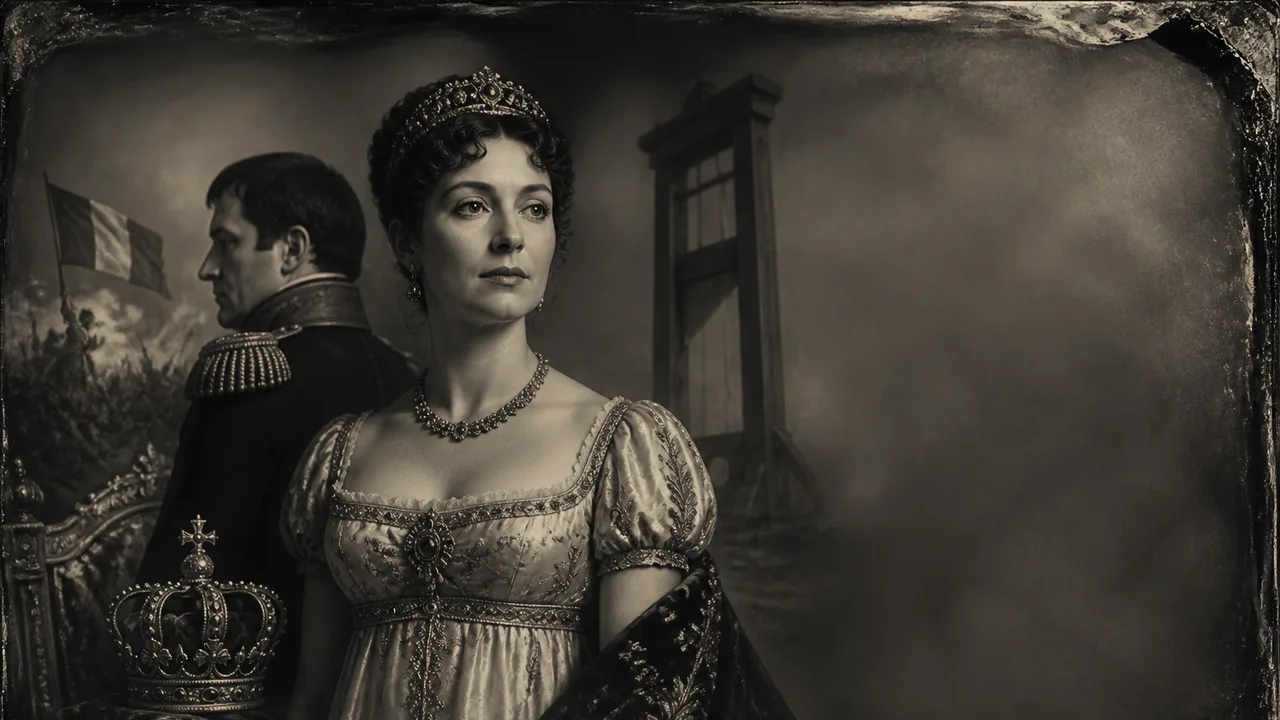
On July 23, 1794, Alexandre de Beauharnais was guillotined in Paris. His wife sat in the Carmes prison, where she had been held since April, waiting to learn whether she would follow him. Five days later, Maximilien Robespierre was arrested and executed, the Reign of Terror collapsed under the weight of its own logic, and Joséphine de Beauharnais walked free: a widow at thirty-one, nearly penniless, with two children and a social network scattered by revolution.
Within two years she would marry Napoleon Bonaparte. Within ten she would be crowned Empress of France.
The Caribbean Foreigner
Joséphine arrived in France already a foreigner twice over. Born Marie Josèphe Rose Tascher de La Pagerie on June 23, 1763, in Martinique, according to Wikipedia, she grew up on a plantation in the French Caribbean colony, daughter of a minor aristocratic family whose fortunes had declined considerably. She came to France at sixteen for an arranged marriage to Alexandre de Beauharnais, a match driven by colonial social ambition. The Library of Congress research guide on women in the French Revolution describes the marriage as loveless.
That word lodges in the record early. Alexandre was a liberal nobleman who embraced revolutionary ideals, at least until those ideals turned on him. He was arrested in 1794 on charges whose specifics mattered less than the political climate producing them; Joséphine was arrested shortly after. According to The Collector, she spent three months in prison. On July 23, Alexandre was executed. Robespierre fell five days later. Joséphine was released.
The Library of Congress guide notes that her near-death experience "fueled Joséphine's ambition and heightened her determination." That verb, "fueled," carries a specific claim: the prison sharpened her rather than broke her. The Carmes had been the site of the September Massacres of 1792, when counter-revolutionary prisoners were dragged out and killed by mobs. Anyone who survived that system understood, with physical clarity, how provisional their existence was.
Rebuilding Without a Blueprint
After her release, Joséphine rebuilt. According to Britannica, she became a leader in Parisian society after Alexandre's execution. Historians sometimes skip over this period: the two years between the Terror and her marriage to Napoleon, when she navigated the post-revolutionary social landscape without an obvious protector, leveraging connections, charm, and the particular authority that accrues to someone who has survived something most people didn't.
Paris in 1794 and 1795 was a city processing its own recent atrocities. The social structures of the ancien régime had been destroyed; the new ones were still improvised. Joséphine's position as a widowed aristocrat with Caribbean origins could have been a liability. She made it an asset, moving through the circles of the Thermidorian reaction with enough fluency that when she encountered Napoleon Bonaparte, she was the one with social credentials he lacked.
Napoleon, born in Corsica in 1769, was French by the most recent and convenient definition of citizenship: Corsica had been transferred from Genoa to France only a year before his birth. He was a military man of provincial origins in a city that ran on social fluency. Joséphine, Créole by birth, aristocratic by first marriage, and a survivor of the Terror: she moved through Parisian salons with an ease he was still acquiring.
The Marriage and the Coronation
According to World History Encyclopedia, they married in March 1796. According to Britannica, she was "initially indifferent" to Napoleon but later used her position to support his political aims.
Jacques-Louis David's painting "The Coronation of Napoleon," completed in 1807, records the formal architecture of that partnership. Napoleon is shown crowning Joséphine rather than the Pope, a composition David and Napoleon designed together to communicate sovereign autonomy. She kneels before him but receives the crown; the image fixes a precise moment where personal alliance and imperial ambition became the same gesture.
Across nearly fourteen years of marriage, affection and political utility both operated, in shifting proportions. Napoleon's early letters to Joséphine are famously, almost embarrassingly passionate. Her replies were cooler. Both had affairs eventually. What the historical record shows with more consistency is a partnership structured around complementary resources: his military ascent needed her social legitimacy in the circles that mattered in Paris, and she needed his protection, and later his imperial position, to secure her own standing.
Britannica notes that she used her position to intercede on behalf of individuals and families caught in the machinery of Napoleonic administration, brokering clemency in cases that formal channels wouldn't address. That pattern describes a political actor working within the constraints of a role that lacked formal power but carried real weight in daily governance.
The Annulment and the Aftermath
The marriage was annulled on January 10, 1810, according to Wikipedia. Napoleon's need for an heir had driven the decision; Joséphine had not produced one, and the succession question for an empire built from nothing carried existential urgency. She was given the title of Empress Dowager, the Château de Malmaison, and a substantial pension. The separation appears, by most accounts, to have been painful for both.
Napoleon married Marie-Louise of Austria in April 1810, three months after the annulment. They had a son, Napoleon II, in March 1811. Napoleon's first abdication came on April 6, 1814, under pressure from coalition armies that had pursued him across Europe. Joséphine died at Malmaison on May 29, 1814, less than two months after Napoleon's first abdication. She was fifty years old. He outlived her by seven years, dying in exile on Saint Helena in 1821.
What the Record Leaves Out
How history has handled Joséphine reveals something about the default categories available for women in official memory. She shows up most often as Napoleon's wife, then as the woman he divorced, then as a figure of fashion associated with Malmaison's gardens. Those things are accurate and also incomplete in the way the historical record tends to be incomplete about women who operated through influence rather than command.
The Library of Congress research guide situates Joséphine explicitly within the framework of women in the French Revolution, a framework that acknowledges how the revolution simultaneously expanded and contracted the political terrain available to women. The Terror she survived was, in part, a product of a revolutionary order that defined legitimate political participation in ways that excluded women from formal roles while remaining dependent on their social and domestic labor.
Joséphine worked that contradiction with considerable skill across five decades. She came from a Caribbean plantation, survived a Paris prison where she had expected to die, rebuilt a social position from almost nothing, became Empress of a continental empire, and died in her own house with her title intact and her garden famous across Europe.
The question the record raises, and leaves open, is what it would look like to count that kind of work as political history rather than biographical color.
More Like This
The Colosseum at 2,000: Engineering, Politics, and Survival
From Vespasian's political gambit to a luxury shoe brand's sponsorship deal, the Colosseum has always been about power as much as stone.
The Spanish Civil War at 90: What the Coup Unleashed
On July 17, 1936, a military coup fractured Spain and drew the world in. What the Spanish Civil War's 90th anniversary still asks of us.
Venice Is Sinking and Emptying at the Same Time
Venice faces two accelerating crises: rising seas and a vanishing population. Neither MOSE nor a €5 tourist fee comes close to solving either one.

Colombia's Ituango Dam: Ambition Meets Disaster
Explore the failure of Colombia's Ituango Dam, a $4BN project that faced engineering, political, and socio-economic challenges.
Queen Caroline's Arthurian Gambit and the Politics of Myth
In 1735, Queen Caroline built Merlin's Cave to tie the Hanoverian dynasty to Arthurian legend. The stakes were more than symbolic—they were strategic.

Sophie Adenot Makes History as First French Woman to Spacewalk
ESA astronaut Sophie Adenot became the first French woman to conduct a spacewalk on Aug. 18, 2026. Here's what that actually means—and why it matters.
Savannah's Urban Grid: A Utopia Built on Slavery
Savannah, Georgia was designed as an egalitarian utopia in 1733. What it became reveals how idealism and slavery shaped one of America's most walkable cities.
Ten Engineering Projects That Remade the World
From the Panama Canal to the International Space Station, ten engineering feats that didn't just solve problems — they rewrote what was thought possible.