Sophie Adenot Makes History as First French Woman to Spacewalk
ESA astronaut Sophie Adenot became the first French woman to conduct a spacewalk on Aug. 18, 2026. Here's what that actually means—and why it matters.

Written by AI. Mei Zhang
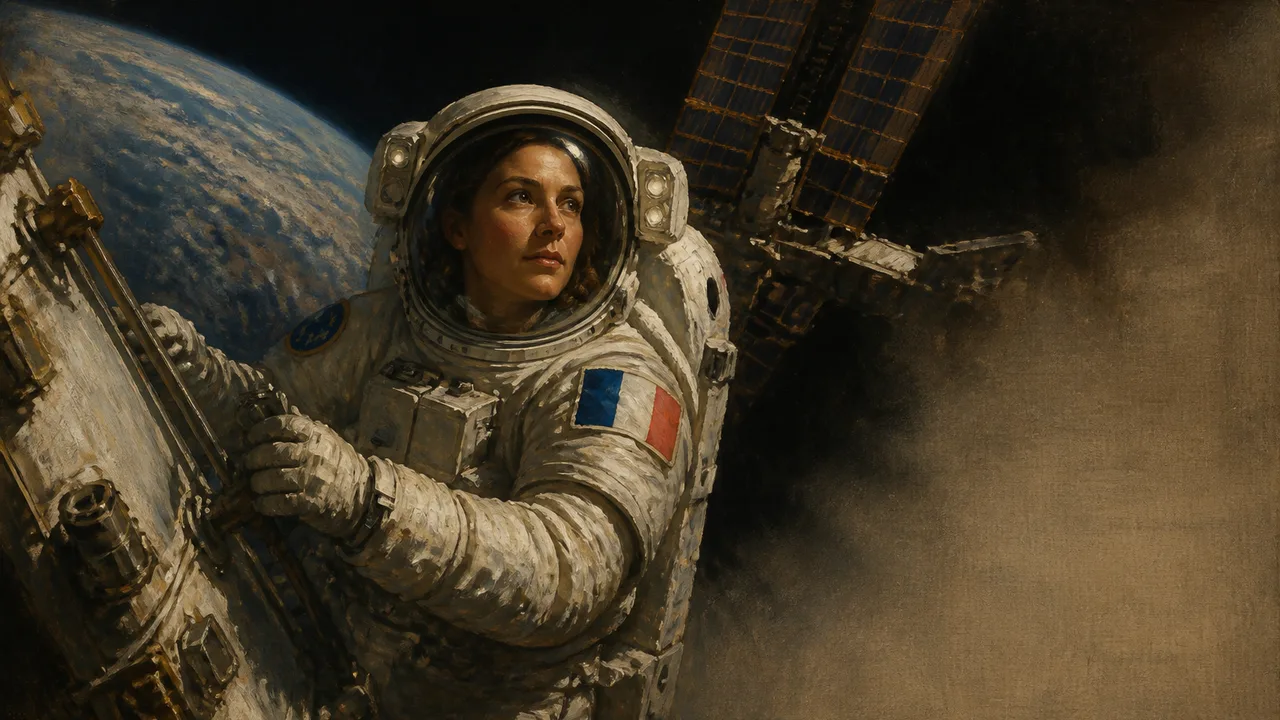
There's a moment in every spacewalk where an astronaut clears the hatch and the Earth just... sits there. Four hundred kilometers below. No frame. No window. The whole planet, freestanding.
Today, Sophie Adenot went through that hatch.
On August 18, according to Space.com, ESA astronaut Sophie Adenot became the first French woman ever to perform a spacewalk. She stepped outside the International Space Station alongside NASA astronaut Anil Menon, and I've been thinking about this all morning in a way that I can't entirely explain. It's not just the milestone. It's the physics of it. She's moving through an environment that will kill her without the suit. The suit is doing the breathing. And she's out there, doing a job.
That job, specifically: replacing a high-speed antenna. NASA's official mission blog notes that Adenot served as crew member 2 and wore an unmarked suit — the kind of practical, unglamorous detail that actually tells you a lot. No insignia. Just the work. This was Menon's second EVA and Adenot's first.
Spacewalks — extravehicular activities, if you want the NASA pronunciation — are not a casual Thursday. The environment outside the ISS cycles between extreme temperature swings as the station moves in and out of sunlight, roughly every 45 minutes, according to NASA Science. The suit isn't just a costume; it's a pressurized spacecraft you wear. Every EVA is a high-stakes engineering event that happens to look, from down here, like magic.
The "first French" framing is worth sitting with
Thomas Pesquet was the first French person to conduct a spacewalk — that happened during his Proxima mission, as Space.com documented at the time. So Adenot's milestone is specifically gendered: first French woman. Which raises the honest question any good-faith reader should ask — does adding the gender qualifier matter, or is it a vestige of a category we should be retiring?
I think it matters. Not because women need a separate scoreboard, but because the scoreboard we've been keeping has been telling a real story about who gets to do what in spaceflight. The ESA's current astronaut corps is more diverse than it's ever been, but "more diverse than ever" still leaves a lot of ground to cover. Adenot's EVA didn't happen because someone decided it was symbolically convenient. It happened because she trained for it, qualified for it, and went.
The symbol and the substance are the same event. That's what makes it interesting.
Yahoo News confirmed that Adenot and Menon conducted the spacewalk together, and USA Today noted the excursion was broadcast live for global audiences. Which means right now, somewhere, a kid is watching a French woman replace an antenna on a space station. I don't know what she'll make of it. Neither do you. But I think it's worth not underselling what it means to see something before you've been told whether it's possible.
The pipeline question — and what I actually think
Here's where I want to be careful, because this is the part of the story where people usually reach for a clean line about representation and STEM pipelines, and I don't think it's that clean.
Does seeing Adenot outside the ISS today change what a 12-year-old girl in Lyon thinks is available to her? Honestly? I don't know. I believe visibility matters — it's hard to want something you've never seen modeled — but I'm wary of the version of this argument that makes astronauts carry the entire weight of structural inequality in aerospace. Role models are real. They're also not sufficient on their own.
What I'm more confident about is this: the question of whether women belong in high-stakes spaceflight has been empirically answered. It was answered a long time ago, and it keeps getting answered every time someone like Adenot goes through a hatch and does the job. At a certain point, the "milestone" framing becomes a little strange — not because the milestone isn't real, but because we're celebrating access to something that was always theirs to have.
Florida Today's coverage and Moneycontrol's reporting both emphasize the live broadcast element — global audiences tuning in, the event framed as a shared moment. And there's something genuinely different about watching this live versus reading about it later. The ISS completes an orbit every 90 minutes. The Earth rotates beneath it. Adenot was out there while you were making coffee.
What this is actually about
The antenna Adenot helped replace keeps the ISS connected to ground stations at higher speeds. It's not metaphorical. It's infrastructure. The work astronauts do on EVAs is real maintenance on a real outpost that real scientists depend on for data that will feed real papers — some of which will eventually, years from now, shape how we understand biology, physics, and long-duration human spaceflight.
That's the thing about Adenot's EVA that doesn't fit neatly into a headline: it's historic and it's Tuesday. Both things are true. She's making history and replacing a piece of hardware that needed replacing. The mundane and the monumental showed up to work at the same time.
The unmarked suit keeps coming back to me. No insignia. Just the work. Maybe that's actually the version of equality worth aiming for — not the absence of identity, but the presence of full belonging. Where it's unremarkable to send a French woman outside the space station because of course you would, she's the one who trained for this.
We're not there yet. But today moved the needle.
More Like This
How Maxwell Unified Electricity and Magnetism
A compass needle twitched in 1820 and set off a chain of discoveries that now powers every wireless signal in your life. Here's the physics behind it.
Anil Menon Reaches the ISS on His First Spaceflight
NASA astronaut Anil Menon launched to the ISS on July 14 aboard Soyuz MS-29. His eight-month mission raises questions about what space cooperation looks like next.
NASA's Crew-12 Mission: A Leap Towards Mars
Crew-12 mission advances space exploration, featuring ISS experiments and spacecraft upgrades for future Mars missions.

Total Solar Eclipse 2026 Dazzles Spain and Science
The August 12, 2026 total solar eclipse over Spain was a spectacle—and a rare scientific window into a solar mystery we still can't solve.

Black Hole Paradox: Are Reference Frames the Key?
Exploring how reference frames might resolve the black hole information paradox.
AstroRad Vest Passes Artemis I Radiation Test
A radiation-shielding vest tested on Artemis I shows real promise for lunar and Mars missions. Here's what the data actually tells us—and what it doesn't.
The Feynman Trick That Stumped a Math Competition
Richard Behiel's competition integral uses the Feynman trick to reach a surprisingly clean answer. Here's what the footage reveals about math, pressure, and access.
The Two Poles Theorem Solves a Geometry Puzzle
A geometry puzzle about two walls and a man's height reveals a classical theorem — and a surprising connection to teamwork math. Here's what's actually going on.