Japan's MMX Mission Will Bring Mars Moon Rocks to Earth
JAXA's MMX spacecraft launches October 19 to collect samples from Phobos. Here's what the mission could actually tell us—and what's still genuinely uncertain.

Written by AI. Amelia Nwofor
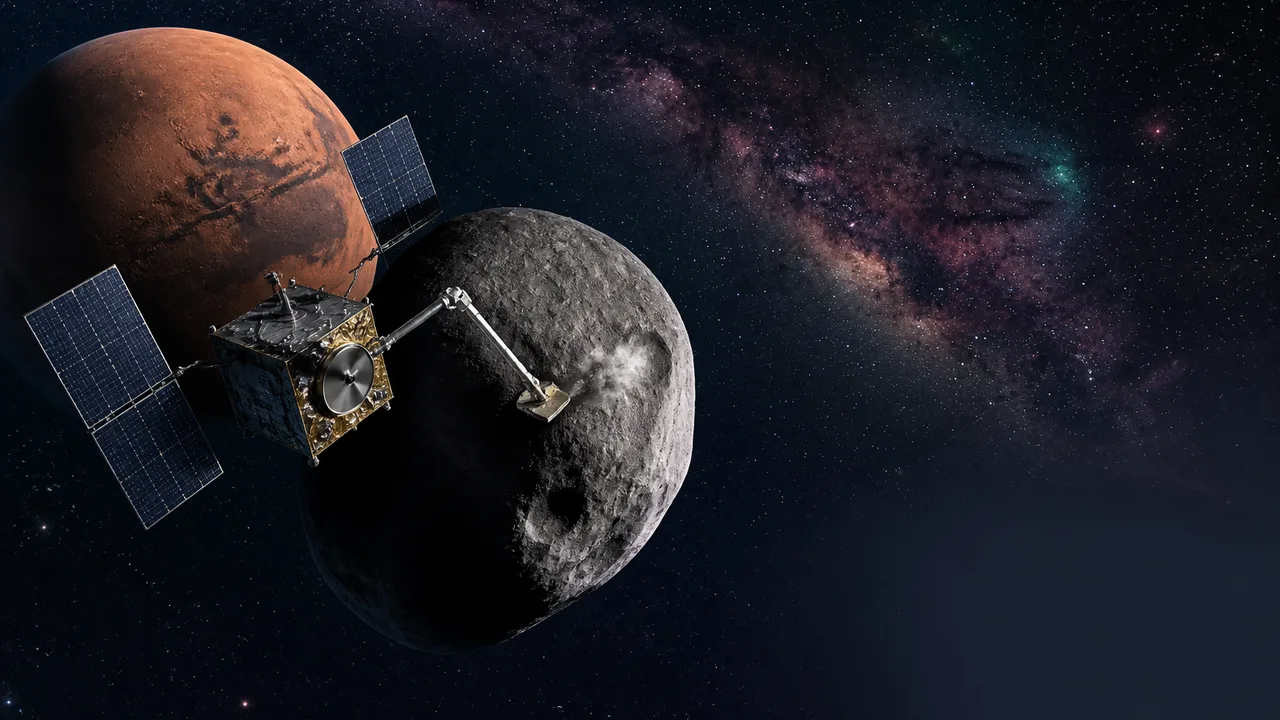
Phobos is one of the stranger objects in the solar system—a lumpy, crater-gouged potato of a moon that orbits Mars so closely, according to the German Aerospace Center (DLR), that it skims just roughly 6,000 kilometers above the Martian surface. It's tidally locked. Its origin is genuinely contested. And sometime before sunrise on October 20 local time in Japan, a spacecraft is going to leave Earth to go collect pieces of it.
That spacecraft is the Martian Moons eXploration probe, or MMX. According to Phys.org, JAXA's flagship H3 rocket will lift MMX off from Tanegashima Space Center at 4:41 a.m. October 20 Japan time—7:41 p.m. GMT on October 19. Space.com recently published photos of the finished spacecraft, and JAXA has already moved it to the launch site. The hardware is real, the date is fixed, and the science questions it's been designed to answer are some of the most consequential in planetary science.
What makes MMX worth paying attention to isn't the engineering bravura, though that's real. It's the fact that nobody actually knows what Phobos is.
A question that keeps not getting answered
There are two leading theories about where Phobos and its sibling moon Deimos came from, and they have radically different implications for our understanding of the early solar system. One holds that both moons are captured asteroids—debris from the asteroid belt that Mars's gravity snagged at some point in the deep past. The other, more disruptive hypothesis is that they formed from a giant impact, the same process thought to have created Earth's Moon: something large hit early Mars, and the ejecta coalesced into two small moons.
Spectroscopic observations from Earth and from Mars-orbiting spacecraft haven't settled it. The surface reflectance of Phobos looks similar to certain carbonaceous chondrite asteroids, which supports the captured-body hypothesis—but the orbital geometry of the two moons fits better with an impact origin. Remote sensing has limits. You can measure what the surface reflects; you can't fully characterize what it's made of, or what's underneath.
This is the core argument for sample return: you send a spacecraft, you touch the surface, you bring material back, and you run laboratory analysis that no remote instrument can replicate. Japan has proven this works. The Hayabusa2 mission returned samples from asteroid Ryugu—a body so far that, as EarthSky reported, the spacecraft had to travel beyond 300 million kilometers to reach it at certain points in its journey. Those samples upended assumptions about carbonaceous asteroids and delivered organic compounds that fed directly into origin-of-life research. MMX is built on the same logic, at even higher stakes.
What the mission actually does
According to Kyodo News, MMX will collect rock and sand samples from Phobos—making it the world's first mission to return material from a Martian moon. The spacecraft will spend time in the Mars system observing both Phobos and Deimos before landing on Phobos, collecting at least 10 grams of surface material, and departing. A return capsule will separate and land in Australia in 2031, according to The Japan Times.
Five years is a long time to wait for a delivery. It's worth being clear about why the timeline is what it is: the travel distance, the complexity of orbital mechanics around a low-gravity body, and the sheer engineering involved in getting samples all the way back to Earth's surface intact. JAXA has done this before. It hasn't done it from this far away, or from a target this dynamically complex.
Phobos's low gravity—a tiny fraction of Earth's—means a spacecraft can't just land on it the way you'd land on the Moon. It has to essentially hover, make brief contact, and collect material without the moon's surface swallowing it or sending it bouncing off into space. The Japanese team has spent years refining the approach. The engineering is genuinely impressive, even before you get to the science.
The race nobody's officially calling a race
The Japan Times noted something the official JAXA press materials don't dwell on: a Chinese mission is also targeting Mars's moons, and it aims to return samples before MMX does. China's Tianwen-2 mission has Phobos on its itinerary. The two programs are pursuing overlapping scientific goals on overlapping timelines, which is diplomatically awkward and scientifically interesting.
The awkwardness is obvious. The interesting part is less discussed: even if both missions succeed, the samples won't be redundant. Different landing sites on Phobos could return materially different material—literally. Phobos has regions with distinct spectral signatures, and geologists have been arguing about what those differences mean for years. Two independent sample sets from two different spots, analyzed by two different national research communities, would be far more scientifically valuable than either mission alone. The competitive framing obscures what is, structurally, a case for scientific complementarity.
Whether the two space agencies see it that way is a separate question. Planetary science doesn't run on diplomatic goodwill; it runs on data. If both capsules land, the field wins regardless of which one gets there first.
What the samples could actually tell us—and what they can't
It's worth being honest about the limits here, because the coverage of sample-return missions has a tendency to slide into a particular kind of breathless overreach. "Unlocking the origins of the solar system" is a phrase that appears in some of the reporting around MMX, and while it's not wrong exactly, it papers over complexity.
What the Phobos samples can plausibly do: distinguish between the captured-asteroid and giant-impact origin hypotheses with much higher confidence than current data allows. Characterize the chemical and isotopic composition of Phobos's surface material. Determine whether the moons share a compositional origin with Martian surface material, which would be a strong signature of the impact hypothesis. Potentially find organic compounds or volatile-rich material that tells us something about what was available in the early solar system at Mars's orbital distance.
What they can't do, at least not directly: tell us how life started, resolve the full formation history of Mars, or deliver a clean narrative about solar system origins. Sample-return is a probe, not a resolution. It narrows the hypothesis space. It generates new, better-constrained questions. That's how science actually works, and it's a legitimately exciting thing, even without the sweeping claims.
JAXA's own framing is relatively measured: the mission "will reveal how Mars and its moons formed, a key piece of knowledge in working out how the solar system was born." A key piece. That's the right register—ambitious but not overclaimed.
Why this moment matters beyond the science
Japan's space program has a specific character that distinguishes it from NASA, ESA, and the emerging Chinese program. JAXA has consistently targeted scientifically ambitious, technically demanding missions that require deep methodological innovation—and it has a track record of pulling them off, sometimes after setbacks that would have ended lesser programs. Hayabusa, the original asteroid sample-return mission, failed in multiple ways before ultimately succeeding. Hayabusa2 was near-flawless. MMX represents a third generation of that capability applied to a target that's orders of magnitude more complex.
The mission also carries instruments contributed by partners including CNES and DLR, making it a genuinely international scientific effort even if JAXA is running the spacecraft. The data won't belong to Japan. The samples, per the agreements in place, will be shared with the global planetary science community. That's the part that makes this more than a national achievement story.
What returns to Earth in 2031—if everything goes as planned—is material that formed in the early solar system and has been sitting at Mars's orbital distance, largely unchanged, for billions of years. There's no other way to get it. No amount of remote observation substitutes for having the thing in a laboratory.
That's the actual reason to watch the launch window open in October: not because it's a geopolitical milestone, not because it proves Japan can do what it says it can do, but because for the first time, we'll have the ability to ask Phobos directly what it's made of—and actually get an answer.
More Like This
The Deeper Geometry Behind the Pythagorean Theorem
Explore why the Pythagorean Theorem appears in unexpected places, from geometry to relativity.
A 1.27-Billion-Year-Old Mars Meteorite Changes Everything
A dark green Martian rock found in Algeria in 2019 just filled a 1.8-billion-year blank in Mars's geological record — and it came from a region no one knew existed.
Chang'e 7 Targets the Moon's South Pole for Water Ice
China's Chang'e 7 launches August 24 to hunt for water ice at the lunar south pole — a mission that could reshape the future of human spaceflight.
Viking Landers and the Unsolved Mars Life Debate
Fifty years after Viking landed on Mars, one experiment's positive result remains unexplained. Here's what the science actually shows—and what we've learned since.

Why Light Beams Seem to End: Physics Explained
Discover why searchlight beams appear to stop and how physics and atmospheric conditions contribute to this phenomenon.

Donald Hoffman: Evolution Hid Reality From Us
Cognitive scientist Donald Hoffman argues on StarTalk that evolution gave us a VR headset, not a window—and the math behind Darwin backs him up.
How Tectonic Forces Shaped the European Continent
From 3-billion-year-old Norwegian rocks to the Alps still rising today, Europe's geological story is wilder than any human history we know.

TON 618: The Black Hole That Defies Its Own Physics
TON 618 weighs 66 billion solar masses—more than current black hole growth models can explain. Here's what that gap in our knowledge actually means.