Humming for Health: What the Science Actually Says
A grandmother's humming habit gets credit for a long, healthy life. Here's what breathing science supports and which medical claims remain unproven.

Written by AI. Marcus Obi
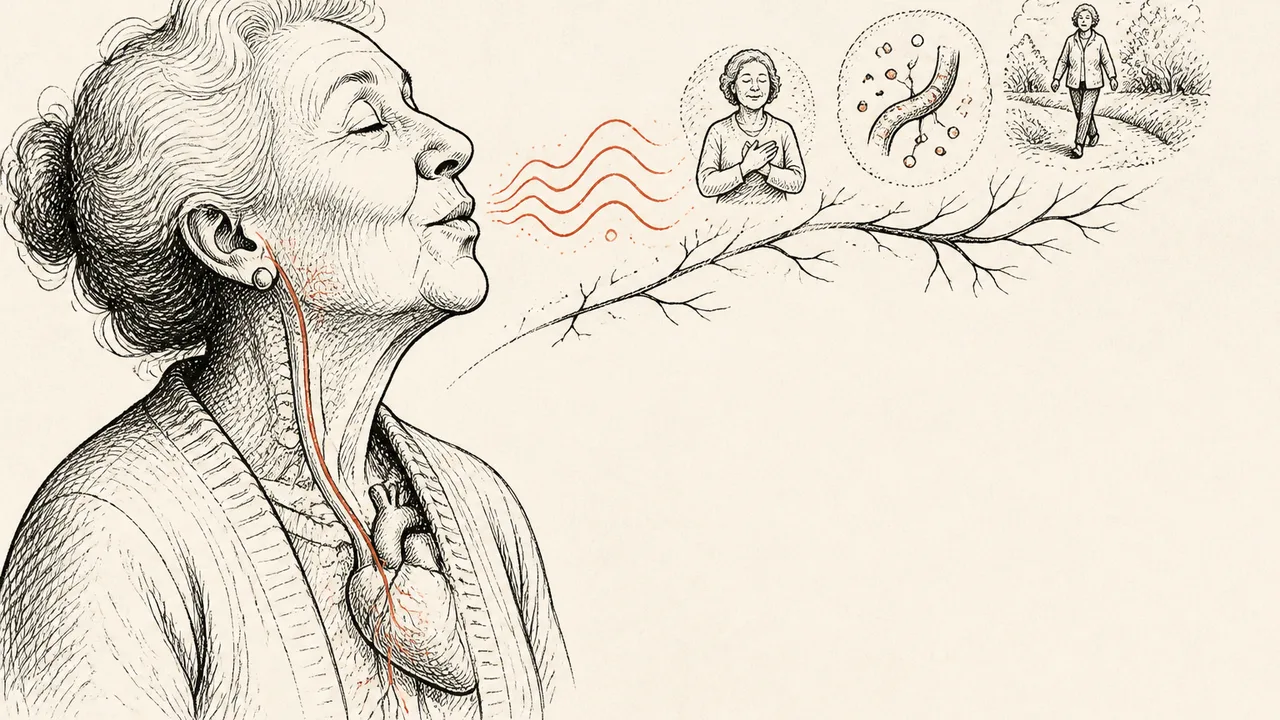
A Psychology Today essay published this month credits the author's grandmother, a lifelong hummer, with a level of health the headline says the habit "may have" helped preserve, and then walks the claim back in the same breath: a vivid anecdote, the piece acknowledges, cannot establish that humming saved anyone's life or reliably produces a medical benefit (Psychology Today). Both halves of that sentence deserve equal attention, because the internet only ever carries the first half downstream.
The second half is already getting quieter. In May, Before It's News published a piece titled "The Old-Timer's Secret: Why Humming While You Work May Be One of the Most Powerful Natural Medicines on Earth," which argues that modern research suggests humming "may trigger a cascade of biological effects involving nitric oxide, oxygen delivery, vagus nerve stimulation, breathing regulation, and even brain-cleaning fluid dynamics." A HubPages article collects testimonials about humming's benefits for the elderly. And Chapter 16 relays the claims of musician and sound-healing teacher Jonathan Goldman, citing work on whether humming may release endorphins, create new neural pathways, and perhaps even neurogenesis, the growth of new brain cells.
So we have a personal story on one end and "most powerful natural medicine on Earth" on the other, with a lot of "may" in between. Here is the terrain, mapped as carefully as I can manage.
The Strongest Case for the Humming Fans
Start with the enthusiasts' best argument, because it's better than their headline writing. Humming is free. It's ancient; people have hummed while working, rocking babies, and walking behind plows for as long as there have been tunes to hum. It carries essentially no risk. And the physiological hooks people point to have some scientific footing, at least in early-stage form.
The breathing mechanics are the most solid part. You cannot hum on an inhale, so humming forces a long, slow exhale, often several seconds longer than an unstructured breath. Slow exhalation is associated with parasympathetic activation, the branch of the nervous system that downshifts heart rate and stress response, which is the whole reason every breathwork coach on the planet tells you to make your out-breath longer than your in-breath. Humming also gives your attention a rhythmic anchor, which crowds out rumination for the duration of the hum. The Psychology Today essay gets this exactly right when it lists lengthened exhalation, a rhythmic attentional anchor, and a pause from rumination as plausible reasons humming might feel calming (Psychology Today).
There is also the nitric oxide thread. Small studies over the years have reported that humming increases nasal nitric oxide levels dramatically compared with quiet breathing, and the Before It's News piece leans on that research, along with vagus nerve stimulation and claims about brain-cleaning fluid, to build its cascade theory. The underlying measurements exist.
What the Skeptical Case Gets Right
The Psychology Today essay's core point is methodological, and it holds up: one long-lived grandmother is a sample size of one, selected precisely because the outcome went well. Nobody writes the essay about the grandmother who hummed all day and died at 61. That's survivorship bias doing what it always does, and it applies to the HubPages testimonials too. To their credit, at least one commenter on that article, Rachael O'Halloran, said as much in December 2014, introducing her own story as "purely unscientific in every sense of the word" (HubPages). Folk data with the disclaimer printed on the label is more honest than most of this genre.
The other gap is the distance between mechanism and outcome. Even if humming raises nitric oxide and slows the exhale, those are intermediate measurements, not health endpoints. Did the grandmother have lower blood pressure? Fewer infections? Longer life than her non-humming peers? The essay offers an anecdote, and an anecdote can't answer those questions. The Before It's News cascade includes "brain-cleaning fluid dynamics," a reference to research on glymphatic flow that is early, mostly animal-based, and nowhere near the point where a singing grandmother constitutes clinical evidence. When an article chains five "mays" together, the compounding uncertainty multiplies rather than averages out.
The Goldman claims relayed by Chapter 16 sit even further out on the evidence curve; the article itself frames endorphin release and neurogenesis as focuses of study and belief rather than settled findings (Chapter 16). New brain cells from humming would be a lovely development. It is currently a hypothesis, and hypotheses are not prescriptions.
What Actually Happens When You Hum
Here's my honest read of the layered evidence. When you hum, three things happen at once: your exhale stretches, your attention locks onto a steady vibration, and your sinuses produce more nitric oxide than they do at rest. The first two rest on well-understood physiology and match what people report feeling. The third is a real lab finding whose downstream health consequences in humans are unmapped. Everything beyond those three, the immunity claims, the disease claims, the life-extension claims, currently runs on stories.
That distinction matters more than the wellness industrial complex wants it to. The gap between "this feels calming" and "this treats disease" is where health claims go to get funded, and preliminary mechanism research gets laundered into grand promises somewhere around the third retweet. Before It's News calling humming possibly "one of the most powerful natural medicines on Earth" based on a cascade of maybes is the pattern in miniature.
Where a Parent Files This
I'll be straight about my angle here: I write about family stress for a living, and I have two seven-year-olds who hum constantly, usually as a stalling tactic rather than a vagal maneuver. Stress is a genuine health problem in our houses, the tools we're offered are expensive or time-consuming, and a free one that requires no app, no membership, and no childcare is seductive.
The neutral reading, and I think it's the accurate one: humming as a relaxation practice is low-risk, plausible, and reasonably supported for the subjective experience of calm. Humming as medicine, immunity booster, or life-saver is unproven and shouldn't be presented otherwise. The Psychology Today essay's guidance, treat it as an optional relaxation exercise rather than a prescription, is the right instruction, and it costs the reader nothing to follow.
What would actually settle this? Randomized trials comparing humming against a control condition, say, slow breathing without the hum at the same pace, with objective endpoints: blood pressure, heart rate variability, inflammatory markers, sleep quality. Dose matters too. Nobody knows whether three minutes of humming does anything that three minutes of slow exhaling doesn't. Until someone runs that study and publishes it, the cascade stays a hypothesis wearing a grandmother's photograph.
The old-timers hummed because it passed the time and felt good. Those are respectable reasons on their own. The science, so far, backs the feeling and not the miracle, and the next person to write about their grandmother might consider leading with that.
More Like This

Eckhart Tolle Says You're Not Who You Think You Are
Eckhart Tolle's 'historical self' vs 'deep eye' framework is either profound or a very elegant dodge. A parenting writer tries to figure out which.

Handwriting Beats Typing for Learning, Studies Find
New research shows handwritten notes improve memory and recall more than typing. Here's what the science says — and what it actually means for kids and parents.
Dr. K Walked Into Chaos and Won the Room
Dr. K's Tiger Belly appearance is a masterclass in social dynamics. Here's what the Charisma on Command breakdown gets right—and what it glosses over.

The Hidden Ripple Effect of Everyday Good Deeds
Psychology and ancient wisdom both argue that your kindest acts often go unwitnessed—and that this invisibility doesn't cancel their impact. Here's what we actually know.

AI Therapists Are Rising. The Questions Are Hard.
AI therapists are moving from novelty to norm, especially for younger users. Here's what's driving that shift—and what remains genuinely unresolved.
The Philosophy of Patience, Learned on the Toilet
The School of Life argues our most private daily ritual holds genuine philosophical lessons about willpower, patience, and the limits of force. Here's the case.

Nature and Mental Health: What the Research Actually Says
Research increasingly links time outdoors to lower anxiety and better focus—including for kids. But access isn't equal, and that matters more than the science.

Boredom Is Good for Your Brain, Science Suggests
Research suggests boredom sparks creativity and deep thinking. Here's what the science says about letting your mind wander in a distraction-saturated world.