Nature and Mental Health: What the Research Actually Says
Research increasingly links time outdoors to lower anxiety and better focus—including for kids. But access isn't equal, and that matters more than the science.

Written by AI. Marcus Obi
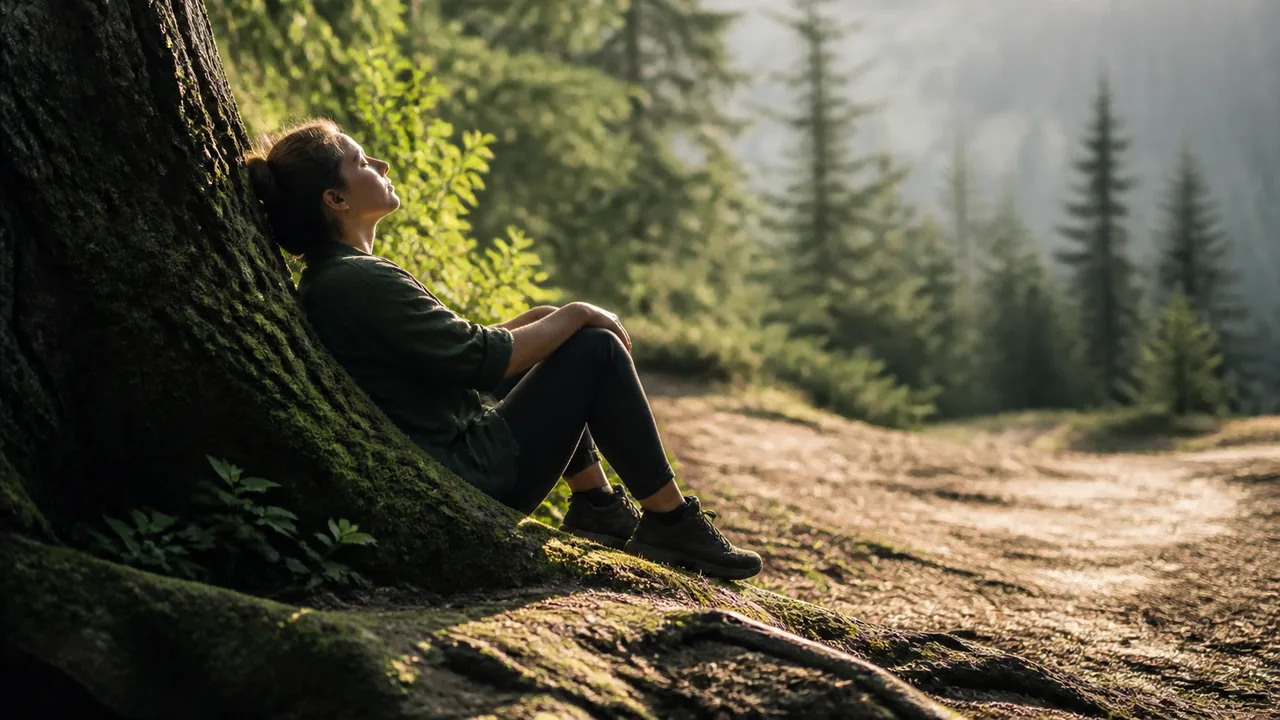
Last Tuesday I stood in a scrubby little municipal park two blocks from our apartment while my twins, Dara and Kofi, took turns eating what I sincerely hope was mud. The wind was doing something aggressive. There was a candy wrapper caught in the one sad tree. I had my phone in my hand, actively fighting the urge to check my email, and I remember thinking: this is the mental health intervention?
Turns out, yeah. Pretty much.
A growing body of research says that spending time in natural environments — even unimpressive ones, even briefly — does measurable good for adult mental health. Psychology Today recently reported that being outside for as little as 10 minutes, even in urban nature, can improve adults' mental health, and that shorter, repeated exposures appear especially helpful. The piece goes further, pushing back on the ambient snobbery around what "counts": "We do not need to romanticise nature or imagine that only mountains, oceans, or wilderness count."
I needed to hear that. The candy wrapper and I were doing fine.
The research has been accumulating for a while now, and it's more robust than the vague "go outside, touch grass" advice that millennials have been getting since, roughly, forever. The Pew Charitable Trusts describe "a wealth of new science" showing that nature exposure reduces stress and negative emotions, restores attention, promotes positive well-being, and helps people feel happier — to the point that some doctors are now prescribing time in nature as part of treatment. The Mental Health Foundation links nature connectedness specifically to lower depression and anxiety.
The Minnesota Department of Health puts it plainly: nature can reduce stress, boost mood, and improve brain function. Which sounds almost too simple — until you remember that "simple" and "accessible" are not the same thing, and we'll get to that.
Here's the part that stopped me cold, parent-wise. Because I spend a lot of mental energy worrying about my kids' attention spans (Dara), their impulse control (Kofi), and their general ability to sit still for longer than eleven seconds (both of them, God help me). And it turns out the research on what nature does for children is not a footnote. It's kind of the whole thing.
According to McLean Hospital and Deconstructing Stigma, time outdoors offers mental rest and rejuvenation that has been shown to improve memory, attention, impulse control, and creativity in the general population — and in children specifically, it has led to improved school performance. Read that again: improved school performance. From being outside.
I thought about Dara and Kofi eating dirt in that park and felt, for one bizarre moment, like I was doing an excellent job.
The mechanism behind this appears to be what researchers call "mental rest" — the idea that natural environments engage our senses softly, without demanding the kind of directed, effortful attention that screens and classrooms and, you know, existing in 2026 require. The brain gets to unclench. And when it unclenches in kids, what comes back online is focus, regulation, creativity. The stuff every teacher's note home says they need more of.
So when I'm standing in that park not checking my email while Kofi argues with a pigeon, it's possible that all three of us are doing something genuinely useful. That reframe is small and it kind of delights me.
Now, ecotherapy. This is the part where things get complicated in a way that I want to be honest about.
"Nature therapy" or "ecotherapy" is an umbrella term for structured therapeutic approaches that use natural settings as part of the healing process — guided walks, wilderness programs, horticulture therapy. The evidence base for the broader principle is solid. Pew and others are clear that nature exposure is increasingly recognized as a legitimate complementary approach — not a replacement for therapy or medication, but a genuine addition to the toolkit.
But here's the thing I keep bumping into: the moment you formalize nature access into a program, you start charging for it. You put it behind a referral, a copay, a commute, a waiting list. You build the exact same walls around it that exist in front of every other mental health resource. And the people most likely to need a mental health boost from a walk in a park are, often, the people least likely to be able to afford a guided ecotherapy session or live within walking distance of anything that qualifies.
The research points at something genuinely democratic — ten minutes, a patch of grass, even urban greenery counts — and then the wellness industry looks at it and thinks: how do we monetize this? I don't think that's anyone's explicit intention. I just think it's what happens.
Which brings me to the access question, because I can't write this piece without it.
Somewhere in the back of my head — and I suspect in the back of a lot of millennial parents' heads — is the low-grade guilt of knowing that "go outside" has been our generation's prescribed fix for almost every mental health complaint, and that this advice lands very differently depending on your zip code. If you grew up somewhere without a park worth walking to, or somewhere where being outside felt unsafe, or somewhere where your parents worked two jobs and outdoor time was a luxury rather than a routine, "go touch grass" has always sounded a little bit like "have you tried not being stressed?"
The research on green space access in lower-income neighborhoods and communities of color suggests real inequities exist, though I want to be straight with you: the sources I have for this piece don't provide a specific linked study on that gap. The directional claim is well-supported in urban planning literature, but I'm not going to dress it up as a citation I don't have. What I can say is that the Minnesota Department of Health explicitly names "communities" as a stakeholder in improving nature access — framing this not as a personal lifestyle choice but as a public health infrastructure issue.
That framing matters a lot. It's the difference between telling individuals to optimize their lunch breaks and asking cities to build parks. It's the difference between a wellness tip and a policy argument.
As cities grow and more families raise kids in urban environments, the question of who has a decent park nearby isn't a soft quality-of-life concern. It's a mental health equity question. And one that I don't think wellness content — including this piece — should paper over with soft language about "integrating nature into your routine."
I went back to that park on Thursday. Dara had a stick. Kofi had questions about whether worms have feelings. I did not check my email for almost twenty minutes, which is a personal record.
I don't know if those twenty minutes made me measurably calmer or whether Dara's focus in school this week has anything to do with the three afternoons we've spent outside this month. The science says probably yes, at least at the margins. But what I know for sure is that the park exists two blocks from us, that it's free, and that not every family has a version of that — and now I can't think about the mud and the pigeon and Kofi's worm philosophy without also thinking about that.
The scrubby lot with the one sad tree is doing something real. The question is whether we're willing to make sure more people have one.
More Like This

When Teens Look Fine but Feel Invisible
Deniz Erdemir's TEDx talk on adolescent belonging reveals how social exclusion registers as physical pain—and what adults keep missing.

Eckhart Tolle Says You're Not Who You Think You Are
Eckhart Tolle's 'historical self' vs 'deep eye' framework is either profound or a very elegant dodge. A parenting writer tries to figure out which.

Handwriting Beats Typing for Learning, Studies Find
New research shows handwritten notes improve memory and recall more than typing. Here's what the science says — and what it actually means for kids and parents.

Why Being Complicated Might Be the Point
Yahia Ghaleb's TEDx talk argues we should stop flattening ourselves into simple labels. Here's what the psychology actually says about living in the gray.
Dr. K Walked Into Chaos and Won the Room
Dr. K's Tiger Belly appearance is a masterclass in social dynamics. Here's what the Charisma on Command breakdown gets right—and what it glosses over.

Sunlight Is a Nutrient Your Office Job Is Starving You Of
Photobiologist Gerardo Gutierrez explains why decades of sun avoidance and LED-lit offices are quietly wrecking our biology — and what to do about it.
Boredom Is Good for Your Brain, Science Suggests
Research suggests boredom sparks creativity and deep thinking. Here's what the science says about letting your mind wander in a distraction-saturated world.

Taylor Farms Lettuce and the Cyclospora Investigation
The FDA retracted a positive Cyclospora test but still links Taylor Farms lettuce to a multistate outbreak. Here's what that means for your fridge.