When Teens Look Fine but Feel Invisible
Deniz Erdemir's TEDx talk on adolescent belonging reveals how social exclusion registers as physical pain—and what adults keep missing.

Written by AI. Samir Patel
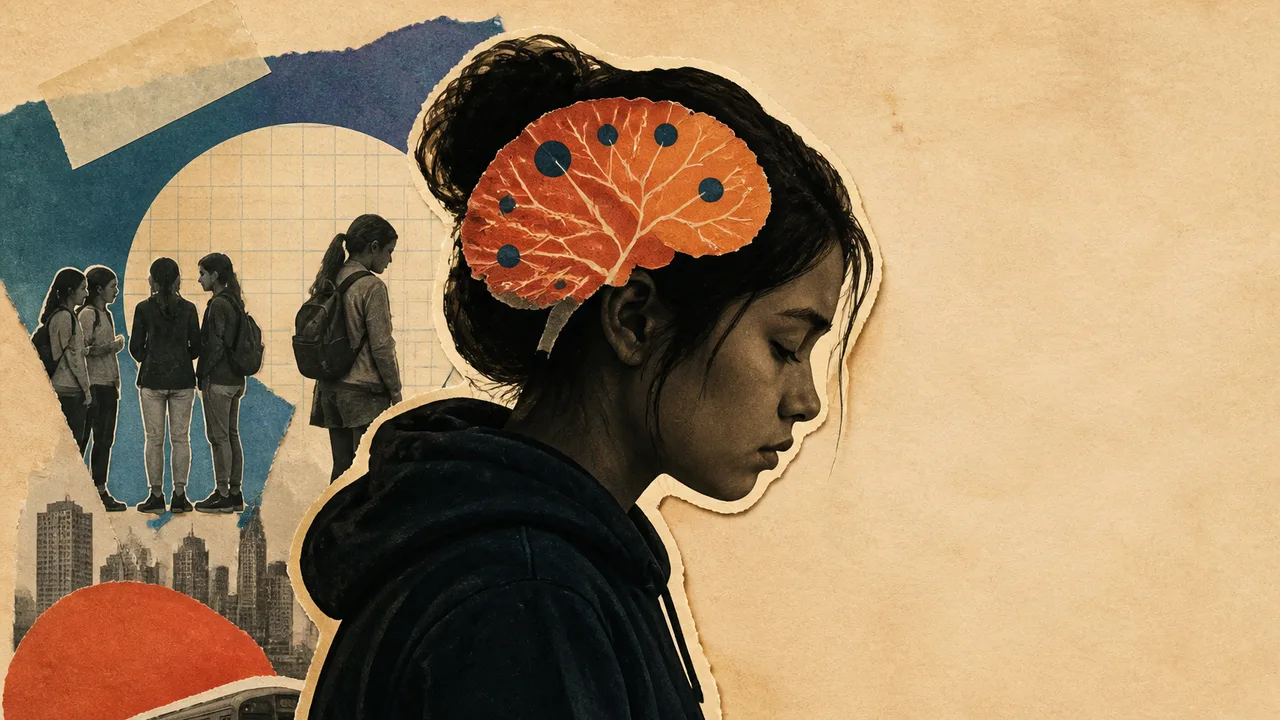
Photo: AI. Wren Sugimoto
There's a particular cruelty in being told, implicitly or explicitly, that your suffering doesn't count because your life looks good from the outside. Deniz Erdemir, a teenager who has lived between Turkey, a British school, and a Polish one, built her recent TEDxVLO Youth talk around exactly that gap—between how adolescent struggle appears and what it actually costs.
The talk is eight minutes. It's structured around three photographs of Erdemir at different points in her life, and a repeated question she poses to her audience: Does this girl look like she's doing fine? It's a device that works precisely because the answer is almost always yes—and that's the problem she's diagnosing.
Erdemir describes arriving at a British school not knowing English, spending her first two months pulling at other kids' arms because it was the only way she knew to get anyone's attention. She eventually learned the language, found her footing, built friendships. "It was the first place and the first group of people that I remember belonging to," she says. "It was my home." Then her parents enrolled her in a Polish school, and she lost all of it. She turned up on the first day in black leggings and a red hoodie—the old school had uniforms, so she didn't know the dress code—and spent a year unable to understand what anyone was saying. Even after learning Polish, something essential remained missing. The language wasn't the barrier. The belonging was.
What I find genuinely interesting about her talk isn't the personal narrative—though it's a good one—it's the neuroscientific frame she reaches for to explain why this matters. She cites research showing that the brain's response to social rejection activates the same neural pathways as physical pain. That finding comes primarily from work by neuroscientist Naomi Eisenberger at UCLA, whose fMRI studies have shown that the dorsal anterior cingulate cortex—a region involved in the distress component of physical pain—also lights up during social exclusion. This isn't metaphor. When Erdemir says "that wasn't just sadness," she's drawing on real neuroscience.
The practical implications of this are worth sitting with, because they often get skipped over. If social exclusion registers as pain in the brain, then a teenager describing their sense of not belonging isn't being dramatic—they're reporting a symptom. That reframe matters enormously for how parents respond, how school counselors triage, and how teenagers understand their own experience. The instinct for many adults, when a kid who gets good grades and seems to have friends says they feel alone, is to offer perspective: You have so much going for you. Things will get better. That response—however well-meaning—essentially tells someone in pain that their pain isn't real. It's the emotional equivalent of telling someone with a broken leg to walk it off.
What Eisenberger's research and subsequent work in developmental neuroscience has established is that adolescence is when this circuitry is most sensitive. Social feedback—acceptance, rejection, status, exclusion—registers with particular intensity in the teenage brain, not because teenagers are dramatic but because the brain is in a developmental window where peer relationships carry evolutionary weight. Erdemir puts it plainly: "When an adolescent says 'I just want to belong,' they aren't going through a phase. They aren't being needy. They're following the ancient survival instincts written into their DNA."
For parents, that reframe suggests a different first move: not reassurance, but acknowledgment. Research on what's sometimes called "validation" in therapeutic contexts—simply reflecting back to someone that their feeling makes sense given their circumstances—consistently shows it reduces distress more effectively than problem-solving or reframing. A school counselor who hears a kid describe loneliness and leads with curiosity rather than solutions ("What does not belonging feel like for you right now?") is doing something clinically meaningful, even if it looks like just listening. And a teenager who understands that their own pain has a neurological substrate—that they're not weak or oversensitive—may be less likely to dismiss what they're experiencing until it becomes a crisis.
Erdemir's talk also raises a question she doesn't fully pursue, and it's one worth extending: whose belonging story gets told, and whose doesn't? Her experience—multilingual, globally mobile, belonging to multiple cultures while fully owning none of them—has a name in the developmental literature. Researchers have used the term Third Culture Kids (TCKs) to describe children raised in a culture other than their parents' home culture for a significant part of their development. The sense of hovering between worlds, of belonging everywhere and nowhere, is well-documented in that literature. Erdemir is describing something real and legible.
But the belonging problem doesn't stop at cultural mobility. For queer teenagers navigating schools that render them invisible or actively hostile, the search for a tribe isn't just emotionally difficult—it's a documented mental health risk. The Trevor Project's 2023 National Survey on LGBTQ+ Youth Mental Health found that LGBTQ+ youth who reported having at least one accepting adult were significantly less likely to report a suicide attempt in the past year. For disabled teenagers who can't access the social spaces where belonging is built—parties, sports, unstructured hallway time—the exclusion is architectural before it's interpersonal. For kids sitting at multiple of these intersections, the stakes compound. The neuroscience Erdemir cites applies to all of them, but the structural conditions that determine whether they find belonging or don't are wildly unequal.
This isn't a critique of Erdemir's talk—it's a teenager giving an eight-minute personal essay at a youth conference, not a policy paper. But the frame she builds is strong enough to hold more weight than she applies to it, and the question of who gets to find their people is precisely where individual pain meets systemic failure. A school that invests in social-emotional learning, that trains teachers to notice the kid who looks fine but sits alone every day, that creates structures for belonging rather than assuming it will happen organically—that school is doing something different than one that doesn't, and those schools are not distributed equally.
Erdemir ends her talk in a way that I think is more honest than most: "The girl you see standing before you today—I hope I did, but I suppose only time will tell." She doesn't claim to have solved her own belonging problem. She's still in it. That open-endedness is important, because one thing the research is consistent on is that belonging isn't a milestone you reach—it's a condition you maintain, and adolescence is when the work of maintaining it is hardest and the scaffolding for doing so is thinnest.
The girl in the red hoodie is in every school. The question is whether anyone is actually looking.
If you or a teenager you know is struggling with isolation, loneliness, or a mental health crisis, the 988 Suicide and Crisis Lifeline (call or text 988 in the US) offers free, confidential support around the clock. The Crisis Text Line is available by texting HOME to 741741.
More Like This
Student-Athletes and the Mental Health Toll of Competing
Behind the scholarship and the starting lineup, many college athletes are quietly breaking down. Here's what the data — and the silence — actually tells us.
Parenting and Smartphones: A Balanced Approach
Exploring how parents can navigate smartphone use, focusing on development and communication.
The Emotional Resonance of Sound: Teresina's Journey
Explore how Teresina Kerubo uses sound to navigate love and grief, finding peace through recorded memories.
Tiny Experiments: Embrace Uncertainty and Grow
Discover how tiny experiments can help you embrace uncertainty, break free from control, and foster personal growth.

Your Distracted Mind Isn't Social Media's Fault
Philosopher Bence Nanay argues our attention crisis runs deeper than TikTok. The real culprit? The cognitive cost of a fragmented mind policing its own secrets.

Youth Economic Inactivity Is a Structural Problem
262 million young people are NEET worldwide. Unemployment figures miss most of them. Here's what the data actually shows about youth economic disengagement.

Maladaptive Daydreaming: When Fantasy Becomes Escape
Maladaptive daydreaming is vivid, hours-long fantasy that disrupts real life. Here's what psychology knows—and doesn't—about this under-researched experience.

How to Survive a Sleepless Night, According to Science
When sleep isn't possible, science offers real strategies. Here's what sleep banking, caffeine naps, and thermal drops can actually do for you.