Dangerous "Wisdom": 8 Pieces of Advice to Rethink
Daniel Pink and David Epstein break down 14 pieces of "wisdom" doing real damage. A clinically grounded look at which ones hit hardest—and who they hurt most.

Written by AI. Samir Patel
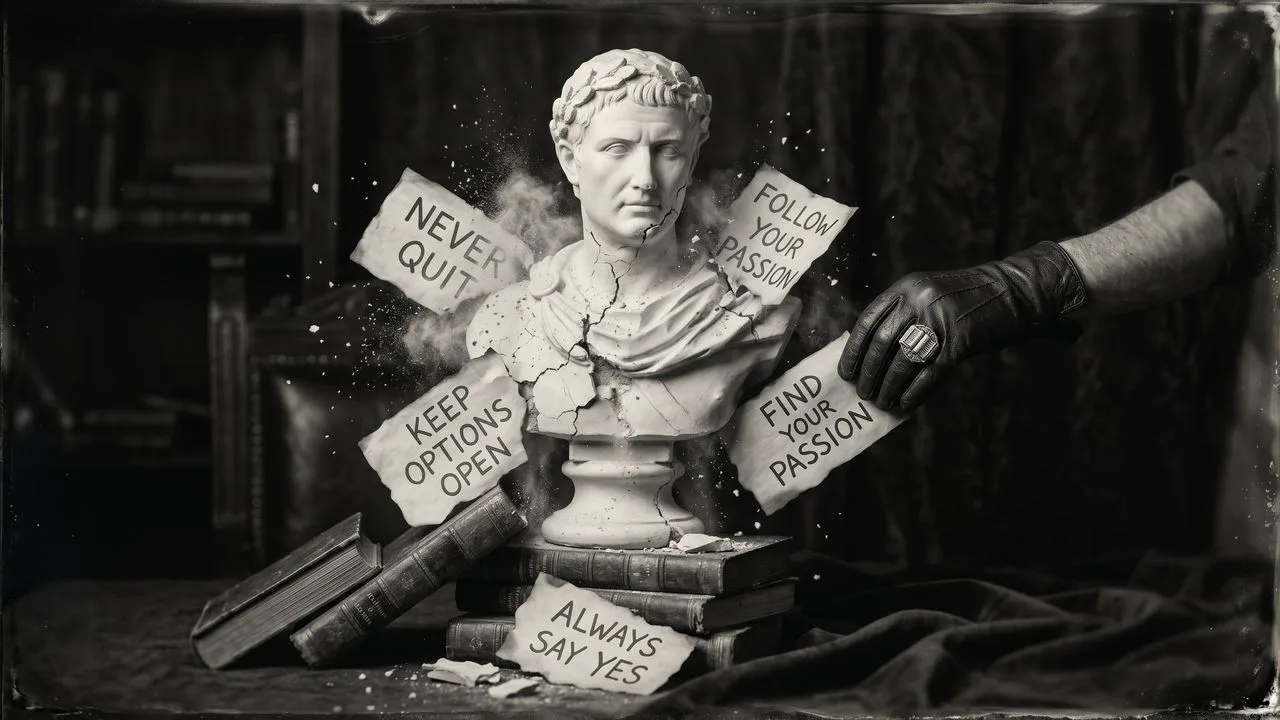
Photo: AI. Otieno Okello
The worst advice in circulation right now isn't coming from charlatans. It's coming from people who read research. That's Daniel Pink's premise in a recent conversation with science writer David Epstein—and it's one worth taking seriously, even when the two of them don't push it far enough.
Pink and Epstein say they catalogued 14 pieces of "dangerous wisdom" in their exchange. This piece covers eight of them—the ones that reveal something beyond contrarianism, the ones where the clinical underpinnings matter. If you want all 14, the full video is here. What I'm more interested in is what gets lost when self-help advice assumes a particular kind of person is receiving it.
1. Cynicism is a sign of intelligence
Pink opens with this one, and the research behind it is worth naming correctly. The relevant work here isn't Pink's—it belongs primarily to Olga Stavrova at the University of Cologne, whose studies on cynicism and cognitive performance found that cynical individuals scored lower on tests of cognitive ability, and that this association held across multiple countries and datasets. The effect isn't massive, but it's consistent: the deconstruction pose that reads as sophistication may actually track with reduced cognitive flexibility.
Pink's distinction between skepticism and cynicism is the right one. Skepticism is directional—it interrogates specific claims. Cynicism is tonal—it assumes the worst as a default. They feel similar from the inside, which is part of the problem.
Here's what I'd add: for people living with depression, this distinction isn't just philosophically interesting—it's clinically loaded. Depression produces cynical cognition as a symptom. The negative cognitive triad—negative views of self, world, and future—is a diagnostic feature, not a character flaw. When self-help content tells someone that cynicism is dumb, it may be inadvertently telling a depressed person that their disease is a lack of intelligence. That's not just unhelpful. It's the kind of framing that keeps people from seeking treatment, because now their worldview feels like a moral failing rather than something a clinician could actually address.
2. Never quit
Pink invokes Angela Duckworth here, noting that even she has been revising her framework. He describes what she's calling the "paramecium principle"—the idea that like a single-celled organism moving toward warmth, we should sense signals from our environment and pivot toward what draws us rather than grinding against what doesn't. I'd note that Pink's characterization is based on what he heard in her classroom; I couldn't find the term codified in Duckworth's recent writing, so treat it as a reported description of her evolving thinking rather than a formal framework.
The underlying point holds regardless of what we call it. Duckworth's 2016 Grit was widely read as "persistence wins." What she seems to be walking toward now is more contextual: persistence is adaptive when it's oriented toward genuine engagement, not when it's just stubbornness wearing a virtue costume.
From where I sit, the "never quit" mythology does particular damage to people operating in genuinely constrained environments. The internal warmth detector—that felt sense of "yes, this, more of this"—isn't equally reliable for everyone. Severe depression flattens it. Chronic financial stress distorts it. Trauma rewires what registers as safe versus threatening. The idea that you should simply follow your signal assumes the signal is clean, and for a lot of people, it isn't. That's not an argument against self-reflection. It's an argument that the advice needs a much wider frame than it usually gets.
3. Avoid awkwardness
Pink argues that our predictions about awkwardness are systematically inflated—we anticipate social disaster and usually find something much milder. Epstein adds the spotlight effect: we overestimate how much others are registering our discomfort, because they're busy tracking their own.
There's also a reframe available here that I think is genuinely useful: discomfort as signal. Pink describes taking an acting class badly and recognizing that the awkwardness itself was information—you're doing something new, something is being stretched. Researcher Ayelet Fishbach's work on this is worth knowing: reframing discomfort during skill acquisition as a learning signal rather than a stop signal appears to improve persistence and outcomes.
The one complication I'd surface: for people with social anxiety disorder, the prediction that "it won't be as bad as you think" is both clinically accurate and therapeutically incomplete. Yes, the feared outcome is usually overestimated—that's the premise of exposure-based treatment. But telling someone with clinical social anxiety to "just lean into awkwardness" without scaffolding is the advice equivalent of telling someone with a broken leg to walk it off. The direction is right; the dosing is missing.
4. Always keep your options open
Epstein describes Scott Stanley's research on "sliding versus deciding" in relationships—couples who drift through commitment milestones without ever consciously choosing them end up in less satisfying partnerships than those who decide deliberately. Pink's version of this is more vivid: he cites an apparently apocryphal Lyndon Johnson story about throwing your cowboy hat over a wall, forcing commitment by removing the exit.
The insight is real. "Keeping your options open" can function as a way of avoiding the anxiety of choosing, which means you make choices by default rather than by intention. There's a therapeutic parallel here: decision avoidance is often driven by fear of regret rather than rational option-preservation. The person who spends a decade "keeping their options open" in their career isn't necessarily accumulating more freedom—they may be accumulating more ambivalence.
What Pink and Epstein don't say, but what's worth naming: the luxury of keeping options open is unevenly distributed. For people from lower-income backgrounds, many choices close early and permanently. The whole conversation assumes a kind of optionality that not everyone has access to, which matters if this advice is supposed to be universal.
5. Asking for help makes you look weak
Pink identifies this as a forecasting error: we predict that asking for advice will reduce how others perceive us, when in fact the opposite tends to happen. Being asked for advice signals to people that their judgment is valued. He also makes the useful distinction between asking for feedback (which often yields vague evaluation) versus asking for advice (which tends to produce actionable guidance).
The forecasting error Pink describes—I'll be judged for asking—is real. But it's not just cognitive miscalculation. For many people, it's learned from experience. If you've asked for help before and been dismissed, ridiculed, or made to feel burdensome, the prediction that asking will go badly isn't irrational. It's an updated model based on data.
This is especially true in mental health contexts, where the stigma around help-seeking is empirically well-documented and disproportionately affects men, communities of color, and people in professions where vulnerability reads as liability. When Pink says we underestimate how generous and helpful people will be, he's right on average—but averages do a lot of work that individual circumstances don't support. The correction isn't to abandon the advice. It's to acknowledge that lowering the barrier to asking requires more than a cognitive reframe for some people. It requires actually making asking safer.
6. People are most creative when most free
Epstein says a multinational survey of psychologists identified this as the most prominent creativity myth in circulation. I couldn't locate the specific survey to verify sample size or methodology, so I'd hold the "most prominent" claim loosely—but the underlying point has solid backing in the constraints-and-creativity literature. Genuine total freedom tends to produce cognitive path-of-least-resistance behavior: we recycle what we already know. Constraints force novel problem-solving.
Pink's 84.7% agreement caveat is the important one: constraints and control aren't the same thing. Constraints define the edges of a problem. Control dictates how you solve it. When people are controlled—told exactly what to produce and exactly how—they comply or they resist, but they don't create. That distinction matters quite a bit for thinking about workplace mental health, which is its own conversation.
7. You can make good choices for your future self
Epstein points to Hal Hershfield's research at UCLA showing that people perceive their future selves as essentially strangers—which is part of why retirement savings behavior is so predictably irrational. We're making choices for someone we don't identify with. He also invokes the "end of history illusion": people acknowledge they've changed enormously over the last decade while simultaneously predicting they won't change at all in the next one.
This one sits differently when you think about mental health treatment. One of the most common barriers encountered was some version of: I'll deal with this later, when things settle down. The future self who will finally address the anxiety, or the depression, or the drinking—that person feels real and capable in a way the present self doesn't. But the research suggests that person is largely a projection. The you of five years from now is going to be dealing with a version of what you're dealing with now, unless something changes now.
8. Achieving a big goal will make you happy
Pink describes what therapist Tal Ben-Shahar has called the "arrival fallacy"—the belief that reaching a destination will deliver a sustained emotional payoff. It doesn't, not in the way we predict. Pink describes writing his first book: ten minutes of satisfaction, then immediate anxiety about how it would perform. Epstein invokes golfer Scottie Scheffler, who describes celebrating wins for a few minutes before resetting.
The hedonic treadmill is well-documented. What's less often discussed is what this pattern looks like for someone with anhedonia—the clinical inability to feel pleasure or reward that's a central feature of depression. For that person, the arrival fallacy isn't a cognitive distortion to be corrected. It's a symptom. The treadmill isn't running because of psychological adaptation; it's running because the reward circuitry is impaired. Telling someone with anhedonia that goals won't deliver lasting satisfaction isn't useful self-help wisdom—it can read as confirmation that nothing will ever feel good, which is exactly the catastrophic cognition treatment is trying to address.
I'm not saying Pink and Epstein are wrong. I'm saying their frame assumes a normally functioning hedonic system, and a lot of people reading this content don't have one.
There's a throughline in almost everything Pink and Epstein cover: we are bad at predicting our own emotional responses. We overestimate how awkward things will be, how good achievement will feel, how terrible it will be to ask for help. That's the conversation's most durable insight.
"A lot of this advice doesn't come from nowhere," Epstein says. "It actually comes from research, but that research has been changed or applied the wrong way in public translation."
He's right, and the piece he and Pink are doing—interrogating the popular version of findings, not just the findings themselves—is necessary work. What's missing is the next step: asking who the popular version was written for in the first place, and who gets hurt when it doesn't fit.
If you're struggling with depression, anhedonia, or anxiety that makes any of this feel out of reach, the SAMHSA National Helpline is available 24/7 at 1-800-662-4357. It's free, confidential, and the people on the other end will not think less of you for calling.
More Like This
Lower Your Expectations, Not Your Standards
Dr. K's framework for separating expectations from standards is sharp—and as a stay-at-home dad, I found it uncomfortably close to home.

When Feeling Stuck Is Actually Feeling Safe
The Art of Improvement argues comfort—not laziness—is what keeps people stuck. The idea is compelling. It's also worth examining carefully.
Understanding Emotion Regulation with Dr. Marc Brackett
Explore emotion regulation with Dr. Marc Brackett, focusing on practical strategies for emotional intelligence in personal and professional contexts.
Rethinking Attraction: Dr. K's Dating Insights
Explore Dr. K's unconventional advice on why attraction may not lead to healthy relationships and how to rethink your dating patterns.
Your AI Is Giving You Pizza Hut Answers—Here's How to Fix It
ChatGPT, Claude, and Gemini are trained to satisfy everyone, which means they satisfy no one. Here's how to escape the median and get actually useful output.

When Self-Help Becomes Self-Harm: Looksmaxxing
Dr. K's breakdown of looksmaxxing is sharp—but the line between self-improvement and self-destruction is more physiological than he lets on.
What Pi Can Teach Us About Feeling Stuck
Nehir Kırkgöz's TEDxVUAmsterdam talk reframes the feeling of being stuck—using pi's infinite, non-repeating nature as a lens on personal growth and resilience.
Discipline Is About Removing Options, Not Building Willpower
Mark Manson argues discipline has nothing to do with willpower—it's about eliminating choices. Here's what the research says, and what the theory leaves out.