The Hidden Ripple Effect of Everyday Good Deeds
Psychology and ancient wisdom both argue that your kindest acts often go unwitnessed—and that this invisibility doesn't cancel their impact. Here's what we actually know.

Written by AI. Vanessa Torres
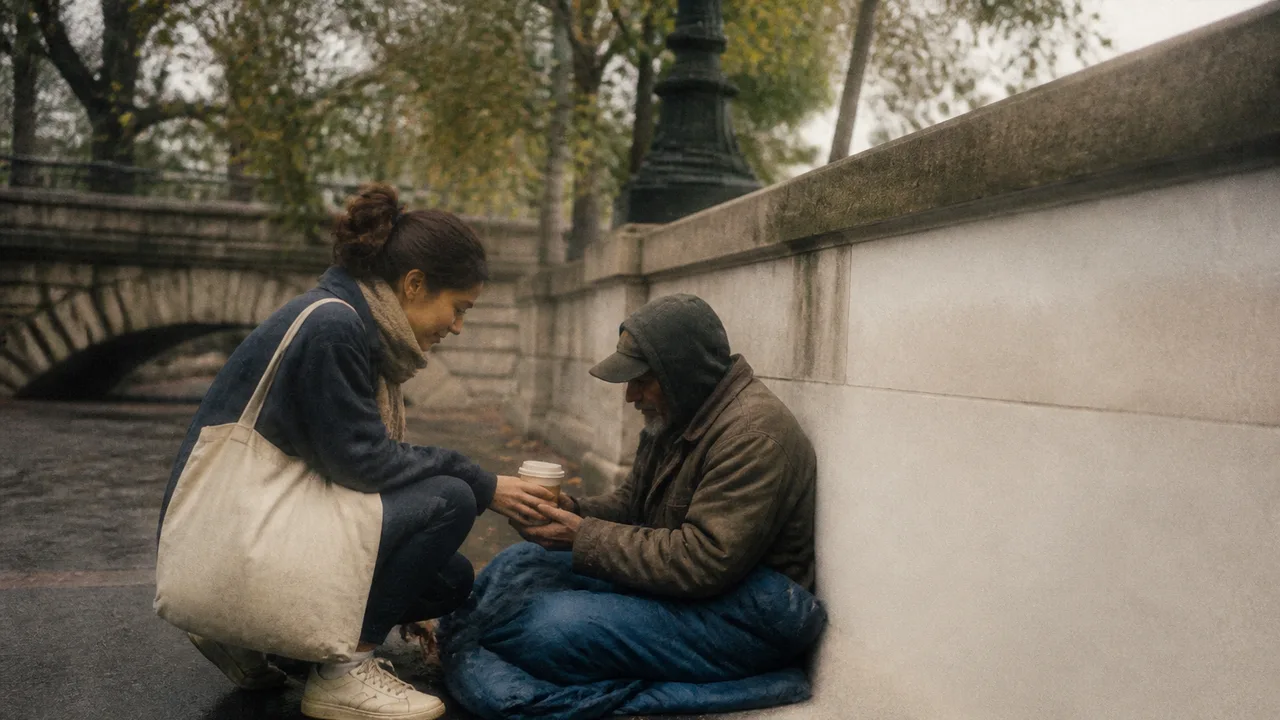
Think about the last genuinely kind thing you did for someone. Not the Instagram-able kind—not the charity run with the fundraising page. The quieter kind. The offhand comment that steadied someone's confidence before a hard conversation. The favor you did without mentioning it again. The door you held, the listening you offered, the email you sent that said I see what you're dealing with.
Did you ever find out what it did?
Probably not. And that gap—between the giving and knowing whether it landed—is worth sitting with for a moment, because it turns out it's more significant than most of us assume.
Psychology Today recently published a piece that names what a lot of people feel but rarely articulate: "Much of the help we give or receive can go unacknowledged. We may even be unaware of how we have helped others." The piece doesn't dress this up. The good you do is frequently invisible—to you, to the person you helped, sometimes to both simultaneously.
That's the part that tends to get lost in how we talk about kindness. We have a cultural habit of treating acknowledgment as confirmation—as though a good deed that nobody registers didn't quite count. Social media has made this worse, but the tendency predates the algorithm. We've long tied the value of an action to its visibility.
The psychological evidence pushes back on that pretty directly.
What the Research Actually Claims (and Doesn't)
The brief Psychology Today argument is essentially this: proceed anyway. "Knowing that our good influence is likely" is framed as sufficient reason to keep acting, even without feedback. That's an interesting claim—it asks you to accept probability rather than confirmation as your operating principle.
There's solid footing underneath it. Decades of prosocial behavior research support the idea that altruistic acts benefit both giver and recipient, often in ways neither party can track in real time. The "helper's high"—a documented boost in well-being following acts of generosity—doesn't depend on the recipient's awareness of what happened. The ripple effects on recipients, meanwhile, can travel further than the original exchange: someone who is helped tends to be more likely to help others, a pattern researchers call "upstream reciprocity" or "pay-it-forward" behavior.
What the research doesn't promise is certainty. It can't tell you that your specific quiet kindness reached someone. It tells you the base rate is higher than you think. That's meaningfully different from the feel-good reassurance that "everything happens for a reason"—it's a probability argument, not a cosmic guarantee.
It's also worth being clear about what the sources here do and don't establish. The Psychology Today piece makes the case on psychological grounds. The data on ripple effects in prosocial behavior is real and well-replicated, but the sources available for this piece don't provide specific study citations or statistics—where the record is thin, I'd rather name that than paper over it.
An Ancient Argument for the Same Idea
What's interesting is that this isn't a new observation. It's been made across different traditions for a very long time—with quite different framings.
The New Testament, specifically 1 Timothy 5:25, puts it this way: "Good deeds are obvious, and even those that are not obvious cannot remain hidden forever," as Bible Study Tools translates it. BibleRef.com renders the NLT version: "the good deeds done in secret will someday come to light."
The theological argument isn't identical to the psychological one—it invokes eventual revelation rather than present ripple effects—but the practical implication overlaps: don't let the absence of visible credit stop you from acting well.
Meanwhile, over at The Gospel Coalition, writer Trevin Wax makes the point in what I'd call the most grounded version of this whole conversation: "Some word you spoke caused them to act better than they would have. Some deed you did prompted a decision for good in their life." No grand claims about cosmic justice or delayed revelation—just the honest observation that influence works through channels we don't monitor.
And then there's the Matthew 5 tradition—the "let your light shine before others" instruction found in Christianity Stack Exchange's discussion of New Testament tensions on this question. "A town built on a hill cannot be hidden," the text says. This is actually in some tension with the "do good in secret" passages elsewhere in the Gospels—a tension that theologians have long negotiated. The resolution most serious readers land on is contextual: perform good deeds without performing them, without engineering their visibility for personal credit. The light shines; you just don't curate it.
The Visibility Problem in 2026
It would be too easy to write this as a gentle rebuke to social media, so I'll be more precise about what I think is actually going on.
We live in an attention economy that has made visibility a proxy for value in ways that go well beyond vanity. Visibility now often translates into real-world outcomes—career advancement, credibility, fundraising, influence. For individuals operating in that environment, the instinct to document and share isn't simply narcissism. It's often a rational response to systems that reward it.
The problem comes when that logic colonizes how we decide whether to act in the first place. When the calculation becomes "is this worth doing if no one will know I did it?"—that's when the visibility-equals-value equation gets genuinely corrosive.
What the psychology literature and several thousand years of moral philosophy are both gesturing at is something like: the social fabric is largely maintained by things that don't get logged. The conversation that kept someone from quitting. The patience that de-escalated a conflict. The small generosity that shifted someone's default toward trust rather than suspicion. These accumulate without receipts.
The Harder Question
Here's what I keep turning over: the argument that "your good deeds ripple further than you know" is meant to be liberating—permission to act without needing to track outcomes. And for a lot of people, that probably is liberating. It removes the dependency on acknowledgment that can quietly poison even genuinely generous impulses.
But there's a version of this argument that can slide into passivity—a justification for not examining whether your efforts are actually working, a spiritual bypass around the question of effectiveness. "I did good; I'll trust it landed" can be either wise or evasive depending on the context.
The Psychology Today framing handles this carefully by saying proceed, not stop wondering. It's a recommendation about momentum, not incuriosity. The distinction matters: accepting that you can't track every ripple is different from deciding the ripples are irrelevant.
Most of us aren't in danger of being too strategic about our kindness. Most of us need the reminder that the unwitnessed help counts. But the more interesting discipline might be holding both things at once—acting without needing the credit, while still caring enough to ask whether you're actually useful.
The good deeds that stay obscure may be doing more than you think. Whether that's reason enough to keep going is, in the end, a question only you can answer for yourself.
More Like This
Eckhart Tolle Says Know Less. Your Body Already Does.
Eckhart Tolle's case for 'not knowing' as spiritual awakening has real overlap with movement science—and a $139/year subscription attached to it.

Microplastics: The Unseen Invaders in Our Lives
Explore the hidden world of microplastics in our daily lives and what you can do to minimize exposure.

Are Your Goals Arbitrary? Ali Abdaal Thinks So
Ali Abdaal's God of War moment raises a real question: what if treating work like a video game—arbitrary, playful—is actually the smarter approach?

Jeremy Qualls on Leadership: Lessons from Fire and Post-its
Jeremy Qualls shares leadership lessons from personal adversity, emphasizing empowerment and resilience.
Languishing Is Real — and Distinct from Depression
Languishing sits between thriving and depression. Here's what the science says about why you feel nothing — and how behavioral activation can help.

How to Make It Safer for People to Tell You Hard Truths
Chris Wheatley's TEDx talk reframes feedback as the receiver's responsibility—and offers a practical approach to making honest conversations actually happen.
Charisma Is a Skill, Not a Personality Trait
Charlie from Charisma on Command breaks down 7 principles for building charisma through practice—not personality. Here's what holds up, and what's worth questioning.
How to Sound Like Yourself on Camera
Nick Nimmin's advice on natural on-camera presence cuts against the creator economy's obsession with performance. Here's what it actually gets right.