The 1% Problem: Why 100 Tries Isn't 100%
A viral tweet got the math wrong on persistence and probability. Here's what the actual numbers say—and why 63% is more interesting than 100% anyway.

Written by AI. Amelia Nwofor

Photo: AI. Marcel Dubois
Leila Hormozi, entrepreneur and co-CEO of Acquisition.com, posted something to X that got 3.7 million views. The post read: "Becoming successful is not luck. It's math. If your probability of success is 1 over 100, and you try 100 times, you have a 100% chance of success."
The intent was motivational. The math was wrong. And what happened next is actually more interesting than either the mistake or the correction.
The Error Is Intuitive—That's the Point
Before reaching for the dunking stick, it's worth sitting with why this particular mistake is so easy to make. Presh Talwalkar, who runs the math YouTube channel MindYourDecisions and covered this episode in a recent video, maps out the intuition clearly: a coin has two outcomes, so in two tosses you can expect heads to show up. A six-sided die has six outcomes, so in six rolls you can expect to see any particular number. Scale that logic up to a 100-sided die, and of course 100 rolls should cover all your bases.
The problem is the word expect. In everyday English, "you can expect X" has a casual, near-certain ring to it. In probability, it means something more precise and more humble: the average outcome, not the guaranteed one. You can roll a six-sided die six times and never once land on a three. That's not a malfunction—it's what randomness does.
Hormozi's error was treating expected value as a guarantee, which is a move that happens at dinner tables and in boardrooms constantly. It's not a mark of stupidity. It's a mark of how poorly the language of probability maps onto human intuition.
What the Number Actually Is
Talwalkar walks through the correct calculation step by step, and it's clean enough to follow without a math degree. If you want the probability of winning at least once in 100 independent trials, where each trial has a 1% chance of success, you don't add probabilities—you multiply failures.
The probability of losing any single trial is 99/100. The probability of losing all 100 trials is (99/100)^100, which works out to about 0.366—or roughly 36.6%. Flip that around: the probability of winning at least once is 1 minus 0.366, which is approximately 63.4%.
Not 100%. Not even close.
But here's where it gets genuinely interesting, because Talwalkar doesn't stop at the correction. He generalizes the problem. Imagine an n-sided die where you have exactly one winning face. The probability of winning at least once in n rolls is 1 − (1 − 1/n)^n. As n gets very large—as your odds get longer and you compensate with more attempts—this expression doesn't converge to 1. It converges to 1 − 1/e, which is approximately 0.632.
The number e showing up here—Euler's number, the base of the natural logarithm, that irrational constant that runs through compound interest and population growth and radioactive decay—is one of those moments in probability that makes you put down your coffee. The universe, being the universe, smuggled a transcendental number into a motivational tweet about hustle culture.
What this means practically: no matter how long your odds, if you try exactly as many times as your odds suggest you should, you'll cap out at roughly a 63% success rate. Talwalkar is direct about this: "If you have a probability of success of 1/n, you have n equally likely outcomes, then even if you try n times, you're still going to be limited to a success rate of about 63%."
To push past that ceiling, you need to increase the number of attempts beyond what the naive intuition suggests. Five hundred attempts at 1% odds? That gets you to 99.3%.
The Correction That Didn't Have to Be Good
Here's where the story takes a turn that's worth examining on its own terms.
When the Community Note appeared on Hormozi's post—flagging the error and showing the correct calculation—she didn't delete the tweet. She didn't ignore it or argue with it. She replied:
"Community note is right. The chance of success is about 63% not 100%. Somehow I managed to function and become successful in business despite being atrociously bad at math, lol. Not a secret, you can ask my team. Here's what I meant to say. One attempt is equal to 1% odds, 100 attempts is equal to 63% odds, 500 attempts is equal to 99.3% odds. Persistence doesn't guarantee success. It does compound your probability until the math is eventually on your side."
This is worth pausing on—not because public figures correcting themselves is rare (though it is), but because the correction is accurate. She didn't substitute one oversimplification for another. She actually engaged with the numbers: 63% at 100 attempts, 99.3% at 500. That's the mathematically honest version of the original argument, and it's a more useful version too, because it makes the cost of persistence legible. You're not grinding toward a guaranteed outcome. You're purchasing probability.
The original framing—"it's math, not luck"—collapses if success is actually guaranteed by formula. If 100 tries = 100%, then persistence is just arithmetic. But if 100 tries gives you 63% and 500 tries gives you 99.3%, then persistence is a genuine choice you're making under uncertainty, with real probability stakes attached to it. That's a harder and more honest story, and it's the one the corrected tweet tells.
What the Internet Did With It
Talwalkar is measured but clear about the pile-on that preceded the correction: "This is when the internet loves to get together and try to humble someone who shows confidence." The dynamic is familiar—a successful person posts something aspirational, a mathematical error surfaces, and the correction becomes less about the math and more about the opportunity to cut someone down.
The math, in this case, was genuinely wrong. That's worth noting. But the gap between "the math here is off" and "this person is a fraud" is enormous, and the internet tends to collapse it. What Hormozi actually demonstrated, by correcting herself publicly and getting the numbers right in her follow-up, is a higher standard of intellectual honesty than most people manage in lower-stakes situations.
There's a separate question worth asking, though, and it's one Talwalkar doesn't quite press: how much does the probability model actually capture about success? The entire analysis assumes independent trials with fixed probabilities—a 100-sided die that doesn't change. But most real-world attempts at difficult things aren't independent in that way. You learn from attempt 1 before you make attempt 2. Your probability of success isn't constant; it changes as you iterate. You might also run out of resources—time, money, energy—before you hit 500 attempts. The geometric probability model is a useful scaffold, but it's an idealization.
That's not a knock on the math. It's a reminder that the math is describing a simplified model, and models have edges.
The 63% Argument
Paradoxically, 63% might be a more motivating number than 100%, once you sit with it.
100% removes agency. If success is guaranteed after enough tries, then persistence is just waiting. 63% tells you something real: roughly one in three people who try as hard as the intuitive baseline suggests will still come away empty-handed. That's the actual situation. You're not protected by the math—you're playing odds, and the odds are better than not trying, but they're not certainty.
That framing requires something different from the person making the attempts. Not just persistence, but a willingness to keep going while knowing the outcome isn't guaranteed. That's harder to sell on a motivational poster, but it's closer to what actually happens.
"Failure is acceptable," Talwalkar concludes. "It is not trying which is not acceptable."
The math doesn't tell you success is inevitable. It tells you inaction makes failure certain—and action makes success possible, in a way that compounds with repetition. That's enough to act on. Whether it's enough to post 3.7 million times is a different question.
More Like This
Solving the 'Harvard' Puzzle: A Mathematical Journey
Explore the mathematical challenge of 8^x + 2^x = 30, a puzzle reminiscent of a Harvard entrance exam.

Exploring Five Ways to Solve a Circle's Radius
Discover five mathematical methods to find the radius of a circle, each offering unique insights into geometry and problem-solving.

Why "Bad at Math" Is a Mental Health Story
Math anxiety is a documented psychological condition. A Poincaré-inspired video about intuition vs. rigor reveals what rote math education does to people's sense of self.
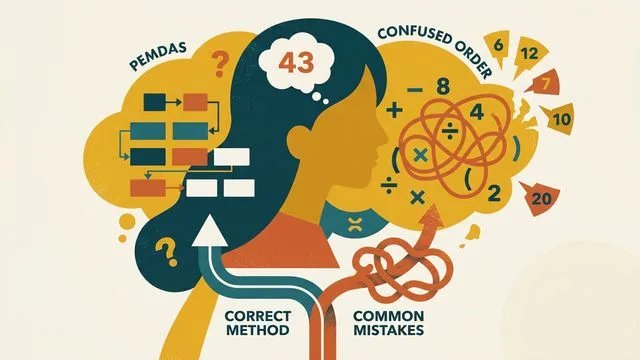
How Old Is Sandra? The Math Puzzle Dividing the Internet
Sandra's age puzzle went viral with 3.8M views—and most people got it wrong. Here's what the disagreement actually reveals about math education.
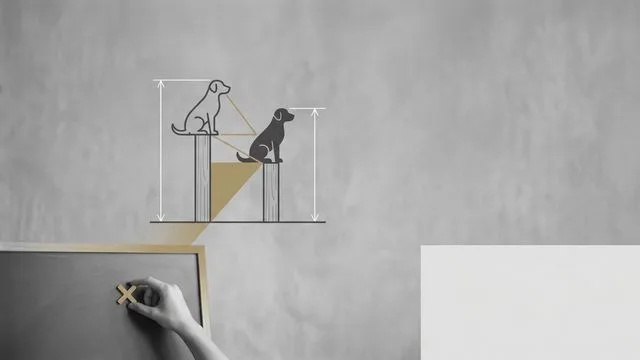
How Tall Is the Dog? The Viral Math Puzzle Solved
A dog, a pole, two measurements—and three different ways to crack it. Presh Talwalkar's viral puzzle reveals something deeper about how we learn math.

Conway's Constant and the Power of Slow Attention
A children's counting game hides a degree-71 polynomial. What John Conway's slow, patient method reveals about how real insight actually works.

Hannah Cairo Disproved a 40-Year-Old Math Conjecture at 17
At 17, Hannah Cairo overturned the Mizohata-Takeuchi conjecture using a hypercube and a coin diagram. Here's what she actually did—and why it matters.

How Language Shapes Thought, According to Lera Boroditsky
Cognitive scientist Lera Boroditsky explains how the language you speak shapes memory, color perception, and thought—and what's lost when languages disappear.