The Philosophy of Patience, Learned on the Toilet
The School of Life argues our most private daily ritual holds genuine philosophical lessons about willpower, patience, and the limits of force. Here's the case.

Written by AI. Ellis Redmond
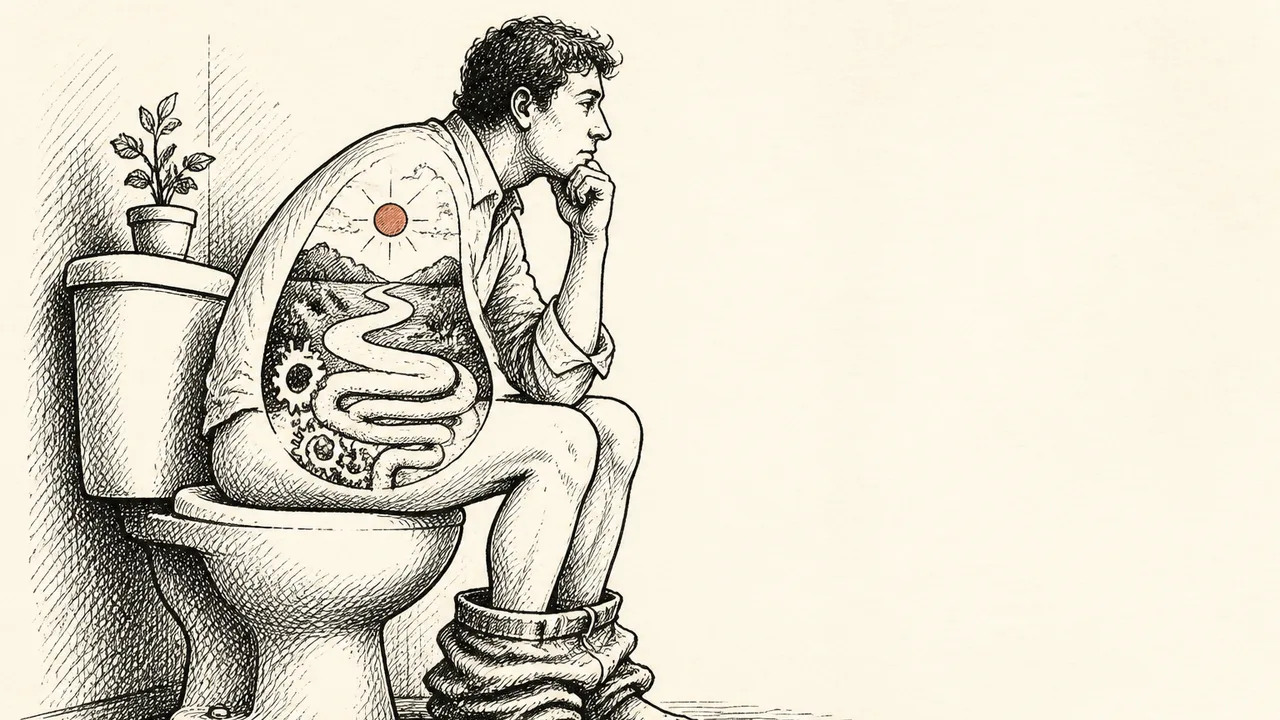
Photo: AI. Eira Pendragon
There's a particular kind of philosophical courage in saying the quiet part loud. The School of Life, in a recent short video, does exactly that—starting from a place most thinkers would flee and arriving somewhere genuinely interesting.
The quiet part, in this case, is the toilet.
The video opens with a thought experiment: imagine a cultivated alien trying to understand humanity through our highest cultural achievements. Art. Literature. Philosophy. The alien would form a picture of creatures who are essentially pure minds—rational, dignified, transcendent. They'd never guess at the other stuff. As the video puts it:
"No visit to the Prado is educative on the topic. The gods and heroes of Homer never defecate, nor does any Jane Austen heroine. The fact has been taken to be far too disgusting for the polite realm of high thought."
It's a fair indictment. Western intellectual tradition has largely built itself on a fantasy of disembodiment—the idea that what matters about us is the part that reasons, not the part that requires fiber. And the School of Life's provocation is this: in airbrushing out the biological, we may have also airbrushed out some useful wisdom.
So. The toilet.
The argument, taken seriously
The core claim is about the gap between will and body—and what that gap reveals.
Most of the time, the mind leads and the body follows. You want to pick up a glass; your hand moves. You decide to speak; your lungs comply. The obedience is so automatic that we barely notice the relationship. But on the toilet, the arrangement breaks down. You want something to happen. Your body has its own timeline. And—here's the philosophically interesting part—trying harder makes things worse.
"In a crucial perversity of our nature, the fact that we are trying may be the very obstacle to performance."
This is, as it happens, a genuinely documented phenomenon. Psychologists call it "ironic process theory"—the idea that the mental effort to suppress or force a particular outcome can paradoxically produce the opposite. Tell yourself not to think about something and you'll think about it constantly. Try to force sleep and you'll lie awake. The toilet, in this reading, is just the most honest and unambiguous classroom for a lesson the body delivers elsewhere too.
The video extends this into adjacent territory: you can't will yourself into sexual arousal, or make yourself sneeze, or drag yourself into creativity by sheer force of want. And then it takes the argument one step further—you can't bully yourself into emotional states either. Cheerfulness ordered is cheerfulness denied. Genuine change, the video argues, requires something more like negotiation than command.
What the argument illuminates
What I find genuinely useful here—beneath the admittedly arresting framing—is the challenge it poses to a specific cultural assumption: that willpower is the master key.
Self-help, broadly speaking, is obsessed with willpower. The dominant narrative runs something like this: you are capable of whatever you want, the only thing standing between you and your goals is insufficient commitment, and the solution is to want it more. Try harder. Discipline yourself. Build better habits. Grind.
The toilet argument cuts sideways through all of that. Not to say effort doesn't matter—it clearly does, across most domains of life—but to identify a category of things where effort applied directly produces friction rather than progress. Where the relationship with the self has to look more like diplomacy than dictatorship.
The video frames this as learning to be "a partner to the magnificent, stubborn, and often lowly reality of being ourselves" rather than a tyrant over it. That's a sentence with some real reach. There's a whole mode of self-improvement culture—the kind that talks about "crushing your goals" and "dominating your day"—that treats the self as an obstacle to be overcome rather than a system to be understood. The toilet, of all things, offers a rebuke.
Where to push back
The School of Life's house style leans toward the lapidary and the universal—observations that feel profound precisely because they arrive dressed in literary reference and elegant prose. That's a feature, not a bug, for most of their audience. But it's worth noticing what the style can obscure.
The video presents the mind-body gap as a shared human experience, which it largely is. But the specific lesson—that patience and strategic cooperation work better than force—doesn't map cleanly onto every domain where people reach for willpower. If you're in an exploitative work situation, or a system that's actively working against you, "cooperate strategically with the internal state of the system" starts to sound like advice to accommodate things that should be changed. There's a version of this philosophy that becomes a rationalization for passivity.
There's also the question of what "cooperation" actually looks like when the rubber meets the road. The toilet analogy is instructive precisely because the feedback loop is so immediate and visceral—you know fairly quickly whether your approach is working. For larger psychological processes—trying to build motivation, or recover from depression, or reshape a creative practice—the signals are murkier. "Be patient and don't force it" is genuinely good advice, but it's also the kind of advice that can sit comfortably alongside doing very little at all.
The video acknowledges that this applies to changing other people, too. And there, I'd want more nuance than three minutes allows. Cooperating strategically with someone else's "internal state" is either wise relationship psychology or, depending on context and power dynamics, something shadier. The same insight that describes good therapy also describes manipulation. The toilet is, thankfully, a closed system.
What remains
None of that is a reason to dismiss the core observation—which is, I think, genuinely worth sitting with (sorry).
The specific insight about non-volitional processes—the ones that operate partially outside conscious control—is well-supported by research in psychology and neuroscience. Sleep, creativity, emotional regulation, immune function: all are systems that respond poorly to direct command and better to what you might call contextual invitation. You can't force a good night's sleep, but you can build the conditions that make sleep more likely. You can't manufacture creative insight, but you can arrange your time in ways that give insight room to arrive.
What the School of Life is doing, in its three-minute format, is pointing to this class of experiences and asking: what if we actually took their logic seriously? What if the toilet—that stubbornly unheroic fixture—is a daily reminder that we are not the straightforward command-and-control systems we prefer to imagine ourselves as?
"The hardest thing is patience. Realizing that trying to speed a process up is often the surest way of shutting it down."
That's a lesson most of us know abstractly. The video's small, strange contribution is to suggest we're already practicing it every morning—whether we're paying attention or not.
More Like This

Adult Rage and Emotional Suppression: What We Hold In
Alain de Botton argues adults deserve the emotional honesty of a toddler's tantrum. The science on suppression is more complicated than that.

Making Studying Stick: The Psychology of Starting
A YouTube video promises you can get addicted to studying in 10 minutes. The psychology is mostly real. The missing piece is who gets to use it.

Neurotic vs. Psychotic: What the Terms Really Mean
Alain de Botton's School of Life video reframes "neurotic" and "psychotic" as degrees of self-awareness—not insults. Here's what the distinction actually reveals.

The Power of Starting Conversations with 'What'
Discover how asking 'what' instead of 'why' can transform communication and influence.

What Gratitude Research Actually Says About Happiness
TED Talks on gratitude reveal a maturing research field—one that's honest about resistance, specificity, and what the practice can and can't do for you.

Patience as a Skill: What the Science Actually Says
Patience keeps getting called a "superpower." But what does the research actually say about cultivating it—and what does the wellness framing get wrong?

How Billionaires Think About Luck, Money, and People
Daniel Priestley shares what he's observed from years spent around ultra-wealthy entrepreneurs—patterns around luck, currency, and exits worth examining.

The Hard Ceiling on Human Lifespan, Explained
Can science push humans past 115? From longevity clinics to cellular reprogramming, here's what the evidence actually says—and what it doesn't.