Adult Rage and Emotional Suppression: What We Hold In
Alain de Botton argues adults deserve the emotional honesty of a toddler's tantrum. The science on suppression is more complicated than that.

Written by AI. Samir Patel
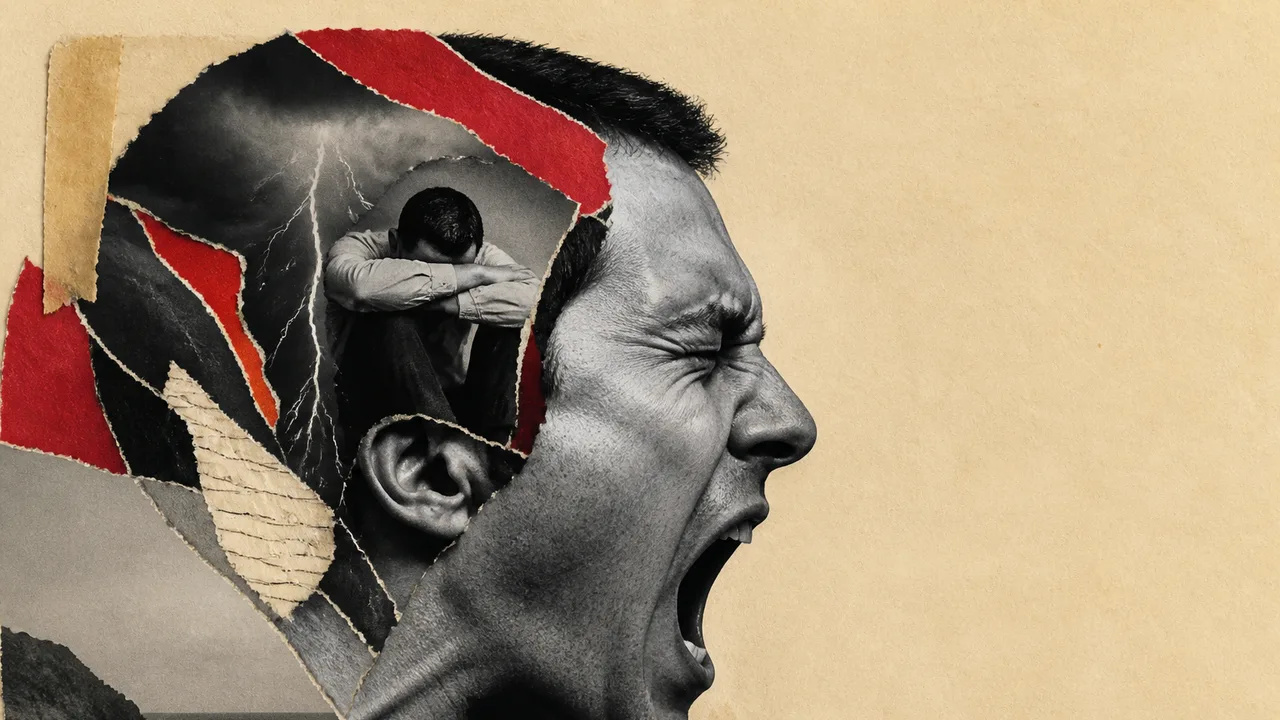
Photo: AI. Wren Sugimoto
Picture the supermarket aisle. Three-year-old on the floor, coat half torn off, boots in the air, producing a sound that shouldn't be possible from something that small. You've seen it. You've felt the particular combination of pity and relief — glad that's not mine — and moved on toward the chicken breasts.
Alain de Botton, in a new School of Life video, wants to interrupt that walk-away. His argument: the toddler isn't the embarrassing one. We are.
"The toddler may show its feelings," de Botton narrates, "but we in the more honest parts of ourselves have every reason to be just as incensed, furious, and crazy — and essentially are."
It's a provocation dressed as philosophy, and it's worth sitting with rather than immediately accepting or dismissing. De Botton is doing something genuinely interesting here, even if what he's building doesn't quite hold the weight he puts on it.
The Case He's Making
The video's core move is a comparison of burden. Yes, the toddler lost a yogurt. But the adult standing in judgment is quietly carrying: a rejection after three months of hope, a contract not renewed, a boiler that failed on the worst possible week, a partner who doesn't quite seem to listen. De Botton lists these with precision — not abstractly, but in the specific, mundane, accumulating way that actual adult disappointment arrives. The concrete floor cracking. The mole on the back you haven't had checked.
The argument isn't that adults should scream in supermarkets. It's that the gap between what we contain and what we're permitted to express has grown so wide that we've stopped noticing we're containing anything at all. We "smile," he notes, "we say we've had a pleasant weekend. We keep going."
Against that backdrop, de Botton offers a gentle provocation: "Is it not in some ways a proper miracle that we've not this week at least yet thrown ourselves onto the floor in public and tried to rip off our own clothes?" He means it affectionately. He's asking us to recognize the labor involved in performing composure under genuinely difficult conditions.
That recognition matters. One thing the wellness industry does badly — and de Botton is gently calling this out — is treat emotional regulation as costless. As though calm, achieved through meditation or Marcus Aurelius, is a neutral state rather than active, effortful work. The stoic ideal tends to erase the exertion required to maintain it.
Where the Argument Gets Complicated
Here's where I want to slow down, because de Botton's framing does something subtle that deserves examination.
He positions the tantrum as honest — as an authentic expression of a real emotional state, in contrast to the managed composure that constitutes adult life. But honesty isn't the same as health. A tantrum in a three-year-old reflects both an overwhelming feeling and an undeveloped capacity to process it. De Botton is right that adults have the overwhelming feeling. He's quieter about whether what we'd want is to replicate the processing — or the lack thereof.
The distinction between acknowledging difficult emotions and enacting them in their raw form is where clinical thinking diverges from the video's more poetic argument. Emotion-focused therapies — rooted in the work of Les Greenberg and others — draw precisely this line: the goal is access to emotional experience, not unmediated discharge of it. Feeling your rage matters. Understanding what it's telling you matters more.
The APA longitudinal study Emotion Cause or Symptom? A Longitudinal Test of Bidirectional Relationships found that chronic emotional suppression and mental health symptoms move in both directions — suppression predicts worse outcomes, but it's not a clean causal story of "suppress emotion, get worse." The relationship is bidirectional and complex. Which means that simply opening the valve isn't the whole answer, either.
De Botton seems to know this, to his credit. He's not actually arguing for public meltdowns. His ask is smaller and more defensible: acknowledgment. Recognizing that the small person inside you "would right now like to destroy the universe because so much eludes us." That's meaningfully different from acting on it — and meaningful in a specific way that the video's more colorful imagery can obscure. Naming the rage as real is the precondition for doing something useful with it. Collapsing that into the tantrum metaphor flattens the distinction.
What the Video Gets Right About Emotional Culture
Step back from the therapeutic specifics and de Botton's cultural critique lands harder than his psychological one.
The advice pipeline he describes — "perspective, meditation, mindfulness, stoicism, Buddhism, psychoanalysis, a visit to a doctor" — isn't wrong in itself. These are real tools with real evidence behind them. But as a cultural response to widespread emotional difficulty, there's something worth questioning about the sheer volume of advice directed at individual regulation, relative to the volume directed at the conditions generating the difficulty in the first place.
The boiler breaks. The contract isn't renewed. The relationship ends. The mole grows. None of these is a personal failure. Some of them are bad luck; some are shaped by economic structures that make financial precarity routine; some are just the ambient loss that accumulates in any human life. The advice to meditate is not wrong, but it addresses none of those sources directly. It helps you carry the weight without asking why the weight keeps arriving.
De Botton doesn't push this structural critique far — the video is more interested in interior life than in politics — but the critique is latent in his catalogue of adult grievances. He's noticed that the burdens are real and the solutions offered are almost entirely internal. That's worth noticing.
Who This Framing Serves — and Who It Doesn't
There's a version of "honor your inner screaming toddler" that functions as liberation from excessive self-control. There's another version that can rationalize avoiding the harder work of actually processing what's underneath the rage.
For people whose emotional suppression is the primary problem — who learned early that feelings weren't safe or welcome, who perform composure at serious cost to themselves — de Botton's video is permission worth hearing. The cultural pressure to maintain equanimity is real, it falls unevenly (on women more than men, on people in certain professional or class positions more than others), and it does psychological damage.
For people whose primary challenge is understanding their emotions rather than simply unlocking them, the framing is less useful. Rage is often a secondary emotion — sitting on top of grief, or fear, or shame — and the toddler in the supermarket has no more access to that layer than we do when we're in the grip of it. The question isn't just whether to feel it. It's what you do when you get close enough to find out what's actually there.
De Botton closes with a line that threads this needle better than the rest of the video: "We perhaps won't ever be really wise if being wise is all that we're ready to be."
That's not a case against wisdom. It's a case against wisdom as performance — against the emotional equivalent of saying you've had a pleasant weekend when you haven't. It's asking whether any real equanimity is available to someone who's never acknowledged what they're actually holding.
That question doesn't resolve neatly. It shouldn't. But it's worth asking every time you walk past a toddler on a supermarket floor and feel entirely certain you have nothing in common with them.
More Like This

How to Stop Losing Time Without Realizing It
Not a time management overhaul—just a clearer look at where your hours actually go, and what's worth doing about it.

Your Childhood Coping Strategies Are Running Your Life
The marshmallow test wasn't measuring self-discipline. It was measuring trust. What that means for how we parent—and how we were parented.
Understanding Emotion Regulation with Dr. Marc Brackett
Explore emotion regulation with Dr. Marc Brackett, focusing on practical strategies for emotional intelligence in personal and professional contexts.

Languishing Is Real — and Distinct from Depression
Languishing sits between thriving and depression. Here's what the science says about why you feel nothing — and how behavioral activation can help.

Sam Harris: The Self Disappears When You Look for It
Sam Harris tells Brian Keating why the "self" can't survive close inspection—and why that matters more than any wellness trend. A climate reporter's take.
Rethinking Loneliness: A Signal, Not a Failure
Explore loneliness as a signal of unmet needs, not a failure. Discover its impact on health and how reframing it can benefit well-being.

When Teens Look Fine but Feel Invisible
Deniz Erdemir's TEDx talk on adolescent belonging reveals how social exclusion registers as physical pain—and what adults keep missing.

Maladaptive Daydreaming: When Fantasy Becomes Escape
Maladaptive daydreaming is vivid, hours-long fantasy that disrupts real life. Here's what psychology knows—and doesn't—about this under-researched experience.