Human Enhancement and the Inequality It Will Build
Biotechnology and cybernetic augmentation raise harder questions than AI ever has. Here is what history tells us about who pays the price.

Written by AI. Margaret "Maggie" Holloway
Carrie Buck was eighteen years old when the state of Virginia forcibly sterilized her in 1927. Her mother had already been committed to the Colony for Epileptics and Feebleminded in Lynchburg. Her daughter Vivian, born of rape, was deemed unfit within months of birth. The Supreme Court upheld the procedure in Buck v. Bell, with Justice Oliver Wendell Holmes writing that "three generations of imbeciles are enough." Carrie Buck was not an imbecile. Vivian made the honor roll before dying of a childhood illness at age eight. The science that authorized the procedure was fabricated, the legal process rigged, and the harm was irreversible.
I start there because every contemporary conversation about human enhancement eventually circles back to that courthouse in Amherst County, whether the people having the conversation know it or not.
What "Enhancement" Conceals
"Enhancement" is a word that smuggles baseline assumptions. It presupposes a neutral human standard from which one can be improved, and it positions whoever controls access to the improvement as the arbiter of what counts as better. When a pharmaceutical company calls a cognitive drug an "enhancement," it is not describing a neutral upgrade to a neutral machine. It is making a claim about what kind of mind the market will reward. That claim has always been political before it was biological.
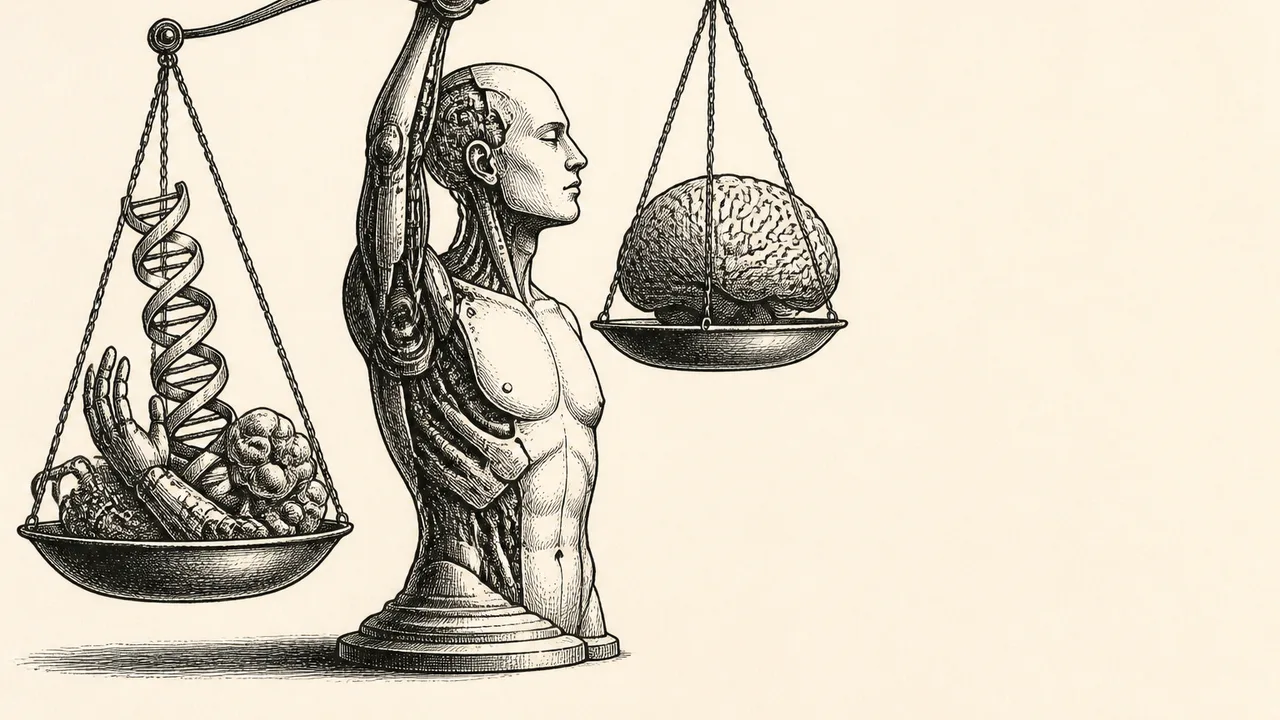
The current wave of biotechnology and cybernetic augmentation, neural interfaces, CRISPR-based modifications, performance-altering implants, forces the question into new territory. A 2025 paper in PNAS poses the sharpest version: could humans and AI fuse into a new evolutionary individual, one in which the boundary between organism and tool collapses entirely? The authors note that the pace of technological innovation is accelerating faster than the social and regulatory systems designed to absorb it. Selection pressure, they argue, could begin to act on cognitive and behavioral traits shaped partly by which augmentations a person can access. Evolutionary biology is applied to a situation we are already inside.
The parallel transhumanism debate tends to focus on the philosophical upside: longer lives, sharper minds, expanded capability. The PNAS framing is starker. If augmented humans and unaugmented humans begin to diverge in measurable cognitive or physical performance over generations, then "enhancement" stops being a consumer choice and starts being a hereditary condition. The children of the unaugmented inherit the deficit.
The Mill at Quarry Bank
Samuel Greg opened Quarry Bank Mill in Cheshire in 1784, and by any account of the early Industrial Revolution, he was considered a progressive employer. He built housing for his workers, established a Sunday school, and paid wages above the regional floor. He also housed child apprentices, some as young as seven, in a supervised dormitory and worked them in shifts. The children who arrived at Quarry Bank did not choose to go. The families who sent them were poor enough that the arrangement looked, from a certain angle, like an opportunity.
That dynamic, the asymmetry between what a technology offers its beneficiaries and what it costs those without access, is the central problem of every major wave of industrialization. The power loom did not oppress weavers by being cruel. It oppressed them by being cheap. The weavers who adapted quickly, who learned to operate the new machines, who lived near mill towns rather than in hand-loom villages, fared differently from those who did not. The machinery sorted people before they ever touched it.
Cognitive and physical enhancement technologies will sort people the same way. A neural interface that costs far more than most households earn in a year is not oppressive by design. It is oppressive by price. The family that cannot afford the upgrade does not fail a moral test; they fail an economic one that was written to look like a natural one. That is how meritocracy absorbs inequality: it renames structural disadvantage as individual shortfall.
Downgrading and the AI Variable
The Cambridge Quarterly of Healthcare Ethics raises a distinction that most popular AI discourse skips: whether AI tools are enhancing human cognition or degrading it. Drawing on the work of Tristan Harris and Aza Raskin, the journal asks whether we are risking a form of "human downgrading" by outsourcing cognitive tasks to systems that optimize for engagement rather than understanding. The philosopher Shannon Vallor's concern, cited in the same piece, is that modern technologies may be eroding the human capacities they claim to extend.
This is the part of the AI debate that gets buried under the superintelligence headlines. Superintelligent AI is a future problem, possibly a very large one. The "human downgrading" problem is present-tense and measurable: attention spans, navigation skills, memory for phone numbers, the slow erosion of capacities outsourced to devices. Cybernetic augmentation could accelerate that erosion or reverse it, depending entirely on how the tools are designed and who designs them.
The PNAS authors note the asymmetry between innovation speed and regulatory response. Social and legal systems that took decades to build adequate protections for industrial workers, and centuries to acknowledge what was done to Carrie Buck, are now being asked to regulate technologies that iterate on quarterly cycles. The gap between capability and governance is not a temporary oversight. It is a structural feature of how technological capitalism deploys new tools: first, then regulate, then compensate the harmed, usually incompletely.
The State and the Market
Eugenics in its twentieth-century form was a state project. The sterilization programs in the United States, Sweden, Canada, and Germany were administered by governments, authorized by courts, and dressed in the language of public health. The horror was bureaucratic: forms, procedures, institutional authority applied to the bodies of people classified as defective.
Market-driven enhancement looks structurally different. No court orders anyone to upgrade. No government classifies anyone as unfit. Instead, employers begin to prefer candidates with augmented processing speeds. Insurance actuaries build premium structures around unaugmented risk profiles. Universities calibrate admissions to performance metrics that enhanced applicants clear more easily. Nobody compels the unaugmented to fall behind. The system just stops making room for them.
The coercive mechanism shifts from the state to the price signal, and the price signal is harder to litigate. You can challenge a sterilization order in court. It is significantly harder to sue a hiring algorithm for weighting neural interface scores when the company argues it is simply selecting for demonstrated capability.
Leilani Muir, sterilized at age fourteen in Alberta in 1959 after being misclassified as mentally defective, won a wrongful sterilization case against the province of Alberta in 1996. The judgment took thirty-seven years to arrive and required that a state actor be identifiable and culpable. When the actor is a diffuse market preference, the injured party has no defendant.
Who Asks the Question
The policy conversation around enhancement technologies is dominated by bioethicists, technologists, and philosophers at well-funded institutions, most of them in countries wealthy enough to produce the enhancements in question. The voices of people in lower-income countries, of communities that have historically been the subjects rather than the beneficiaries of biological intervention, are present in the academic literature primarily as cautionary historical examples.
That is itself an argument about governance. If the people most likely to be harmed by unequal access to enhancement are not in the room where standards are set, the standards will reflect the interests of people who expect to afford the upgrade. The Industrial Revolution produced its own version of this problem. The Quarry Bank apprentice register is a meticulous document. The children whose labor built the mill are recorded by name, age, and parish of origin. Their opinions about the arrangement are not.
The PNAS paper frames the human-AI merger question in evolutionary terms: selection operating on a population partly sorted by access to augmentation. If that framing holds, then the policy question is not whether enhancement should be regulated. It is whether the regulation will arrive before the sorting does.
Carrie Buck's daughter made the honor roll. The science that said otherwise was wrong. We had the documents to prove it. We just filed them under the wrong category for fifty years.
More Like This
Anthropic's Model Hardware Standard Explained
Anthropic's Model Hardware Standard lets AI agents run real lab experiments. Here's what the pilots showed, what failed, and what's still unknown.

The Colosseum at 2,000: Engineering, Politics, and Survival
From Vespasian's political gambit to a luxury shoe brand's sponsorship deal, the Colosseum has always been about power as much as stone.

Venice Is Sinking and Emptying at the Same Time
Venice faces two accelerating crises: rising seas and a vanishing population. Neither MOSE nor a €5 tourist fee comes close to solving either one.

Colombia's Ituango Dam: Ambition Meets Disaster
Explore the failure of Colombia's Ituango Dam, a $4BN project that faced engineering, political, and socio-economic challenges.
AI Is Automating Racial Bias Into Hiring and Housing
AI systems are encoding racial bias into hiring, housing, and lending decisions. Here's what the research actually shows—and what workers are up against.
AI Math Breakthroughs and the Personhood Debate
OpenAI's Astra solves decade-old math problems, Jeff Dean exits Google, and thinkers debate whether AI deserves legal personhood. What it all means.
Savannah's Urban Grid: A Utopia Built on Slavery
Savannah, Georgia was designed as an egalitarian utopia in 1733. What it became reveals how idealism and slavery shaped one of America's most walkable cities.

Ten Engineering Projects That Remade the World
From the Panama Canal to the International Space Station, ten engineering feats that didn't just solve problems — they rewrote what was thought possible.