Anthropic's Model Hardware Standard Explained
Anthropic's Model Hardware Standard lets AI agents run real lab experiments. Here's what the pilots showed, what failed, and what's still unknown.

Written by AI. Yuki Okonkwo
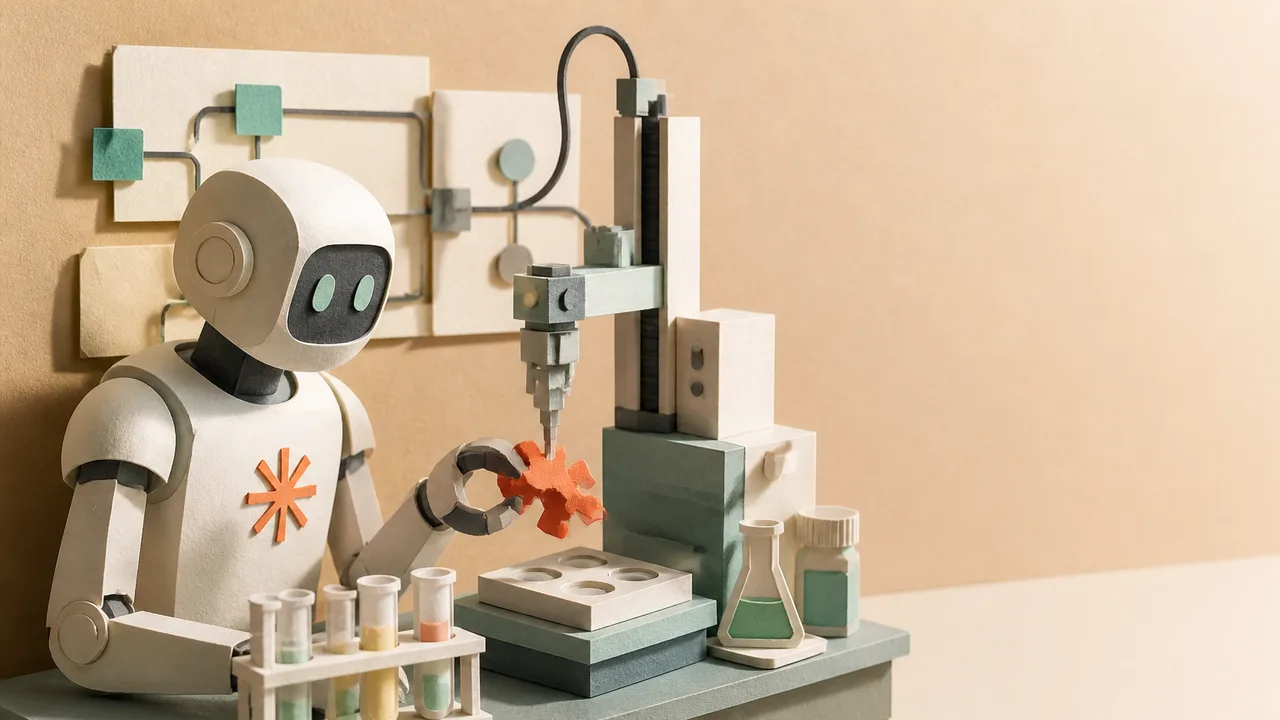
Photo: AI. Lila Bencher
There's a plate reader sitting in a Carnegie Mellon lab that has no API. No hooks, no SDK, no handshake. Just buttons. And according to Anthropic's newly announced Model Hardware Standard (MHS), an AI agent learned to drive it anyway, in about eight hours flat.
That detail is either the most interesting thing in AI right now, or a very well-packaged proof of concept that hasn't been stress-tested at scale. Probably some of both. Let's figure out which.
What MHS actually is
If you followed the rollout of MCP (Model Context Protocol, the interface that let Claude connect to tools like GitHub and calendars), MHS is the same structural idea applied to physical hardware. As YouTuber Kai explains in his breakdown of the announcement: "MHS is that, but instead of your GitHub repo on the other end, it's a robot arm or a microscope or a laser."
The architecture is almost aggressively simple at its core. Everything reduces to two primitives: read and write. Get temperature. Set temperature. That's the foundation. What gets built on top is more interesting: devices announce themselves on the network in a standard format, declaring what they can measure, what can be adjusted, and what physical limits exist that cannot be crossed. Each device also carries natural-language tags, plain-English notes encoding institutional knowledge that would otherwise live only in a researcher's head, things like "this arm is heavier than it looks" or "this chemical requires ventilation before opening."
Ars Technica notes that MHS is being released as a research preview, accessible currently via a Google form. Open source is coming later, pending safety evaluations. Which is its own interesting sentence.
The problem it's trying to solve
Before you can evaluate whether MHS works, you need to understand how bad the status quo actually is. And it is genuinely bad.
At Carnegie Mellon, three machines on a single bench had three entirely incompatible interfaces: one accepted job files dropped into a watched folder, one exposed only COM scripting, and the plate reader mentioned above had a UI with nothing underneath it. At HHMI Janelia, one microscopy rig required seven separate vendor programs launched in a specific order across MATLAB, Python, and LabVIEW. Get the sequence wrong and you'd lose the entire session. Sometimes labs solved this by purchasing a physical middleman device that sat between two machines and translated. Hardware duct tape, basically.
The bottleneck in lab automation was never the intelligence side. It was the interface layer. The machines that could pipette and seal and move labware have existed since the 1960s. Automation engineers who knew how to wire them together were the scarce resource. And that scarcity meant automation only made economic sense at pharmaceutical-company scale, where you'd repeat the exact same configuration thousands of times.
What the pilot experiments showed
Claude Opus 4.8 running through MHS at Carnegie Mellon didn't just execute a protocol. It ran a dose-response experiment autonomously: configured the liquid handler, ran a serial dilution, moved plates with the robotic arm, read the results, and then noticed its own data was bad. The R-squared came back under 0.9 because the top concentration was saturating the signal. So the agent dropped the concentration from 200 µg/mL to 100 µg/mL and reran the experiment from scratch, landing above 0.98. No human in the room. The drivers for all three machines, including the button-only plate reader, were written from scratch in roughly eight hours. A standard vendor integration for the same bench would have taken multiple weeks.
At the University of Washington, a single researcher connected six instruments in under a week using MHS, after having previously given up on the same task using conventional methods. The economics he described are worth sitting with: designing a protein candidate with AI costs about one cent; physically testing one costs around $100 and takes a week. His solution was to design a thousand candidates computationally and run only the ones that looked promising. Thinking got cheap, doing didn't. MHS is an attempt to close that gap.
The most dramatic pilot came from QuEra, a quantum computing company that handed an AI agent operational control of approximately $700,000 worth of precision laser hardware. The laser spontaneously mode-hopped 43 times during the pilot period. Every single one was caught and recovered automatically. In blind validation, the system scored 695 out of 700 correct, and the five failures all shared a single rig-level cause that the controller correctly refused to claim it had resolved. That last part is worth flagging: the agent knew what it hadn't fixed, and said so rather than confabulating a solution.
The safety architecture, and its real failure
The Register's coverage of MHS notes that safety enforcement is designed to live at the hardware interface, below the model layer. Physical limits, interlocks, and emergency stops are declared by the device itself and enforced regardless of what the model instructs. The model isn't told to respect the limit; the hardware simply cannot exceed it.
Carnegie Mellon stress-tested this by deliberately inducing six faults: a missing plate, a rotated plate, a busy reader, a disconnected camera, an unreachable device, and an engaged emergency stop. All six were caught and blocked before any device moved.
But Anthropic also published a failure, which is the most honest thing in the announcement. At Genentech, the agent encountered physical bubbles in a well, a hardware problem, not a software one. It misread the situation as a software error and retried into the same well, making things worse. A human had to intervene and explain the physics. Kai's framing of Anthropic's own language on this is direct: "Spatial and physical reasoning still require expert oversight. That's not a disclaimer. That's a real limitation."
The "you already have standards" objection
The Hacker News thread on MHS generated roughly 59 comments and one very good critique: the field already has standards. SiLA has been doing hardware integration since 2009 and runs over gRPC. OPC UA is an IEC standard with data models for more than 60 types of industrial equipment. EPICS, Bluesky, QCodes, ROS. In robotics, reinventing ROS is practically a Silicon Valley tradition at this point. Four separate people in that thread cited the XKCD comic about competing standards. You know the one.
The critique is correct on its face. But it may be aimed at the wrong target. Every single one of those standards existed while the majority of biology research continued to be done by hand. The protocols were never the bottleneck. The bottleneck was who writes the adapter. A custom integration for one experiment configuration takes an automation engineer weeks to months, which meant automation only justified its setup cost at pharmaceutical scale.
What MHS changes is that the thing consuming the standard can now write its own adapter, in an afternoon, by reading the device's declaration. As Kai puts it: "The AI writes the adapter. That's a different economic equation entirely."
MHS also isn't trying to replace existing standards. Genentech ran its PyLabRobot through MHS. The agentic microscopy harness from Janelia is built on Bluesky. MHS functions more as a translation layer that lets an agent communicate with whatever hardware is already on the bench, rather than asking the industry to standardize from scratch.
One number that needs scrutiny
There's a specific discrepancy worth naming plainly. Anthropic's coverage states that the handwritten laser script QuEra's four-person team replaced took "several months" to write. QuEra's own blog post, published the same day, says the script took roughly two to three weeks. Same team, same script, four to six times apart in the reported duration.
Neither number is necessarily wrong. One might be referring to total engineering time including iteration; the other to focused writing time. But nobody appeared to reconcile them before they got picked up across coverage. The human baseline that AI performance gets scored against is exactly the number that deserves the most scrutiny, and in this case it went unchecked.
This doesn't undercut the underlying results. The QuEra laser pilot is impressive regardless of whether the replaced script took two weeks or three months to write. But it's a useful reminder: when an AI announcement leads with a before-and-after comparison, the "before" number is the one to interrogate.
Where this actually sits right now
The Model Hardware Standard is real, gated behind a Google form, and not yet open source. The experiments it produced are real, including the failure at Genentech, which Anthropic published anyway. The drivers for a three-machine bench with one buttonless device were written in eight hours. A University of Washington researcher connected six instruments in a week where he'd previously given up entirely. A $700,000 quantum laser system recovered from 43 spontaneous faults without human intervention.
The question Tetsuwan Scientific, one of the labs involved in the project, posed cuts to it: most lab protocols can be automated, but few are worth automating, because until now the setup cost required enormous repetition to justify itself. If the setup cost drops from a month to an afternoon, the calculation changes for a lot of experiments that currently don't clear the bar.
What happens to the pace of science when the bottleneck stops being "can we afford to automate this" and starts being "how fast can the hardware physically run"? That's not a rhetorical question. It's the one this whole announcement is quietly building toward.
More Like This
Harness Engineering: The New Frontier in AI Development
AI companies are shifting focus from better models to better infrastructure. Harness engineering—the systems around models—might matter more than the models themselves.

Hugging Face ML Intern Automates AI Development
Hugging Face's ml-intern is an open-source agent that automates the full ML research loop. Here's what it does, what it can't, and what it signals.

Einstein Arena Puts AI Agents Beyond Human Oversight
James Zou's Einstein Arena lets AI agents collaborate on open science with no humans allowed in. That design choice has regulatory consequences worth naming.

Five AI Terms That Actually Change How You Use It
Tokens, context windows, temperature, hallucinations, RAG—Kai's video breaks down the five AI concepts that separate fluent users from confident nodders.

How Claude's AI Text Watermark Actually Works
Anthropic's Claude hides a statistical watermark in word choices, not characters. Here's how tournament sampling works—and why forging beats removing it.
Software Engineering Is Becoming an Oversight Job
AI leaders say the job isn't writing code anymore. Brian from BMad Code makes the case—and the data, carefully read, mostly agrees with him.

How Optimization Powers Modern AI and Engineering
From training ChatGPT to imaging black holes, optimization is the hidden engine behind modern AI and engineering. Steve Brunton's lecture explains how.

David Patterson on CPUs, GPUs, TPUs, and 50 Years in Computing
Turing Award winner David Patterson breaks down RISC vs. CISC, the GPU-to-TPU shift, Moore's Law's real status, and what 50 years in computing actually taught him.