AI Is Automating Racial Bias Into Hiring and Housing
AI systems are encoding racial bias into hiring, housing, and lending decisions. Here's what the research actually shows—and what workers are up against.

Written by AI. Vanessa Torres
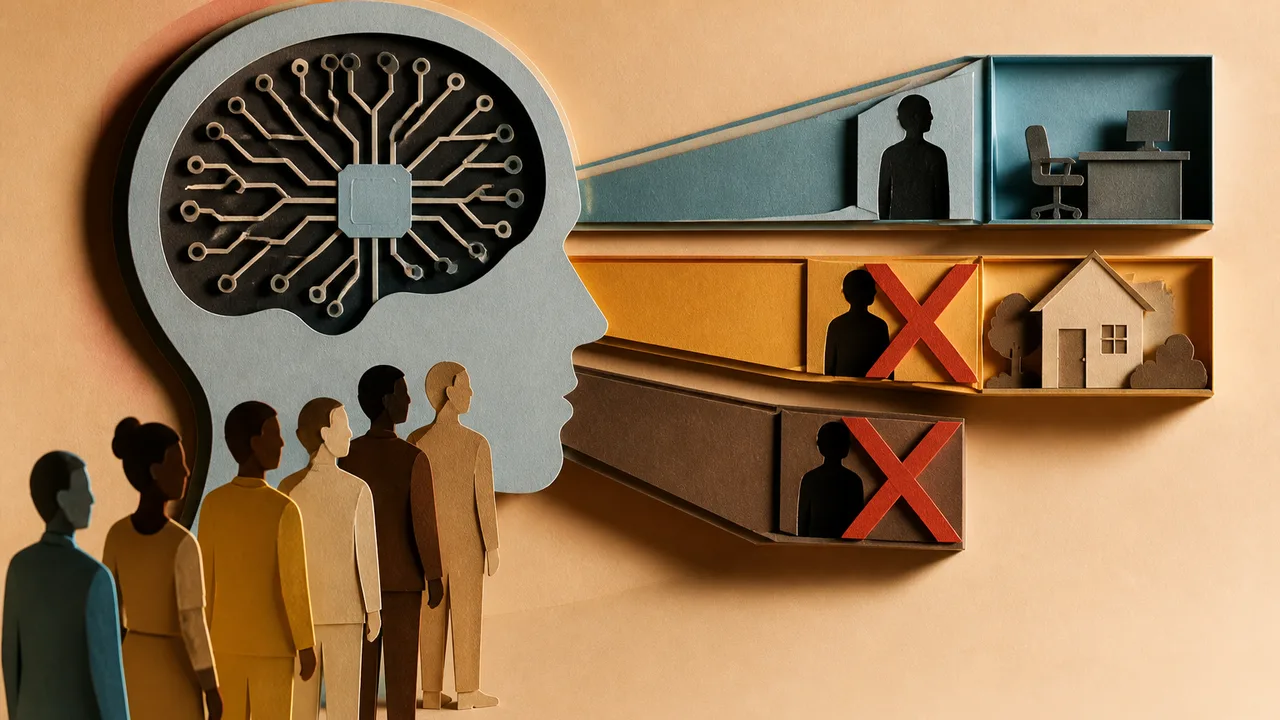
Picture this: You've done everything right. You went back to school, polished your resume, practiced your answers, swapped out the "ethnic-sounding" name on your application after reading one too many studies on callback rates. You optimized. And then an algorithm, trained on decades of biased hiring data, quietly sorted you into the no pile before a human ever blinked at your credentials.
This is not a hypothetical. This is the specific, grinding exhaustion that researchers have been documenting while the tech industry was busy calling AI a great equalizer.
Last year, a study published in Nature found that large language models generate covertly racist decisions about people based on dialect alone — meaning AI systems make different judgments about the same person depending on whether they write in African American Vernacular English versus standardized American English. The decisions weren't just subtly different. The models consistently assigned worse outcomes to AAVE speakers: lower-prestige jobs, harsher criminal sentencing recommendations, less access to resources. The bias was covert — the models didn't announce it. They just quietly delivered it, dressed up in the language of objectivity.
That word — covert — is doing a lot of work here, and it's the part that should make you sit down.
The Con We Were Already Running
Hustle culture told a generation of workers that meritocracy was real and that optimization was the path through it. Work harder. Network smarter. Personal brand yourself into something an ATS can read. The promise was always the same: if you do everything right, the system will recognize it.
AI didn't invent that lie. But it is industrializing it.
When a resume screener, a tenant scoring tool, or a loan underwriting model encodes historical bias — and those models are trained on historical data, which was generated by historically biased human decisions — it doesn't just repeat discrimination. It launders it. It converts the prejudice of the past into the clean, neutral-sounding output of an algorithm. And because it's a machine, it carries an implicit authority that a biased hiring manager sitting across a desk does not. You can push back on a person. Pushing back on a score is a different fight entirely.
Olga Akselrod of the ACLU put it plainly: AI "continues to perpetuate housing, tenant, hiring, and financial discrimination, further fueling the systemic racism issue we already have." That's not a critique of AI's potential. That's a description of what it's doing right now, in markets that were already stacked.
The UN's Office of the High Commissioner for Human Rights framed it with matching precision. Ashwini K.P., the UN Special Rapporteur on contemporary forms of racism, has warned that recent developments in generative AI "are allowing AI to perpetuate racial discrimination." Her framing — "bias from the past leads to bias in the future" — captures the mechanical truth of what's happening. These systems don't start from scratch. They start from us, from all our accumulated decisions and prejudices, and then they automate forward.
The Guardian put it as a computer science principle: garbage in, garbage out. That piece was published in 2017. It's now 2026. What's changed in those nine years is not the principle — it's the blast radius.
When the Design Tool Is the Problem
The discrimination showing up in high-stakes decisions like hiring or housing gets the most attention, reasonably. But a recent piece in Psychology Today traced the same pattern into something as mundane as a graphic design platform — specifically Canva. The argument isn't that Canva is uniquely bad. It's that AI-driven communication tools "have the capacity to perhaps unwittingly harness and amplify racist and sexist worldviews." When the AI autocompletes your marketing copy, suggests your imagery, or fills in your template, it's drawing on a well. What's in the well matters.
The "unwittingly" in that framing deserves scrutiny. At some point, if a tool has been flagged repeatedly for reproducing stereotypes, the "unwitting" defense starts to wear thin. These are not mysteries. The mechanism is well understood. The question companies are quietly making is not whether to fix it but how much fixing costs relative to how much accountability they currently face — and what the answer to that math tells you about their actual priorities.
The Disinformation Angle Is the Same Problem in Different Clothes
There's a separate but related front here that connects directly to how workers and job-seekers absorb information about the labor market itself. The Conversation has reported that "AI-generated racism does not spread because it is technologically convincing. It revives familiar narratives that audiences accept and circulate, even when they are exposed as false."
Read that again in the context of hiring. If AI-generated content is reinforcing stereotypes about which groups are "reliable" workers, "professional" communicators, or "culture fits" — and those narratives circulate through the same professional networks where hiring decisions get made — then the discrimination doesn't just live inside the algorithm. It lives in the ambient information environment that shapes how human decision-makers see candidates before the algorithm even runs. These systems are talking to each other. The bias compounds.
What Workers Are Actually Navigating
None of this is abstract if you've applied for an apartment in the last five years, submitted to an automated background check, or had a phone interview with an AI screener that you knew — but couldn't prove — was ranking your voice. The machinery is largely invisible. The outcomes are not.
There is genuine effort happening inside some corners of the industry. Researchers are publishing. Ethicists are raising flags. Regulatory attention, slow as it moves, is starting to apply pressure in the EU and in scattered U.S. jurisdictions. That's real, and pretending it isn't would be its own distortion.
But the structural problem is this: diverse oversight and ethical review slow deployment, and the competitive pressure in AI development does not reward slowing down. Companies that built the most equitable models do not, by default, win the market. The market rewards speed and capability, and bias audits are a cost, not a feature.
So workers are left navigating a system where the discrimination they've always faced has been encoded into tools that wear the costume of objectivity. Where you can't argue with the algorithm the way you might argue with a biased interviewer. Where the output says not a fit and offers nothing more.
The workers who've been doing everything right for thirty years — the ones who learned the game and played it — deserve to know that the game has a new dealer now, and the deck was stacked before the shuffle.
That's not a reason to stop playing. It's a reason to stop pretending the shuffle was ever fair.
More Like This
Microplastics: The Unseen Invaders in Our Lives
Explore the hidden world of microplastics in our daily lives and what you can do to minimize exposure.

Are Your Goals Arbitrary? Ali Abdaal Thinks So
Ali Abdaal's God of War moment raises a real question: what if treating work like a video game—arbitrary, playful—is actually the smarter approach?

Jeremy Qualls on Leadership: Lessons from Fire and Post-its
Jeremy Qualls shares leadership lessons from personal adversity, emphasizing empowerment and resilience.
The 60-Second Resume Hack: Using Claude AI to Apply Faster
Stockholm tech consultant shows how Claude AI rewrites resumes in 60 seconds. The workflow is brilliant. The implications? Worth examining.

AI Is Reshaping Silicon Valley Jobs and Finances
A new report finds AI-driven layoffs are eroding the financial security of Silicon Valley tech workers — a shift that's faster and broader than past tech disruptions.

AI Is Making Good Enough the Enemy of Great
Matt Beane warns that AI's flood of B+ output is quietly eroding human skill. Here's what organizations must do before the bill comes due.

Freelance Consulting vs. Employment: How the Money Works
Freelance consultants earn significantly more than employees—but not for the reason most people think. Here's how the money actually moves, and what it costs you.

How to Apply for Jobs Strategically in Cybersecurity
TCM Security's free course breaks down the job application process for cybersecurity roles—from job boards and Google Alerts to OSINT worksheets and cover letters.