AI Is Making Good Enough the Enemy of Great
Matt Beane warns that AI's flood of B+ output is quietly eroding human skill. Here's what organizations must do before the bill comes due.

Written by AI. Bob Reynolds
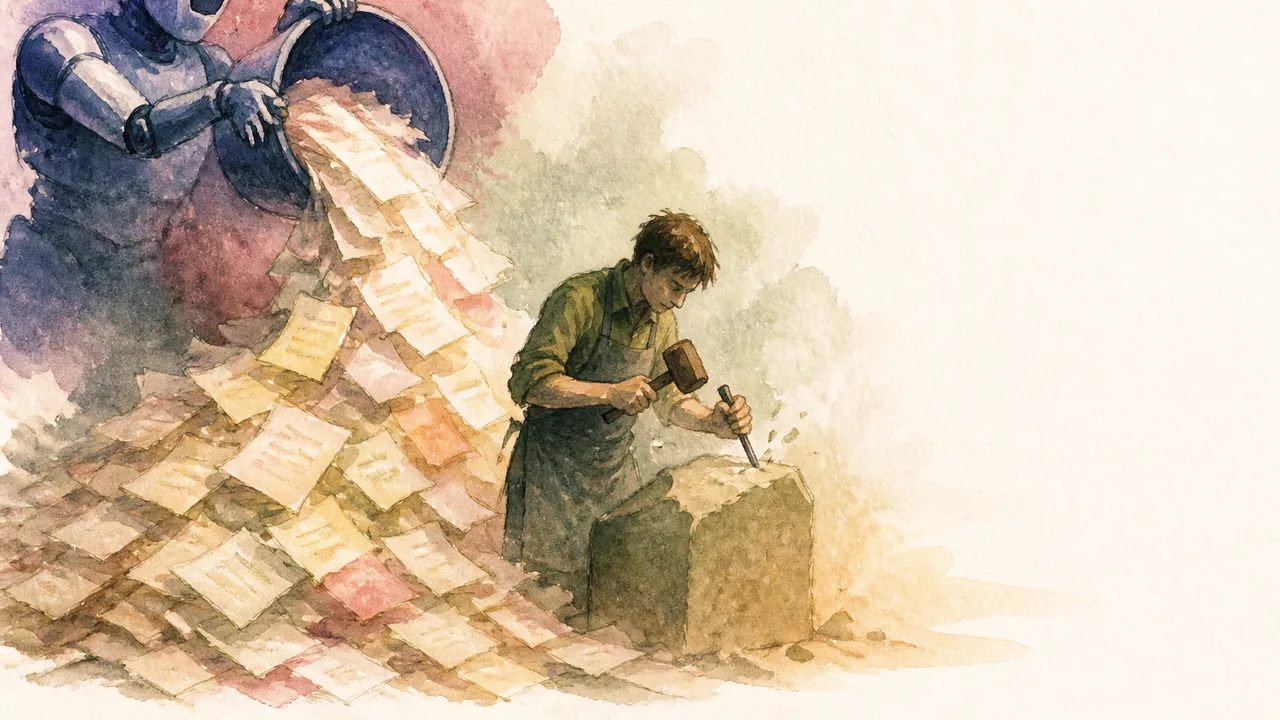
Photo: AI. Júlia Almeida
There's a productivity trap hiding inside every AI deployment, and it doesn't announce itself. It looks like efficiency. It feels like momentum. And it only becomes visible years later, when the people who made the original call have moved on and someone else is left wondering why nobody on the team can do the hard thing anymore.
Matt Beane, an associate professor of technology management at UC Santa Barbara and author of The Skill Code, has a name for what's happening. He calls it the B+ trap, and his argument is worth sitting with: AI is extraordinarily good at producing work that is almost excellent. Not brilliant. Not wrong. Just... good enough that you'll ship it. And if you ship enough of it, you'll stop being able to tell the difference.
"All AI can do most of the time is create B+ content," Beane says in a recent talk for EO. "It will give you lots of free B+ content and you will forget what an A+ looks like."
That's the trap. It's not that AI produces bad work — it's that it produces work that passes without triggering your internal alarm. The problem compounds: once you stop exercising the judgment that recognizes the gap between good and great, you lose the ability to close that gap yourself.
I've watched a version of this before. When companies offshored whole functions in the 2000s, the immediate math looked clean — lower costs, same output. What they didn't model was what happened a decade later, when they needed to rebuild institutional knowledge that had quietly walked out the door. The deskilling shock that Anthropic has been documenting in AI-enabled workplaces rhymes with that pattern almost exactly.
The Token-Burning Problem
Beane takes particular aim at a metric that has become fashionable in engineering circles. He recounts, in the talk, how Nvidia's Jensen Huang has reportedly argued that a highly-paid engineer should be burning a proportionate volume of AI tokens to justify the salary — the idea being that heavy AI usage signals productivity. Beane quotes Huang to make his point, then dismantles it: "You can burn many, many tokens very inefficiently. It's like saying, 'I burned a lot of calories today.' But did you just run in circles?"
Volume of AI output is not a proxy for quality of thinking. An engineer who generates ten thousand lines of B+ code has not done ten thousand lines of good engineering. They've done a lot of accepting. That distinction matters enormously when knowledge work quality — not just output — is what organizations are actually competing on.
Beane's prescription for leaders is blunt: reward the people who kill bad ideas, not just the ones who ship things. A team that stops three mediocre initiatives to pursue one excellent one is more valuable than a team that ships constantly. "A wise leader in an organization will reward people with cash or promotion or visible recognition for stopping a B+ idea from making it forward," he says. That requires building a culture where restraint is legible as skill — which cuts against almost every incentive structure currently in use.
What the Rule-Breakers Knew
The most interesting part of Beane's argument comes from his research on what he calls "shadow learning" — people who built skill through means their organizations hadn't sanctioned. His original work examined surgical residents who, faced with a senior surgeon who now handled cases more independently using robotic tools, found themselves frozen out of the learning they needed. The technology made the expert more capable and more self-sufficient, which meant the novice had less room to participate, make mistakes, and grow.
Most residents ground it out the conventional way and learned slowly. A small number went sideways — watching recorded surgery footage at a volume far beyond any peer, finding ways to get hands-on experience that wasn't strictly approved. They weren't reckless; they were desperate. The formal learning channel had narrowed to near-nothing, and they built workarounds.
Beane says in the talk that he's found this same pattern across what he describes as more than 35 occupations — a figure he offers from his own research, and which he says has held consistently. The shadow learners aren't a model to copy. But they're a diagnostic. They reveal what people will fight for when organizations stop providing it.
What were they fighting for? Beane distills it to three things: challenge, complexity, and connection.
Three Things Worth Protecting
Challenge is the one that sounds obvious until you realize how systematically AI undermines it. Learning requires operating near the edge of your capability — not overwhelmed, but strained. You need to fail in small ways, feel the friction, and push through it. AI removes the friction. Hand a difficult draft to a language model and you skip the productive struggle that would have made you better at drafting. The output exists; the learning doesn't.
Complexity is the one I think organizations are most likely to let slip, because it doesn't show up on any dashboard. Beane's point is that a surgeon who only ever practices sutures — and never pays attention to the nurse, the supply chain, the hospital's finances, the IT system — is a less capable surgeon than one who has absorbed the whole environment. When something goes wrong in an unexpected way, the narrow practitioner is lost. The person who was curious about the whole system can improvise.
He offers a warehouse example that I find clarifying. Two warehouses, same pay, same job titles. In one, workers stay on their section of the line. In the other, they rotate every few days to different parts of the operation. The second warehouse is more resilient — not because managers were trying to develop their people, but because they needed a workforce that could handle surprise. They stumbled into good learning conditions by chasing operational flexibility.
Connection is the three C's member that gets the least airtime in most AI-and-work conversations, and Beane is right to insist on it. The bond between a senior and junior person is not just mentorship — it's a motivational structure. You work harder when someone whose judgment you respect is watching, when you want to earn their trust, when the relationship itself gives you a reason to improve. AI doesn't replicate that. It doesn't care whether you get better.
Of the three, connection strikes me as the easiest to protect if leaders actually tried — it costs nothing structurally, and most organizations already understand its value in principle. The problem is that cutting junior hires, which is the trend Beane flags as alarmingly common right now, eliminates exactly the relationships that make connection work.
The Junior Hire Problem
Organizations across the economy, Beane observes, have been pulling back on entry-level hiring and doubling down on senior talent — the logic being that experienced people get more from AI tools. He calls this short-sighted, and the two-class dynamic this creates is already visible in how knowledge work is splitting between those who direct AI and those who are directed by it.
His counter-proposal is "inverted apprenticeship" — structured learning that runs in both directions. The junior hire, who grew up native to these tools, teaches the senior person how to use AI fluidly. The senior person teaches the junior what good actually looks like and why the B+ output isn't quite there. Neither learns alone. Both come out better.
Leaders, Beane argues, need to model this openly — including the failures. The most effective executives he observes right now are the ones using AI in public, showing what they tried, showing what didn't work, and being honest that nobody has this figured out yet. "No one knows how to use this technology now," he says simply. That honesty, modeled at the top, gives everyone else permission to learn instead of just pretend.
Beane leaves his audience with a longer horizon than most people are comfortable holding. He says in the talk that we should be genuinely open to the possibility that AI becomes better than humans at everything — including judgment, empathy, and creativity — and that our institutions may not adapt fast enough to handle that transition gracefully. He frames this not as prophecy but as a planning assumption worth taking seriously.
Whether you find that bracing or implausible probably depends on how many technology transitions you've actually lived through. What I'll say is this: the organizations that will be most exposed aren't the ones that adopted AI too slowly. They're the ones that adopted it without thinking about what they were trading away. Good enough is a dangerous place to stop.
More Like This

AI as a Life OS: Promise and Privacy Stakes
Daniel Miessler argues AI tools should manage your entire life, not just your code. The idea is compelling — and the privacy questions are serious.
Claude Fable 5 Access Is Changing: How to Use It Now
Claude Fable 5's subscription access is ending soon. SEO consultant Julian Goldie outlines how to make the most of it before the window closes.
How AI-Native Companies Ship Faster Than Everyone Else
Nate B Jones argues the speed gap between AI-native teams and everyone else isn't about better models—it's about what they've moved into code.
AI Tools: Colleague or CNC Machine?
Explore AI's dual role as a colleague or tool and its impact on work.

Building a Personal Agent OS: One Dashboard for AI
Julian Goldie's custom Agent OS centralizes AI agents, shared memory, and autonomous loops. A look at what it does, how it works, and what it can't yet promise.

Why Senior Engineers Struggle Most With AI Agents
Philipp Schmid breaks down 5 mental model shifts that trip up experienced engineers when building AI agents — and why expertise can be the actual problem.
Claude Code Developer: AI Has a Capability Overhang Problem
Anthropic's Thariq Shihipar argues we're systematically underusing AI tools—not because models are weak, but because users don't know what to ask for.

How AI Is Actually Tested for Human-Level Intelligence
ARC AGI 3 tasks AI with figuring out video games from scratch — and current models can barely start them. Here's what that reveals about the gap between AI and human reasoning.