How Sorcery Became Heresy in Medieval Europe
Dr. Justin Sledge traces how Pope John XXII transformed magic from sin to heresy in the 1320s—and why that shift still echoes in modern moral panics.

Written by AI. Sofia Ramirez
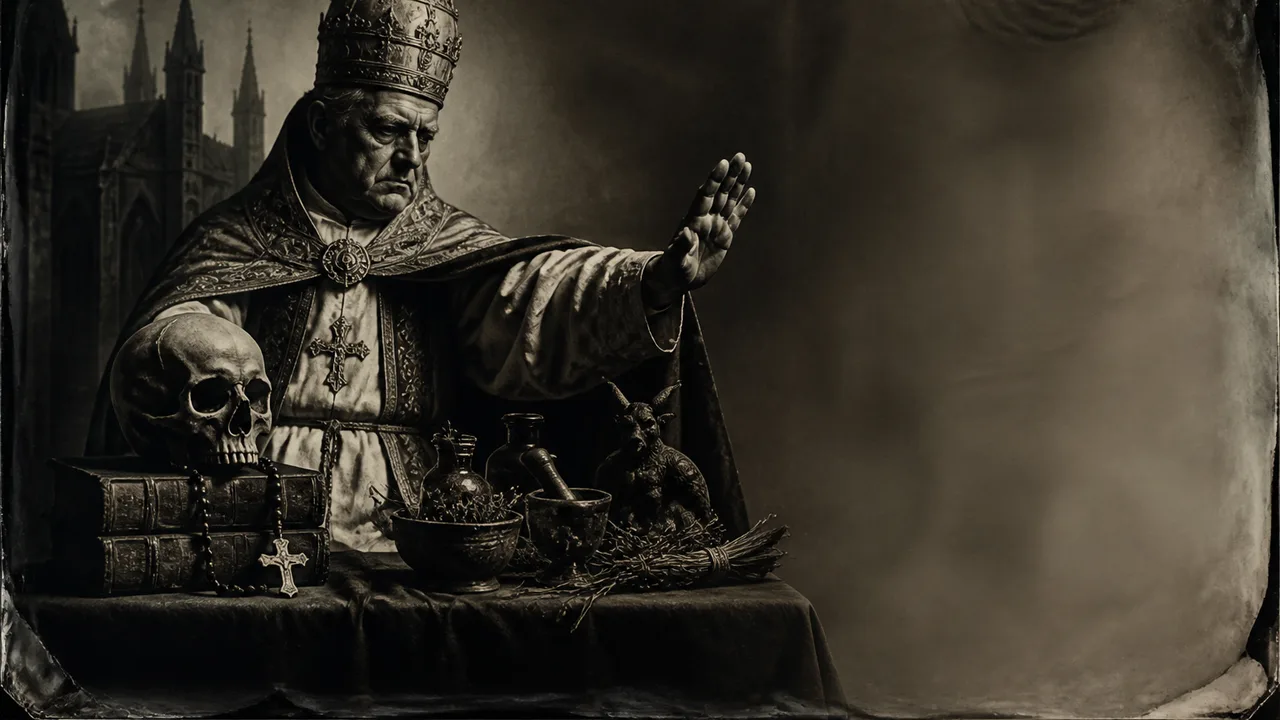
Photo: AI. Otieno Okello
Galeazzo Visconti wanted the pope dead. His alleged plan, according to Dr. Justin Sledge's recent deep-dive for the ESOTERICA channel, involved aconite—wolfsbane, a poison with a long and ugly history—combined with image magic. The image in question was meant to represent Pope John XXII himself. And if that wasn't baroque enough, the plot reportedly sought to rope in Dante Alighieri as a co-conspirator, tasked with charming the wax effigy.
Dante. The poet. Charming a murder puppet.
It sounds like the setup for a historical thriller, and it was, in a way. But Sledge's 42-minute video isn't interested in the lurid details for their own sake. It uses this moment—one of several alleged sorcery-assassination plots against John XXII between 1317 and 1320—as the entry point into a much larger, slower, stranger story: how did magic go from being a sin to being a heresy? And what did that reclassification actually cost people?
The Inquisition Had a Budget Problem
To understand why a pope's paranoia mattered so much, you have to understand the institution he was working through. The medieval Inquisition, founded in 1234 by Gregory IX in the aftermath of the Albigensian Crusade, was not the limitless terror machine popular imagination gives us. Sledge is careful about this. It had a geographic jurisdiction—primarily southern France and northern Italy. It had a narrow mandate: heresy, and heresy only. It couldn't come after you for ordinary sin. That remained the job of local clergy.
It also had a money problem.
The Inquisition's funding depended heavily on confiscating the property of convicted heretics. Early on, this worked well enough—the Cathar lords of southern France had land, and the crusade had loosened their grip on it. But the Cathars, the Waldensians, the Apostolic Brethren, the spiritual Franciscans—the groups the Inquisition most aggressively pursued—shared a commitment to radical apostolic poverty. They genuinely owned almost nothing. Sledge notes, with audible disbelief, that inquisitors complained in writing about how poor the heretics had become, and "pined for the good old days of the rich heretics."
This is the material condition underneath the theological argument. By the late 13th century, inquisitors were writing to Rome asking whether their jurisdiction could expand to cover sorcery and divination—particularly the diabolical kind. A new revenue stream, dressed in the language of spiritual crisis.
The Ambiguous Decree of 1258
Pope Alexander IV's 1258 decree on the question is the kind of document that keeps legal historians employed for centuries. It stated that inquisitors "ought not intervene in the cases of divination or sorcery unless they clearly savor of manifest heresy."
Sledge calls this correctly: the decree cuts in two directions at once. On one reading, it limits the Inquisition—stay in your lane, heresy only. On another, it creates a "probable cause" mechanism: if sorcery smells sufficiently heretical, you can investigate it. The ambiguity wasn't accidental. A 1300 gloss by Johannes Andreae tried to define "clearly savor," landing on examples like praying at the altars of idols, sacrificing to demons, or using the consecrated host in ritual contexts. The interpretive door was open, just barely.
What was behind that door was a boom. Sledge points out that the mid-13th to mid-14th century was something of a golden age for magical literature—the Ars Notoria, the Picatrix (circulating with what amounted to royal Spanish patronage under Alfonso X), the Solomonic grimoire tradition, the Sworn Book of Honorius, early Kabbalistic texts from Spain and France, and a surge in alchemical and astrological study. Magic wasn't underground. It was thriving.
And crucially, the people most capable of engaging with that literature—literate, Latin-trained, with access to manuscripts—were clergy.
1320: The Surgical Strike
By the time John XXII had survived multiple alleged assassination attempts and arrived at 1320, he was done being cautious. In August of that year, the cardinal Sledge identifies as William of Santa Sabina issued a letter to the inquisitors of Carcassonne and Toulouse—the heart of the former Cathar territories, where, as historians have documented, the Cathar suppression had been most intense. The letter authorized inquisitors to proceed against those who sacrificed to demons, made demonic pacts, misused the sacraments, or created wax images bound to demonic forces—using, critically, the same procedures reserved for heretics.
The letter is worth reading closely, because Sledge does, and his reading is precise: this is not yet an equation of sorcery with heresy. It's an expansion of probable cause. You could theoretically perform the acts described and still not be convicted of heresy. The decree was also geographically specific—Carcassonne and Toulouse, not everywhere—and explicitly grounded in existing canon law precedent, not new invention.
The theological logic, though, was doing serious work. The concern wasn't magic as such. It was the reverence magic implied. To receive power from a demon, scholastic thinkers like Thomas Aquinas had argued, some kind of pact must be involved—because why else would a demon give you anything? Demons are evil, not stupid. And a pact with a demon was a covenant. The church understood itself as a covenant community. A rival covenant—even a tacit one—was not just sin. It was a structural rejection of Christianity itself. As Sledge puts it: "This isn't just sin. It's revolutionary Satanism."
Johannes Partamakio's Defense
Here's where the story gets genuinely interesting, and where Sledge's historical instincts are sharpest.
Around the same time Bernard Gui was completing his inquisitor's handbook—which, Sledge notes, barely mentions sorcery and doesn't use the word "heresy" in that chapter at all—a jurist at Avignon was defending a man named Johannes Partamakio against exactly these charges. Partamakio was accused of misusing the consecrated host, creating wax images, consorting with demons, and concocting potions, apparently in the service of erotic binding magic.
His defender's argument: this is superstition, not heresy. Augustine's category. Yes, invoking a demon is wicked. But Partamakio did so to seduce a woman to lust—which is precisely what demons do anyway, so no theological novelty there. He was deranged by lovesickness, effectively diminished in capacity. The investigators had been overzealous, the testimony was contradictory, and the evidential bar for a heresy conviction—which carried the penalty of being burned alive—should be proportionally high.
The appeal court agreed. Partamakio was absolved.
Sledge reads this case as evidence that in the early 1320s, the Inquisition was still listening to rational arguments. The line between superstition and heresy was contested, and it could be argued. Courts could be moved. This matters, because it means what came later wasn't inevitable—it was a choice, or a series of choices, compounded over time.
1326, and Then the Reversal
John XXII's 1326 decree Super illius specula was the sharpest move yet. Anyone who learned, taught, or practiced the forms of sorcery it enumerated was ipso facto excommunicated—automatically, upon the act itself. For the first time, sorcery was formally linked to heresy through an automatic ecclesiastical mechanism. Sledge's characterization is blunt: "Just learning about magic makes you excommunicated and effectively makes the accusation of sorcery one for which you are guilty and must prove your own innocence."
And then, four years later, John XXII pulled back.
In November 1330, he ordered all major inquisitorial centers to send their findings back to Avignon and cease further sorcery-related investigations. The church, famously not an institution given to retracting decrees, retracted. Sledge admits he doesn't have a clean explanation for this, and he's honest about the gap in the scholarly literature—the 1330 order doesn't even appear in the major English-language primary source collections on witchcraft, though it's in the 1901 German edition.
His speculation is worth sitting with: when John XXII opened the door on sorcery prosecutions, the inquisitors may have discovered that the people best positioned to practice learned magic were clergy. Literate, Latin-trained, with access to manuscripts and ritual knowledge—priests and bishops had made up a significant portion of sorcery accusations before this point for exactly that reason. Pursue sorcerers aggressively and you pursue your own institution. The bureaucratic nightmare of investigating and adjudicating vow-of-poverty clergy for heresy, producing no confiscatable wealth and enormous institutional embarrassment, may simply have been too much.
The door opened in 1320. It swung shut in 1330. Sledge calls it the 14th-century equivalent of shutting down the X-Files.
The Longer Thread
The détente didn't hold forever. Nicholas Eymerich—a Catalan inquisitor so zealous he was repeatedly exiled and at one point sentenced to drowning for his excesses—eventually composed the Directorium Inquisitorum, a text in which Sledge argues the sorcery-heresy link hardened into something close to doctrine. From there, through Johannes Nider's Formicarius in the 1430s (where witchcraft began to be feminized as a specifically women-led heresy) to the Malleus Maleficarum of 1486-87, the line from John XXII's assassination anxieties to the early modern witch trials is traceable, if never quite straight.
What makes Sledge's account worth attention is precisely that nonlinearity. Edicts issued, then rescinded. Cases argued and won. Jurisdictions expanded, then contracted. The transformation of sorcery into heresy wasn't a plan. It was an accumulation—of institutional financial pressure, of theological logic developed incrementally by scholastic thinkers, of one paranoid pope's genuine fear that someone was going to kill him with a wax doll.
Popular culture still links magic with Satanism and heresy with the dark arts. That linkage has a paper trail, and it runs through a series of 14th-century bureaucratic disputes about jurisdiction, funding, and what exactly it means for something to savor of manifest heresy.
The question Sledge leaves open—the one that doesn't resolve—is what we do with that knowledge. History as a tool for understanding isn't the same as history as absolution. The satanic panic of the 1980s and 90s wasn't a medieval holdover. It was a choice made by people who had other options.
More Like This
Douglas MacArthur and the People He Left Behind
MacArthur is remembered as a military legend. But what about the veterans he gassed, the soldiers he abandoned, and the Japanese citizens who built a new democracy?
Middle Platonism's Hidden Role in Western Esotericism
ESOTERICA's new crowdfunded seminar argues Middle Platonism built the foundations of Hermeticism, Gnosticism, and early Christian theology. Here's what that means.
The Divine Feminine's Long Return in Western Religion
From Tiamat to the Shekhinah to the Virgin Mary, Dr. Justin Sledge traces the suppressed and resurgent divine feminine across millennia of Western religious history.
What a Victorian Ghost Says About the Afterlife
In a 1963 Leslie Flint séance, a voice claiming to be Elizabeth Fry described the afterlife as a thought-built world. Here's what that cosmology actually says.
Attila the Hun: Scourge of God or Economic Strategist?
Attila never sacked Rome—yet he's history's ultimate barbarian. The real story is stranger, and more familiar, than the legend.
Colonel John Alexander's Life at the Edge of Official Reality
Colonel John Alexander commanded Green Berets, ran Pentagon psychic programs, and investigated UFOs. His 3-hour Why Files interview maps a career lived at the edge of official reality.
California's Hidden Underground: Caves, Tunnels, and Buried History
From a buried Gold Rush city to survival tunnels built by Chinese immigrants, California's underground holds layers of geology, history, and forgotten infrastructure.

Neil Armstrong: The Reluctant Hero of Apollo 11
Neil Armstrong flew 78 combat missions, survived two near-fatal crashes, and walked on the moon—then spent the rest of his life insisting it was all just luck.