How the Second Law of Thermodynamics Was Discovered
From flooded coal mines to Rudolf Clausius's entropy, the Second Law of Thermodynamics emerged from a century of desperate engineering and brilliant theory.

Written by AI. Margaret "Maggie" Holloway
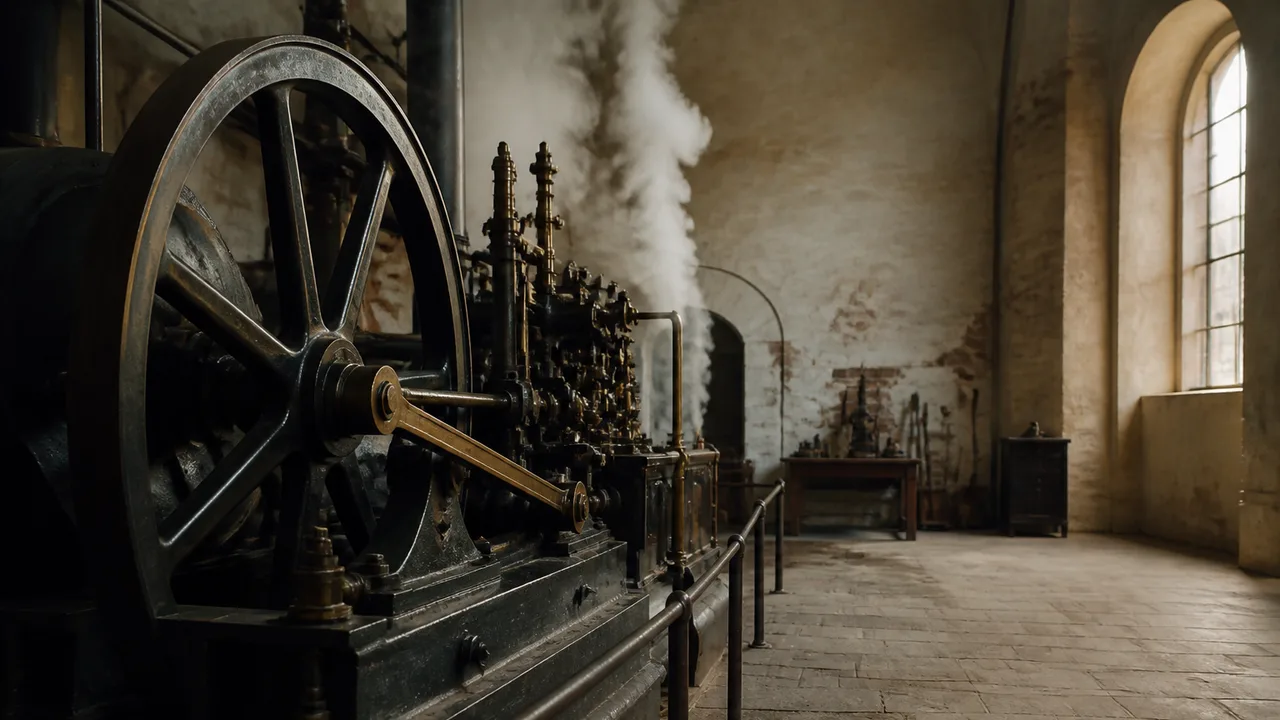
Photo: AI. Marcel Dubois
Somewhere in early eighteenth-century Britain, a mine foreman is watching water rise. It doesn't matter which mine — there were hundreds of them, gouged into the English and Welsh countryside to feed a population that was growing faster than the industry could manage. The water was always the problem. Go deep enough to find the rich seams, and you hit the water table. The coal sat there, unreachable, while the water rose.
That is where the Second Law of Thermodynamics begins. Not in a university laboratory. Not with a philosopher wondering about the nature of heat. It begins with a flooding hole in the ground and an industry that desperately needed a pump.
This is the argument at the center of a recent Abide By Reason video tracing the discovery of the Second Law — and it's a genuinely clarifying one. For most of the physics laws we learn about, the sequence runs from theory to application: someone figures out how the universe works, and engineers eventually build something from it. Thermodynamics ran the other way. The machines came first. The theory came later, built by people trying to understand why the machines worked at all.
The Engine That Started It
According to the World History Encyclopedia's account of coal mining in the British Industrial Revolution, Britain was producing roughly 80 percent of Europe's coal around 1700 — a dominance built partly on geography and partly on the relentless pressure of demand. Coal was fuel, heat, industrial feedstock. And the deeper the mines went, the worse the flooding problem became.
Thomas Newcomen, a Baptist preacher and ironmonger from Devon, solved it. His atmospheric steam engine, developed in the early 1700s, was not elegant. It worked by boiling water to produce steam, pushing a piston up inside a cylinder, then spraying cold water into the same cylinder to condense the steam and create a vacuum. Atmospheric pressure did the rest, pushing the piston back down and driving a pump. The cycle repeated. The mine drained.
It was also, by the measure of the Engines of Our Ingenuity, catastrophically wasteful — consuming less than one percent of the energy its coal produced. The reason lay in the design itself: every cycle, the cylinder had to be cooled to condense the steam, and then reheated to run the next stroke. All that energy spent heating metal, over and over, just to cool it down again immediately.
James Watt saw the problem clearly in 1765. His fix was conceptually simple and mechanically brilliant: add a second, separate cylinder to serve as the condenser. Steam could be vented out of the main cylinder — kept permanently hot — into this separate chamber, where it condensed away from the piston. The working cylinder never had to cool down. According to the Engines of Our Ingenuity, Watt's redesign produced an engine roughly fifteen times more efficient than Newcomen's, though still only about five percent efficient in absolute terms. By the numbers The Guardian has reported from the period's production records, Britain was pulling more than thirty million tons of coal a year out of the ground by 1830, compared to roughly three million at the century's start.
The machines were extraordinary. But no one, quite yet, understood why they worked — or how efficient they could theoretically become.
The Soldier Who Studied Heat
Sadi Carnot was born in 1796 into a family that moved in the highest orbits of French intellectual and military life. His father, Lazare, was a mathematician and one of Napoleon's most capable generals. Sadi entered the École Polytechnique at sixteen — a school whose early faculty included Lagrange, Laplace, and Fourier, and where Carnot himself received instruction from Ampère, Coriolis, and Poisson. He then pursued a military career, as his father had. But after Napoleon's abdication in 1814, he stepped back from that path. France, he concluded, needed him more as an engineer-scientist than as an officer.
The thinking was strategic as much as intellectual. Britain's industrial lead was visibly built on its steam engines, and Carnot believed France's future depended on understanding what Britain had figured out empirically. His answer to that problem was his only published book — Reflections on the Motive Power of Fire, 118 pages, published in 1824.
Carnot is worth quoting directly here, via the Abide By Reason video, because his framing is striking in its confidence: "Notwithstanding the work of all kinds done by steam engines, their theory is very little understood and the attempts to improve them are still directed almost by chance. It is necessary to establish principles applicable not only to steam engines but to any imaginable heat engines."
Any imaginable heat engine. That is the leap. Not "how do we improve Watt's design," but "what are the universal rules governing every machine that converts heat into work?"
Carnot's answer, in his Reflections, was an idealized engine — now called the Carnot cycle — in which a gas expands and contracts in contact with alternating hot and cold bodies, doing work in the process. The key insight: efficiency depended entirely on the temperature difference between the hot source and the cold sink. A larger gap meant a more efficient engine. A hundred-percent-efficient engine would require either an infinitely hot source or a cold sink at absolute zero — neither of which exists. The ceiling is real, and it's built into the nature of heat itself.
Reflections was largely ignored when it appeared. The book found its most consequential reader not immediately but through a relay: Émile Clapeyron, a French engineer, restated Carnot's results in 1834 in more rigorous mathematical form and added the first graphical representation of the Carnot cycle. That paper was translated into German in 1843. And through that translation, it reached Rudolf Clausius.
What Carnot Got Wrong, and Why It Mattered
Clausius was born in 1822 in Pomerania, studied mathematics and physics in Berlin, and in 1850 wrote his own analysis of heat — one that put him in direct, productive disagreement with Carnot.
The disagreement was fundamental. Carnot had believed heat was a conserved fluid — the so-called "caloric" — that flowed from hot bodies to cold ones without being created or destroyed, rather like water moving downhill. But Clausius wasn't convinced. Friction could generate heat where there had been none; that was hard to square with a conservation principle for heat specifically. And the emerging view that heat was actually the motion of tiny particles made it much easier to imagine heat being converted into mechanical work — and vice versa.
From this, Clausius formulated what we now call the first law of thermodynamics: heat is not conserved, but energy is. Heat and work are interconvertible. The currency is energy, not heat.
That settled one question and immediately raised another. If heat and work were interconvertible, what was Carnot's observation actually capturing? Why did heat always flow from hot to cold? What did that directionality mean?
Clausius returned to this in 1854, working through Clapeyron's graphical representation of Carnot's reversible engine. The reversibility was the key. Run the engine forward: heat flows from hot body to cold, and work is produced. Run it backward: supply work, and heat moves from cold to hot. Clausius found a mathematical quantity that remained constant through the entire reversible cycle — and could only increase when the process was irreversible. He called this the "theorem of the equivalence of transformations."
By 1865, that quantity had a name: entropy. And Clausius had arrived at his most complete statement of thermodynamics, condensed into two sentences that remain among the most consequential ever written in physics: "The energy of the universe is constant. The entropy of the universe tends to a maximum."
What the Machinery Revealed
What strikes me about this history — and what the Abide By Reason video articulates well — is how completely the direction of discovery inverts our usual assumptions. We tend to think of physics as preceding engineering, theory preceding practice. Thermodynamics is the counter-case. The miners needed a pump. Newcomen built one. Watt improved it. Carnot asked why it worked. Clausius corrected Carnot and found, embedded in the correction, one of the deepest laws in nature.
The flooding mine did not inspire the Second Law in any poetic or metaphorical sense. It caused it. The law was hiding in the machinery all along, waiting for someone to ask the right question.
That question — why does heat only ever flow one way? — turns out to govern everything from the behavior of gases to the arrow of time itself. Which makes the image of a Devon ironmonger tinkering with boilers and pistons rather more consequential than it might first appear.
More Like This

Why Physics Has No Preferred Direction of Time
Physics equations work equally well forwards or backwards in time. So why does time feel so irreversibly one-directional? The answer is stranger than you'd expect.

Venice Is Sinking and Emptying at the Same Time
Venice faces two accelerating crises: rising seas and a vanishing population. Neither MOSE nor a €5 tourist fee comes close to solving either one.

Colombia's Ituango Dam: Ambition Meets Disaster
Explore the failure of Colombia's Ituango Dam, a $4BN project that faced engineering, political, and socio-economic challenges.
Belzoni's Tomb: The Strongman Who Found Seti I
Giovanni Belzoni was a circus strongman who became Egypt's greatest explorer. His 1817 discovery of Seti I's tomb rewrote what we knew about the ancient world.
How Georg Ohm Discovered the Law That Powers Electronics
Georg Ohm's discovery of V=IR was met with ridicule before it reshaped electrical science. The story behind Ohm's Law is messier—and more human—than any textbook admits.

Maxwell's Demon and the Physics of Information
Physicist John Goold explains how a 19th-century thought experiment about entropy became central to quantum mechanics, computation, and the nature of information.
How William Penn's 1682 Grid Still Shapes Philadelphia
From Penn's Quaker grid to Ed Bacon's urban renewal, Daniel Steiner's video traces how Philadelphia's original plan survived — and who it cost along the way.
Rockefeller, Morgan, and Ford: Who Really Built America
How Rockefeller, Morgan, Ford, and immigrant entrepreneurs shaped American capitalism — and who paid the price along the way.