How Georg Ohm Discovered the Law That Powers Electronics
Georg Ohm's discovery of V=IR was met with ridicule before it reshaped electrical science. The story behind Ohm's Law is messier—and more human—than any textbook admits.

Written by AI. Harold "Harry" Goodman
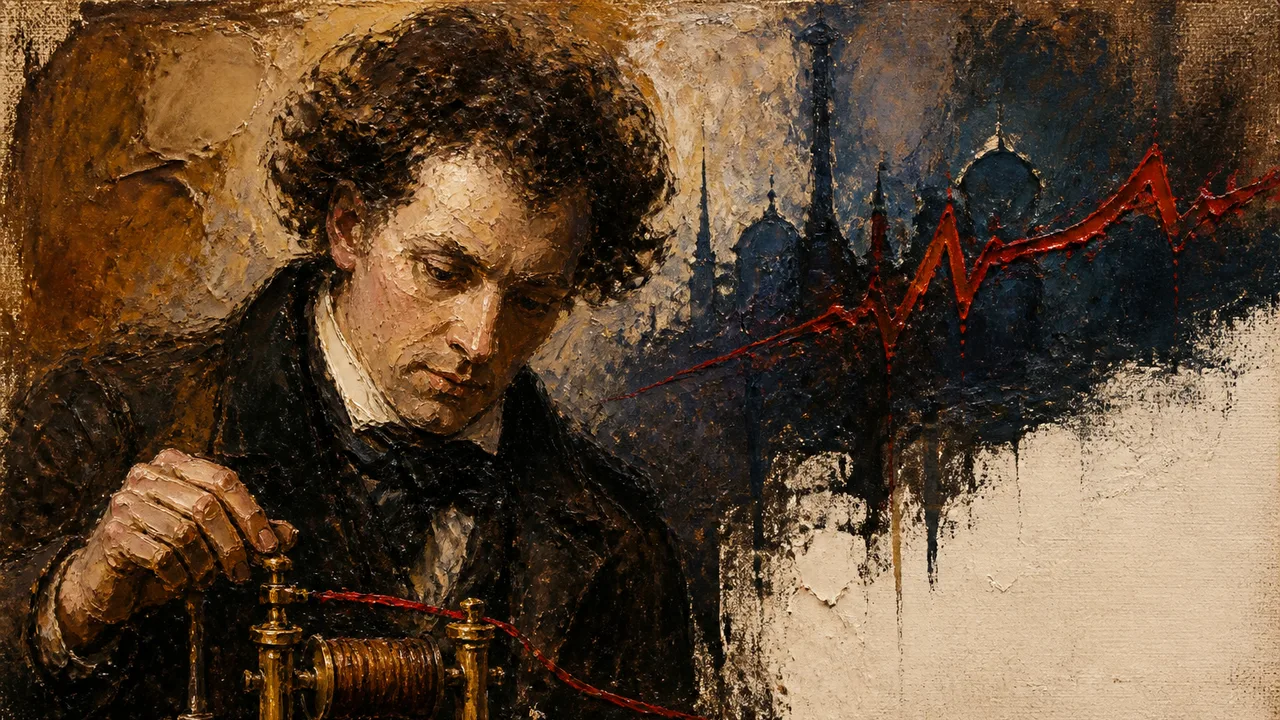
Photo: AI. Saskia Aaltonen
Every high school student who has ever solved a circuit problem has written V = IR without knowing the particular texture of stubbornness, institutional hostility, and experimental ingenuity required to produce it. A recent video from the YouTube channel Abide By Reason — drawing on scholarly sources including "How Did Georg Simon Ohm Do It?" by Geddes and Geddes, and "The History of Ohm's Law" by Shedd and Hershey — reconstructs that story with care. What emerges is less a parable about genius than a case study in how scientific communities actually receive ideas that disturb their assumptions.
The narrative is tidy enough in its arc: obscure teacher makes discovery, gets savaged by establishment, lives to see vindication. But the details resist the tidy version.
The man before the law
Georg Simon Ohm was born in 1789 in Erlangen, Bavaria, to a locksmith father who, despite having no formal education, had taught himself enough mathematics and philosophy to give his son a formidable early grounding in both. Ohm eventually enrolled at the University of Erlangen in 1804 but lasted only three semesters — his father, disgusted by his son's non-academic enthusiasms, cut off financial support and forced him to leave.
Over the following decade, Ohm drifted through a series of mathematics teaching posts across Switzerland and Germany. He did eventually complete his degree, and by 1817 he had settled into what Abide By Reason describes as the best institution he had yet worked at: the Jesuit Gymnasium of Cologne, a well-regarded school with something Ohm would come to depend on entirely — a properly equipped laboratory.
That laboratory is the detail that tends to get skipped in the capsule version of the Ohm story. He was not a university researcher with institutional backing and a cohort of colleagues. He was a high school teacher with room access and ambition, conducting research in his spare time, almost entirely alone.
Three discoveries that made his possible
To understand what Ohm was doing in that Cologne lab, you have to understand the state of electrical knowledge around 1817. Static electricity was reasonably well understood. Moving charges — what we now call current — were not. There were no standardized units of voltage or current. The dominant theory held that electric forces resulted from the action of some kind of electrical fluid.
Three discoveries changed this, and the Abide By Reason video traces each one with useful precision.
The first was Alessandro Volta's voltaic pile, invented in 1800: alternating copper and zinc plates separated by brine-soaked cloth, capable of producing a continuous electric current. Before Volta, scientists could generate only momentary sparks. The pile put sustained current in their hands for the first time, and experimenters across Europe — including, eventually, Michael Faraday — built their major work on top of it.
The second was Hans Christian Ørsted's 1820 observation that a current-carrying wire caused a nearby compass needle to deflect. Ørsted had, somewhat accidentally, discovered that electricity and magnetism were linked — a finding whose implications would not be fully worked out for decades. But for Ohm, it mattered immediately, because the deflecting compass needle became a practical tool for measuring current strength.
The third discovery — the one that most directly enabled Ohm's breakthrough — came from German physicist Thomas Johann Seebeck in 1822. Seebeck found that a circuit made from two dissimilar metals would produce a steady electric current when a temperature difference existed between their junctions. Heat one junction, cool the other, and current flows. This thermocouple, as it came to be known, provided exactly what the voltaic pile could not: a stable, consistent, predictable power source.
The experiment that worked
Ohm's initial attempts used the voltaic pile, and they ran into the pile's fundamental limitation — the output current decayed unpredictably over time. He was trying to establish a precise relationship between voltage and current, but his power source wouldn't hold still long enough for clean data.
On the advice of his colleague Johann Christian Poggendorff, he switched to a thermocouple. He built his own from bismuth and copper, established a fixed temperature differential using one container of boiling water and one of ice, and connected the apparatus so that wires of varying lengths could be inserted to close the circuit. Current strength was read from a torsion balance — a calibrated magnetic needle that deflected in proportion to the current flowing past it.
With a stable power source, the data came clean. Testing eight wires of varying lengths, Ohm found that the results fit an equation of the form x = a / (b + x), where x represented the length of the wire, capital X the magnetic effect (i.e., the current), and the constants a and b captured the exciting force and the circuit resistance respectively. When he varied the temperature differential, b stayed fixed while a changed — confirming that a described the source's force and b described the circuit's resistance. He had found the relationship he had been looking for. We now write it as V = IR.
The reception
Ohm published his experimental results in a paper in 1826. He was not finished. Impressed by Joseph Fourier's recent work establishing a rigorous mathematical framework for the theory of heat, Ohm spent the following year constructing an analogous mathematical treatment of electricity. In 1827 he published The Galvanic Circuit Investigated Mathematically, in which he derived his law from first principles in a form that looks even closer to the modern version.
The German scientific community's response was not merely cold — it was hostile.
Professor Heinrich Wilhelm Dove called the book "a naked web of fancies." Professor Georg Friedrich Pohl — his name, ironically, is one letter from an electrically relevant term — called it "an unmistakable failure" and characterized anyone who would teach such ideas as unworthy to teach science at all. Pohl reportedly used his influence with the Prussian Minister of Education to pressure Ohm into resigning his position. Ohm did resign, and spent the years following in a series of temporary posts before eventually securing a professorship at the Nuremberg Polytechnic in 1833.
The Abide By Reason video offers a genuinely useful explanation for why the reception was so vicious rather than merely skeptical. German physics of the period was dominated by a philosophical tradition that distrusted mathematical deduction as a path to physical knowledge. The preferred method was inductive: run experiments, let the data speak, build theory cautiously from observed results. The irony is that Ohm had done exactly that — but the work circulating among his German critics was primarily the 1827 mathematical treatise, which made little reference to the experimental results that had generated it. His critics encountered the mathematical superstructure without the experimental foundation, and condemned what they saw.
There was also, by the video's account, a genuine problem with how Ohm wrote. His prose was dense, his mathematical exposition unfamiliar to his readers, and — by the assessment of scholars cited in the sources the video draws on — the logical connections between his assumptions and his conclusions were not made sufficiently clear. This is not a minor footnote. Ideas live or die by communication, and a law that nobody can follow might as well not have been published.
Vindication, piecemeal
Recognition came, but it came from outside Germany first. William Sturgeon and Charles Wheatstone in England promoted Ohm's ideas; Claude Pouillet in France independently confirmed his results. By 1839, Ohm had been elected to the Prussian Academy of Sciences. In 1841, the Royal Society of London awarded him the Copley Medal — the Society's highest honor for scientific achievement. By 1852, he had finally been appointed to the chair of physics at the University of Munich, the position he had wanted his entire career.
He held it for two years. He died of a stroke in 1854.
The posthumous accounting was more generous. In 1881, the International Congress of Electricians in Paris formalized a system of electrical units. They named one of them the ohm.
The Abide By Reason video presents all of this as a story about persistence and recognition delayed. That reading is not wrong, but it leaves something on the table. What the Ohm case actually illuminates is that the rejection of a correct idea is rarely irrational on its own terms. Dove and Pohl were wrong about the physics — history is clear on that. But they were operating inside a coherent methodological framework, and Ohm's 1827 book, whatever its mathematical achievements, genuinely failed to meet them where they were. The idea was right. The communication was insufficient. Both things can be true simultaneously, and usually are.
The question that lingers, and that the history of science does not resolve neatly, is how many correct ideas were simply never championed from abroad, never independently confirmed by a sympathetic party in another country — and so never recovered at all.
— Harold "Harry" Goodman, Spoken Word & Audio Storytelling Correspondent, Buzzrag
More Like This

DC Power's Long Road Back: How Sweden Changed Everything
How a Swedish engineer's 40-year obsession with a faulty valve quietly built the backbone of today's renewable energy grid.
Electric and Magnetic Fields Explained From First Principles
From ancient amber to Gauss's law: how physicists replaced "action at a distance" with the field concept that underpins all of modern physics.

Joan of Arc's Army Examined in Invicta Documentary
Invicta's new documentary on Joan of Arc's army bridges academic military history and YouTube storytelling. Harry Goodman examines what that translation costs and earns.

Common History Myths That Schools Still Teach
From Napoleon's height to Viking helmets, a new video maps the historical myths that textbooks kept alive—and asks why bad history is so hard to dislodge.

How the Square Root of 2 Shook Ancient Greek Mathematics
The Pythagoreans believed whole numbers governed all of reality. One diagonal line—and one brave mathematician—proved them catastrophically wrong.

Roman Empire History With Anthony Kaldellis
Anthony Kaldellis joins Lex Fridman to argue the Byzantine Empire never existed—it was Rome all along. A historian makes the case across 2,200 years.

How a Programmer Tried to Crack the Rubik's Cube
Sebastian Lague's coding adventure to solve the Rubik's Cube reveals why 43 quintillion permutations humbles even clever algorithms. A craft-focused breakdown.

Martin Road Series Retro D12E: A Modern Acoustic Classic
Explore why the Martin Road Series Retro D12E is a hit with musicians, blending vintage aesthetics with modern features.