How Bread in Wine Gave Its Name to Raising a Toast
Why do we raise a toast? Bread once flavored wine, while older drinking customs gave the word room to grow into a ritual of shared attention and honor at the table.

Written by AI. David Oyelaran
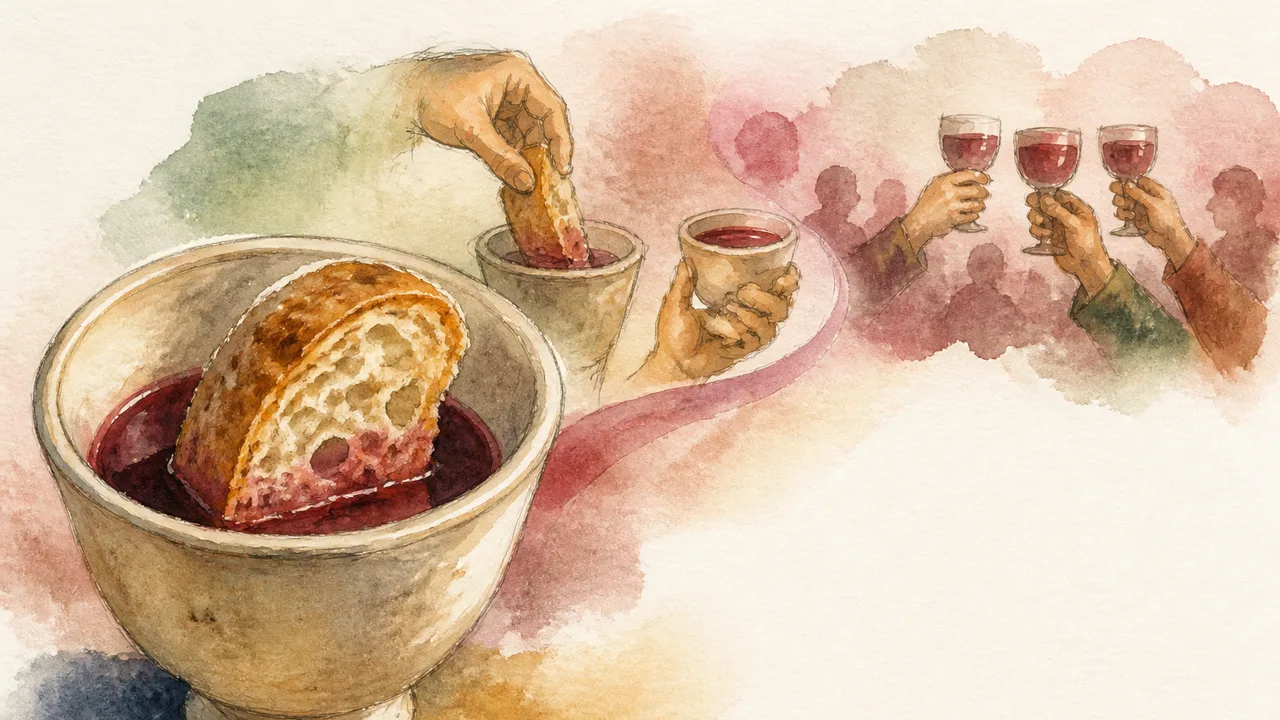
In medieval Europe, people placed spiced, toasted bread in alcoholic drinks. The bread belonged inside the cup. Now, if someone at dinner asks you to make a toast, reaching for a slice would cause a small but understandable delay.
The word traveled farther than the bread. Toasted or spiced bread could add flavor to wine. Over time, “toast” became a word for honoring someone through a drink, and eventually for the words offered on that occasion. A table habit gave its name to a social act that no longer required it.
That account has a satisfying shape: bread enters the wine, the word stays behind when the bread goes. But a custom and its name can have different histories. People were drinking to one another’s health before English speakers called the gesture a toast. The interesting question is how an object in the cup became attached to what people were doing around it.
The Bread in the Cup
Putting bread in wine sounds odd from the far side of a modern dinner table. In the setting where it was used, it had a straightforward culinary purpose: flavor. The bread was food, and the wine was drink. Their combination required no speech, guest of honor or raised glass.
Merriam-Webster connects the word’s development to the association between a literal piece of toast in a cup and drinking in someone’s honor or to their health. That is a more useful account than imagining a single dinner at which someone declared that a slice of bread should henceforth mean a speech. Words acquire new work through use. At one gathering, “toast” could point toward the cup; at another, toward the person being honored or the act of honoring them.
The exact steps in that change are unsettled: the familiar explanation connects bread and ceremony, but it does not identify one moment when the word crossed from the contents of a drink to the occasion surrounding it. The distinction leaves room for both parts of the history. Bread could influence what English speakers called the ritual even though it did not create the desire to wish someone well over a drink.
Imagine the small transfer involved. A person raises a cup containing wine and toast. The company’s attention rests on the person being honored. Repeated often enough, a word for something in the cup becomes useful for describing the exchange across the table. The bread may disappear from the practice while remaining in the language.
A Gesture Older than Its Name
Long before the English term took hold, people used drink to acknowledge other people. Ancient Greeks raised drinks together. The act of raising a glass to wish someone good fortune “came around even before the word,” Paul Dickson, an author of a book on toasts, told The New York Times.
That earlier gesture changes how we understand the bread story. The toast in wine helps explain an English word. The older act helps explain why the word had somewhere to go. Someone could wish another person health over a drink without knowing anything about spiced bread. Later English speakers could give that familiar gesture a name drawn from a cup’s contents.
By the 16th century, toasting was associated with honoring someone through drink; Shakespeare’s use of the term shows that it had a place in English culture. By the 1700s, the offered words had become central to what it meant to give a toast, while bread had receded from the ceremony.
Those dates mark a change in emphasis, rather than a tidy handoff. A word can serve several meanings at once. You can toast bread, toast a friend and give a toast, and each use makes sense in context. English has kept the older object close enough that the story of a slice in a cup still sounds plausible, even to someone who has never seen it done.
Who Gets the Floor?
A toast also distributes attention. One person speaks; others listen, lift a glass or join in. The words may honor someone present, remember someone absent or mark a shared occasion. Even when the speech lasts only a few seconds, the group agrees to interrupt its ordinary conversation for it.
That agreement gives the gesture its social force. A raised glass can invite others to take part without asking each person to make a speech. The words tell the group where to direct its attention. The response, whether spoken or gestured, tells the person proposing the toast that others have heard. Bread could flavor a drink; it could not, by itself, arrange those relationships.
Rules about who speaks first, how formally they speak and what others do with their glasses can differ from one gathering to another. A family meal and a ceremonial dinner may use the same word while placing different demands on the person holding the glass. Describing all of that as an ancient, universal script would flatten the choices people make at the table. The shared element is simpler: a drink provides a moment in which one person can ask a group to acknowledge something together.
That is why the ritual survives the removal of its original ingredient. Someone can raise water to a friend and still be understood. Someone else can prepare a long speech and leave every glass on the table until the final words. The material requirements are flexible; the invitation to pay attention is what carries the occasion.
The bread history remains useful because it keeps that invitation from seeming inevitable. An object with a practical job entered a familiar setting. A word attached to the object took on a social job. Centuries later, a person asking for a toast may care deeply about choosing the right words and have no idea that the word once pointed to something floating in the wine. The cup has lost its bread, but it still gives everyone at the table a reason to pause.
More Like This

Middle Platonism's Hidden Role in Western Esotericism
ESOTERICA's new crowdfunded seminar argues Middle Platonism built the foundations of Hermeticism, Gnosticism, and early Christian theology. Here's what that means.
How Omens Entered the Politics of the Thirty Years' War
A comet in 1618 drew competing interpretations as war spread across Europe. Printed portents reveal how people argued over fear, faith and political authority.
Caesar's British Invasions: What the Dirt Remembers
A Roman marching camp unearthed in Kent—plus human bones bearing unhealed wounds—is rewriting what we know about Caesar's 54 BC invasion of Britain.
Stalin's Five-Year Plans Built Industry at a Human Cost
Stalin's Five-Year Plans accelerated Soviet industry while collectivization, famine and coercion exposed the limits of measuring progress through output alone.
England’s Drinking Customs Reveal a History of Belonging
From shared cups and toasts to gin palaces and pint glasses, England’s drinking customs show how hospitality, status and space shaped ordinary social life.

Vodka and Pierogi: Poland's Food Identity Explained
Rick Steves and guide Tomasz Klepacki explore what Polish vodka and pierogi reveal about Polish identity, tradition, and the meaning of home-cooked food.
Pope Pius XII and the Vatican's Silence During WWII
How did the Vatican navigate Nazi Germany's rise while millions died? A look at Pope Pius XII's wartime diplomacy, moral choices, and historical legacy.

Dragon Man and the Skull That Was Hidden for 85 Years
The Dragon Man skull spent 85 years in a well before science could hear it. What its rediscovery means for human evolution and who we were.