Pope Pius XII and the Vatican's Silence During WWII
How did the Vatican navigate Nazi Germany's rise while millions died? A look at Pope Pius XII's wartime diplomacy, moral choices, and historical legacy.
Written by AI. David Oyelaran
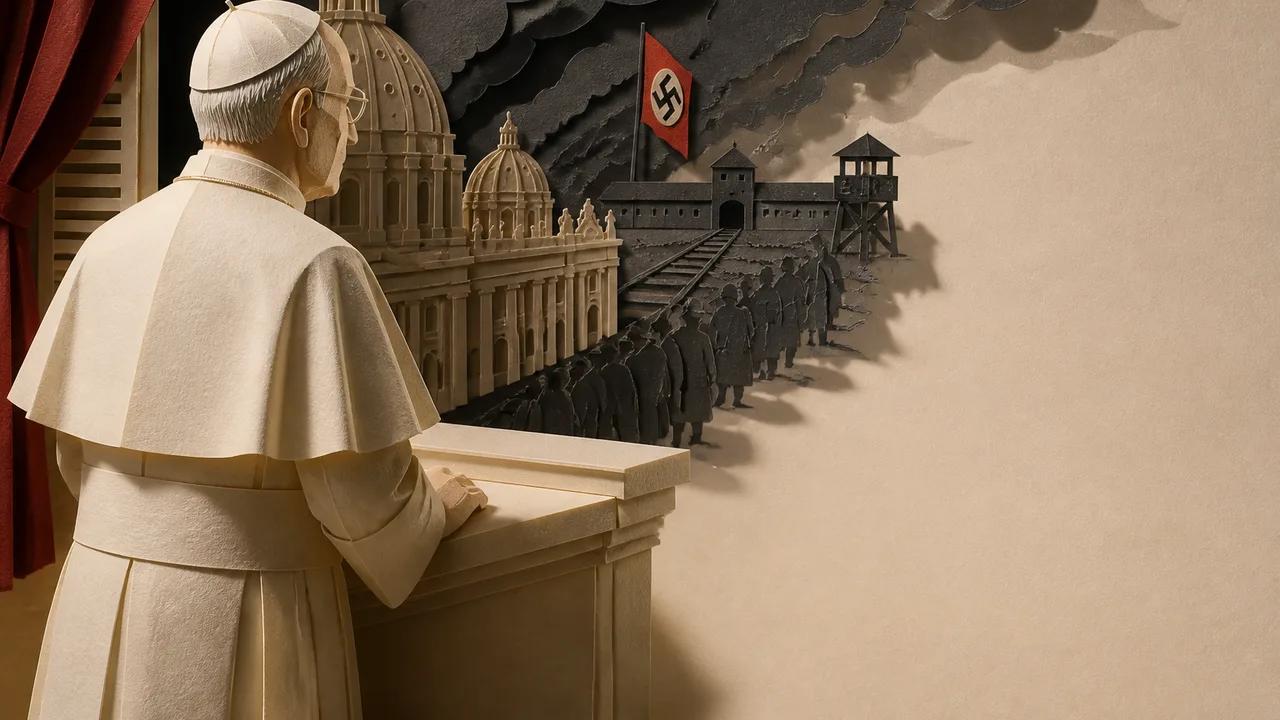
Photo: AI. Lila Bencher
Stalin's alleged quip to Churchill at Potsdam has the bluntness of a man who'd never had much patience for soft power: "How many divisions did you say the Pope has?" It's a line that lands like a door being shut. But it also misses something — because the question of what moral authority is worth, and what it costs to spend it, is exactly what the Vatican's wartime record forces us to sit with.
Kings and Generals' recent documentary, Why the Pope Stayed Silent, walks through that record with care. It doesn't deliver a verdict so much as build a case file and leave the jury in the room with it. What emerges is less a story of villainy than of institutional calculation — which, depending on where you stand, may be worse.
The Man and the Moment
By the time Eugenio Pacelli became Pope Pius XII in 1939, he had spent years as a Vatican diplomat in Germany and served as Vatican Secretary of State. He knew the terrain. He also knew, as Wikipedia's overview of his papacy and the Holocaust notes, that his role would be scrutinized in ways his predecessor's never quite was — Pius XI had at least managed to condemn Nazi racial ideology in the 1937 encyclical Mit brennender Sorge, however cautiously.
Pius XII arrived as a different kind of leader. The documentary describes him as a man known for his "cautious character and unwillingness to rock the boat." That isn't a knock — it's context. He genuinely believed the Vatican could serve as a neutral diplomatic force in a Europe sliding toward catastrophe. The Holy See, he reasoned, had to maintain working relationships with all parties, including Nazi Germany and Fascist Italy, to do any good at all.
That logic held — barely — in the early war years. When Germany invaded Poland in September 1939, Pius XII declined to condemn the aggression publicly. He had secret envoys in contact with Berlin. He urged Polish leaders toward compromise. When France, Belgium, and the Netherlands were invaded in 1940, he sent sympathetic telegrams to their leaders expressing sorrow — but still didn't name the aggressor. The attacked countries were furious. Mussolini was also furious, in the opposite direction. The documentary quotes Ciano's diary noting that Mussolini called the papacy "a cancer that eats away at our national life."
Somehow, being condemned by both sides simultaneously is not the same as moral clarity.
Pius XII seemed to understand this tension. After the Western invasion telegrams, he remarked: "I am profoundly and firmly convinced that I have done my precise duty, taking care not to offend anyone, avoiding any particular references, indeed studiously taking care to say the least possible."
That sentence deserves a long look. "Studiously taking care to say the least possible" — from the leader of the world's largest religious institution, in the middle of a war of extermination. Whether that represents institutional wisdom or moral abdication is the question historians are still arguing about.
What the Vatican Knew, and When
The documentary is clearest — and most uncomfortable — on the question of knowledge. The Vatican was not in the dark about the Holocaust. It was flooded with light, and it drew the curtains anyway.
By October 1941, Pius XII's own envoy to Turkey was documenting conversations with the Pope about Nazi atrocities. Around the same time, Giuseppe Burzio, the Vatican's representative in Bratislava, formally informed the Holy See that German forces were systematically murdering Jews in occupied territories. In November 1941, an Italian military chaplain, Father Pietro Scavizzi, reported on mass exterminations in the Soviet Union in a direct meeting with the Pope. The documentary records that Pius XII "cried like a child and prayed like a saint" in response.
And then, in January 1942, told Scavizzi that he had considered excommunicating the perpetrators — and decided against it. His reasoning: that such a proclamation would only make things worse for Jewish people.
That argument is not frivolous. The documentary notes that EWTN's defense of Pius XII's record includes the claim that Hitler had plans to depose the Pope and install a puppet if the war turned in Germany's favor — which suggests Pius wasn't entirely wrong to fear retaliation. And there are documented instances of Nazi reprisals following Church protests in occupied countries.
But Yad Vashem's Jonathan Gorsky, writing for the institution's academic series, puts the other side plainly: there was no explicit papal reference to Jewish suffering throughout the war years, and information received by the Vatican from 1942 onwards was not disseminated, nor was any direction given. The silence wasn't incidental. It was managed.
The 1942 Christmas Message and the Art of Not Saying It
The closest Pius XII came to a public statement on the genocide was his 1942 Christmas radio address. He spoke of "hundreds of thousands of people who, through no fault of their own and solely because of their nation or their race, have been condemned to death or progressive extinction."
He did not say Jews. He did not say Nazis. He did not say Germany.
Defenders argue the allusion was unmistakable, that any more explicit statement would have provoked devastating reprisals against Catholics in Germany and the occupied territories. Critics — including many of those who were being murdered — found the language inadequate to the scale of the crime. The documentary notes, not without edge, that the Axis powers found portions of the same address useful for their own propaganda.
What remains striking is the Pope's own reaction to the response. He was reportedly disappointed that others didn't recognize the constraints under which he was operating. There's something revealing in that — a man whose caution had become so total that he expected credit for the limits of his courage.
Saving Lives, Protecting the Institution
The documentary doesn't let the Vatican off cleanly, but it doesn't flatten the record either. Pius XII privately instructed Catholic institutions to shelter Jews. He intervened with Italian authorities in April 1943 to prevent deportations from French and Dalmatian territories under Italian occupation — and succeeded. When the Nazis occupied Italy in autumn 1943 and began rounding up Jews from beneath the Vatican's literal windows, the Pope at least ultimately rescinded a disastrous order to evict Jewish refugees from Roman churches, after cardinals pushed back.
The Jewish Virtual Library's documentation of the Vatican's wartime role captures the core tension: publicly, the Pope stayed silent; privately, he instructed Catholic institutions to take in Jews. Both things are true. The question is whether private intervention, even when it saved lives, was an adequate response from the moral center of a global faith.
Curiously, the documentary notes that the Nazis were more responsive than Mussolini to Vatican requests for the release of baptized Jews — which tells you something about how the Vatican understood its leverage, and who it understood itself to be advocating for.
The Weight of Institutional Logic
There's a version of this story where Pius XII made the best calculations available to a leader with limited power, real physical danger, and genuine pastoral responsibility for hundreds of millions of Catholics. There's another version where the leader of the world's largest moral institution decided that keeping the institution intact was worth the silence. Both versions are supported by the historical record.
Cardinal Tisserant, one of Pius XII's own, seems to have held the second view. The documentary closes with his assessment: "I fear that history will have much to reproach the Holy See for for having adopted a policy of convenience for itself and not much more."
That's not a verdict from an enemy. That's a colleague looking at the ledger and not liking what he sees.
The archives of Pius XII were only fully opened in 2020 — and as The Atlantic reported in 2022, the secret back-channel communications between the Vatican and Hitler's representatives are only now being fully examined. The debate isn't settled. It may never be settled in the way that people who want clean answers need it to be.
What is settled is that the Vatican knew. What the knowing required — that's the question that will outlast us all.
More Like This
Middle Platonism's Hidden Role in Western Esotericism
ESOTERICA's new crowdfunded seminar argues Middle Platonism built the foundations of Hermeticism, Gnosticism, and early Christian theology. Here's what that means.
Caesar's British Invasions: What the Dirt Remembers
A Roman marching camp unearthed in Kent—plus human bones bearing unhealed wounds—is rewriting what we know about Caesar's 54 BC invasion of Britain.
Pliny the Younger's Letters on the Eruption of Vesuvius
Pliny the Younger's two letters to Tacitus remain the only eyewitness account of Vesuvius's eruption in 79 AD — and they still read like dispatches from the end of the world.
The Crusades: Two Centuries of Holy War Explained
From Pope Urban II's 1095 call to arms to the fall of Acre in 1291, the Crusades reshaped Christianity, Islam, and the medieval world permanently.
Anne Frank: The Life, the Diary, and the Record
Anne Frank's diary survived the Holocaust when she didn't. A close look at her life in hiding, her death, and what the record still can't tell us.
Unveiling the Mayan Secrets of the Oldest American Book
Explore the Códice Maya de México and its astrological secrets tied to Venus, revealing Mayan culture's celestial insights.
DNA Names a Revolutionary War Teen Soldier After 245 Years
Genetic genealogy has identified Private John Pumphrey, a Maryland teen who died at the Battle of Camden in 1780 — one of America's oldest John Doe cases.
Cicero and the Fall of the Roman Republic
Marcus Tullius Cicero defended Rome's Republic with words alone—and paid with his life. A look at history's most consequential orator and his impossible political moment.