How Omens Entered the Politics of the Thirty Years' War
A comet in 1618 drew competing interpretations as war spread across Europe. Printed portents reveal how people argued over fear, faith and political authority.

Written by AI. David Oyelaran
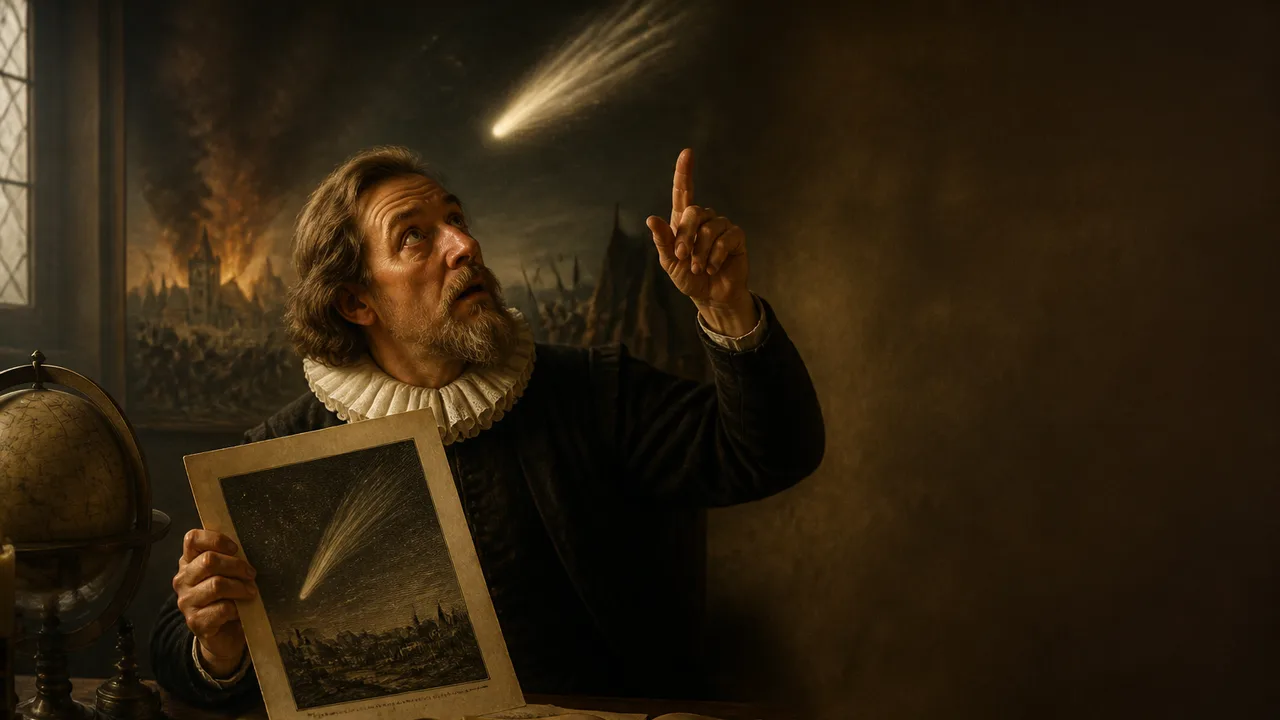
A great comet appeared above Europe in the winter of 1618, the year the Thirty Years’ War began. Many people understood it as a warning of war, hunger and plague. They did not agree on what, precisely, it warned them about.
That disagreement puts human voices into a sky that can look strangely empty from four centuries away. A comet could be seen across a wide area. Its interpretation depended on people with different loyalties, fears and expectations. For someone facing the prospect of violence, a warning might make an uncertain future feel legible. For someone claiming to explain it, the same warning could lend weight to an argument about what a community ought to believe or do.
The comet cannot tell us what would happen next. It can help us understand how people faced what was already happening. Between 1618 and 1648, religious division, dynastic rivalry and foreign intervention prolonged war across central Europe. Armies and diplomacy shaped its course. So did the language in which people described disaster, assigned meaning to it and imagined an end to it.
A Sign with No Agreed Meaning
The temptation is to picture an omen as a message with a fixed translation: comet means war. The dispute over the 1618 comet suggests a harder question. The 1618 comet drew interpretations that circulated among contemporaries. If several people see the same light and draw different conclusions, who gets to say which conclusion a community should trust?
The answer might depend on more than the sky. Religious commitments could affect what someone believed a warning revealed about divine favor. Political loyalties could affect whom they thought it warned. Fear of hunger or disease could draw attention to dangers beyond the battlefield.
An omen became politically useful when an interpretation attached a public consequence to it. A warning could encourage caution or sustain hope; it could also make an opponent’s position seem perilous. They show why competing interpretations deserve a place beside accounts of decisions made by rulers and commanders.
There is a discipline to reading those interpretations. We can ask what people believed an event signified without asking the reader to believe it signified that. A comet’s appearance belongs to one account of the past. A claim about divine intention belongs to the history of how people understood their lives. The latter could affect fear, hope and action even if no celestial event foretold a battle.
Battles and Marvels on the Page
Printed reports carried news of battles alongside accounts of eclipses, unusual births and other portents. Early German newspapers placed the news of battles in wider geopolitical perspectives. The pairing gives a reader today a clue about the questions people brought to news. A report of fighting said something about what had occurred. A report of a marvel invited a further question: what did it mean for what might occur next?
Printed reports could frame wartime events through apocalyptic imagery. Printing let a claim travel beyond the person who first made it. Once a marvel entered a report, readers who had never witnessed it could encounter an interpretation as part of the news of war. It means a reported omen had a life beyond a single sighting, with room for agreement, doubt and argument.
For a historian, the page records several things at once. It may preserve a description of an unusual event. It also preserves a choice to publish that description and, sometimes, to place it near accounts of conflict. Those choices tell us about the appetite for explanations during a long emergency.
A person experiencing the war through a report left a more visible trace than someone whose fears and memories never reached print. No imagined quotation can fill that gap. We can still ask whose view of danger entered public circulation, and whose remained within a household or a conversation that left no record here.
The War Did Not Follow the Comet
A comet is a satisfying opening to a story. It appears at the beginning, seems to cast a shadow forward and gives three decades of conflict a single image. The Thirty Years’ War resists that tidiness. Religious division, dynastic rivalry and foreign intervention helped sustain it from 1618 to 1648. A warning in the sky could make those years feel connected to a larger design, but it could not settle the rival interests that kept the fighting going.
Nor did everyone need to read the same meaning into the comet for omens to enter politics. Disagreement was part of their force. If a portent was thought to reveal divine favor, its interpretation could become one more contested claim in a conflict already shaped by competing religious and political commitments. The argument was over authority as much as prediction: who could explain suffering, and whose explanation should guide others?
That helps account for why portents appear in a history of war without displacing its military and diplomatic causes. A reader can follow the movements of power and still ask how people endured uncertainty while those movements unfolded. An eclipse or an unusual birth offered no reliable timetable for peace. As a reported warning, though, it could give people a language for dread or expectation when the next turn of the war remained unknown.
Reading a Future from the Past
War also changes the way an earlier warning is remembered. After a calamity, a person can look back at a strange event and find in it the shape of what followed. During the calamity, that shape would have been harder to see. The contested readings of the 1618 comet keep that uncertainty in view. People saw a sign while the future was still open to them.
A printed portent tells us that somebody considered a marvel worth communicating. An interpretation tells us what meaning someone tried to give it. Neither gives us a private census of belief among the people who lived through the war. Treating those limits seriously leaves room for the unrecorded people whose experience of hunger, fear or hope never became a printed argument.
The comet crossed the sky in 1618. The war lasted until 1648. Between those dates, people sought explanations for events that could overturn a life before anyone knew how the wider conflict would end. Their arguments over signs preserve some of that uncertainty. The sky offered an image everyone could look toward; people still had to decide what they saw.
More Like This

Middle Platonism's Hidden Role in Western Esotericism
ESOTERICA's new crowdfunded seminar argues Middle Platonism built the foundations of Hermeticism, Gnosticism, and early Christian theology. Here's what that means.

Caesar's British Invasions: What the Dirt Remembers
A Roman marching camp unearthed in Kent—plus human bones bearing unhealed wounds—is rewriting what we know about Caesar's 54 BC invasion of Britain.
Why October's Name Still Carries the Number Eight Today
October is the tenth month, but its name means eight. The mismatch preserves an older Roman calendar and reveals how societies reorganize public time.
Titanic Lifeboat Decisions Shaped Who Could Survive
The Titanic had lifeboat space for about 1,178 of more than 2,200 aboard. Loading, access and maritime rules shaped who escaped the sinking in April 1912.
Homer's Odyssey and What Mortality Means Today
Homer's Odyssey is more than epic adventure — it's a philosophical argument for why a finite life matters, and why immortality might be the real curse.
DNA Names a Revolutionary War Teen Soldier After 245 Years
Genetic genealogy has identified Private John Pumphrey, a Maryland teen who died at the Battle of Camden in 1780 — one of America's oldest John Doe cases.