Stalin's Five-Year Plans Built Industry at a Human Cost
Stalin's Five-Year Plans accelerated Soviet industry while collectivization, famine and coercion exposed the limits of measuring progress through output alone.

Written by AI. David Oyelaran
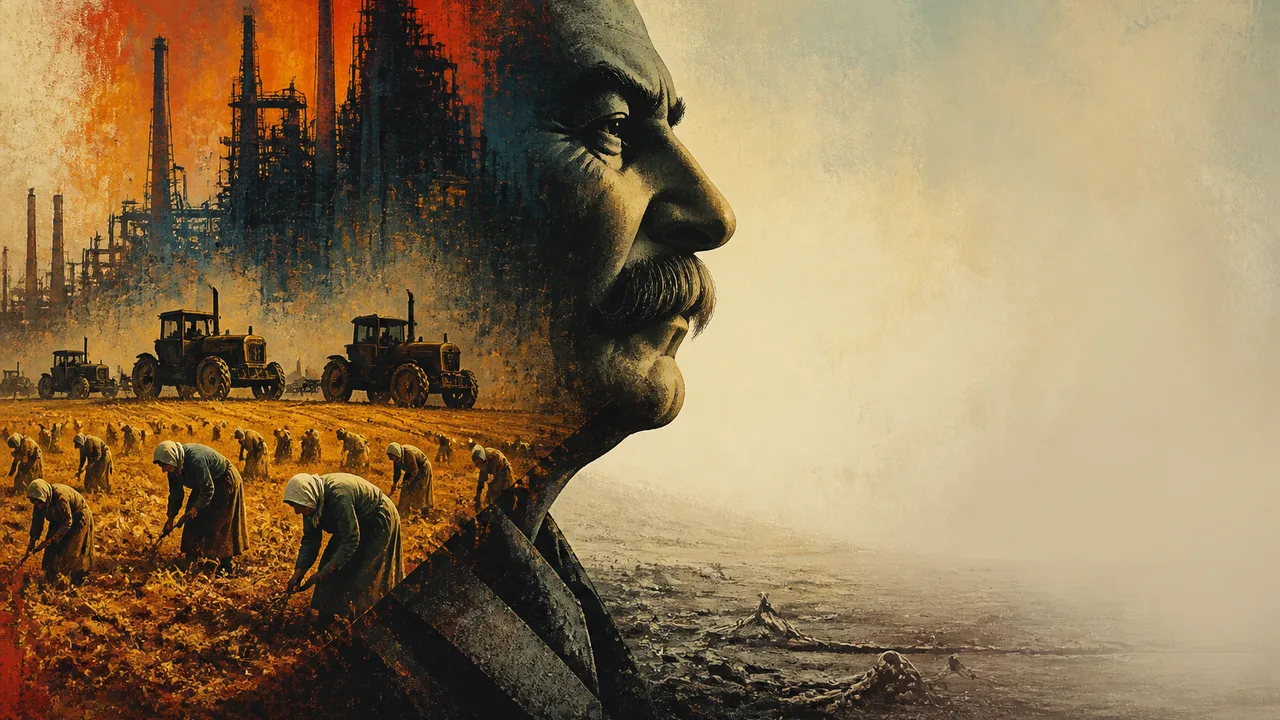
In 1928, Joseph Stalin’s government began a Five-Year Plan to turn the Soviet Union’s largely agricultural economy into an industrial power. State planners directed investment toward heavy industry and set targets for production. In the countryside, they pushed farmers into collective agriculture. The factory-building drive expanded industrial capacity; it also bound the promise of growth to coercion.
A plan can count a new factory. It has a harder time accounting for a household that loses control of its farm, a worker pressed to meet an unrealistic target, or a family facing hunger while officials report production upward. Those experiences belong in the history of Soviet industrialization as firmly as the factories do. None requires denying that the country built industrial capacity. They require asking what the state chose to measure, and what happened to people whose needs fell outside the target.
Why the State Chose Speed
The first plan called for a profound change in what the Soviet economy produced. Heavy industry took priority: the capacity to make machinery and other goods needed for further production. Agriculture, too, was meant to become more efficient through mechanization and collectivization. The government also sought to open large industrial centers in resource-rich areas.
The strongest argument for this program begins with the scale of the task. An economy seeking rapid industrial growth needs equipment, materials and places to produce them. Concentrating investment in those foundations can increase future capacity. From a planner’s desk, the choice has a sequence: build the means of production first, then use them to produce more of everything else.
But people need goods during the years that sequence takes to unfold. Giving heavy industry priority meant that output for everyday use could lag even as industrial production rose. The contrast between soaring industrial output and static consumer-goods production shows how an economy could grow rapidly while doing less to ease ordinary shortages. A production target answers the question the state has written down; it cannot, by itself, tell a household when its needs will be met.
What Collectivization Asked of Farmers
The industrial program depended on changes far from the new factories. Collectivization brought individual farms into larger units under state direction. Officials presented mechanization and consolidation as a route to more efficient agriculture. For farmers, the change reached into decisions about land, animals and work that they had previously made closer to home.
Resistance was an economic consequence as well as a political one. Grain production fell by 10% and meat production by 52% between 1928 and 1934; farmers slaughtered livestock rather than surrendering it to collective farms, partly contributing to the steep fall in meat production. Those percentages have a time span and a subject. They describe changes in production, not the experience of every village or the full cause of every loss. They do show why compelling participation could frustrate the agricultural gains the government sought.
Collectivization also contributed to the catastrophic famine of 1932–33. Hunger cannot be entered in a ledger as a temporary inconvenience on the way to a higher industrial total. The state’s use of force, farmers’ loss of autonomy, resistance and falling agricultural output were connected parts of the transformation. So were the people who could no longer rely on food reaching them.
The familiar account moves quickly from a field to a national figure. It has to slow down at the field. A percentage can register that meat production collapsed; it cannot identify, on its own, who lost an animal, who made the decision to slaughter it, or what that decision meant for the next season. Treating those questions seriously keeps rural people in the account as participants with choices and fears, rather than as units of agricultural output.
The Factory and the Target
Industrialization mobilized workers on a vast scale under harsh labor conditions. New facilities and greater capacity were tangible results. So was the pressure created by ambitious targets. When leaders demand rapid increases and officials face political pressure over reported results, a production figure must be read alongside the conditions under which it was produced and reported.
A target can organize resources. It can also narrow attention. A factory judged on its output has an incentive to pursue the output being counted, while a central authority trying to assess progress depends on information moving upward through people who know what leaders want to hear. The Soviet plans’ unrealistic targets and politically pressured statistics made that relationship especially fraught. Reported success could reflect increased production, pressure around the number, or both; the figure alone cannot separate them.
Building capacity and meeting daily needs were related aims, but the plans gave them different places in the queue. Likewise, a national production increase says little about whether workers had reasonable conditions or farmers retained a say in their lives. Those questions concern the means of growth, not an argument over whether growth occurred.
What the Plans Leave Us to Measure
The Soviet Five-Year Plans present a difficult historical account because their achievements and harms developed together. Central direction helped concentrate resources on heavy industry and speed construction. The same state compelled changes in agriculture, imposed harsh demands on labor and pursued targets amid catastrophic famine. Counting the factories while setting aside the coercion would describe an incomplete process; ignoring the new capacity would leave the reason the program commanded such effort unexplained.
The questions extend beyond the Soviet Union, though its history supplies its own answers rather than a ready-made verdict on every government plan. When leaders promise rapid transformation, readers can ask what receives investment, what must wait, who can refuse, and how an official learns that a target has failed. They can also ask whether the people expected to carry the plan have a way to describe its effects that does not depend on pleasing those who set the target.
In 1928, Soviet planners set out to change what their country could make. A complete account of what followed must keep the factory and the farm in the same frame.
More Like This

Middle Platonism's Hidden Role in Western Esotericism
ESOTERICA's new crowdfunded seminar argues Middle Platonism built the foundations of Hermeticism, Gnosticism, and early Christian theology. Here's what that means.

How Omens Entered the Politics of the Thirty Years' War
A comet in 1618 drew competing interpretations as war spread across Europe. Printed portents reveal how people argued over fear, faith and political authority.

Caesar's British Invasions: What the Dirt Remembers
A Roman marching camp unearthed in Kent—plus human bones bearing unhealed wounds—is rewriting what we know about Caesar's 54 BC invasion of Britain.
Why October's Name Still Carries the Number Eight Today
October is the tenth month, but its name means eight. The mismatch preserves an older Roman calendar and reveals how societies reorganize public time.
The Kesh Temple Hymn: Humanity's Oldest Sacred Text
Written around 2600 BCE, the Kesh Temple Hymn is among the oldest surviving literature on Earth. Here's what it tells us about faith, power, and memory.
Battle of the Coral Sea: How Carriers Rewrote Naval War
In May 1942, the Battle of the Coral Sea changed naval warfare forever. Here's what that first carrier battle actually meant — and why it still matters.