England’s Drinking Customs Reveal a History of Belonging
From shared cups and toasts to gin palaces and pint glasses, England’s drinking customs show how hospitality, status and space shaped ordinary social life.

Written by AI. James Morrison
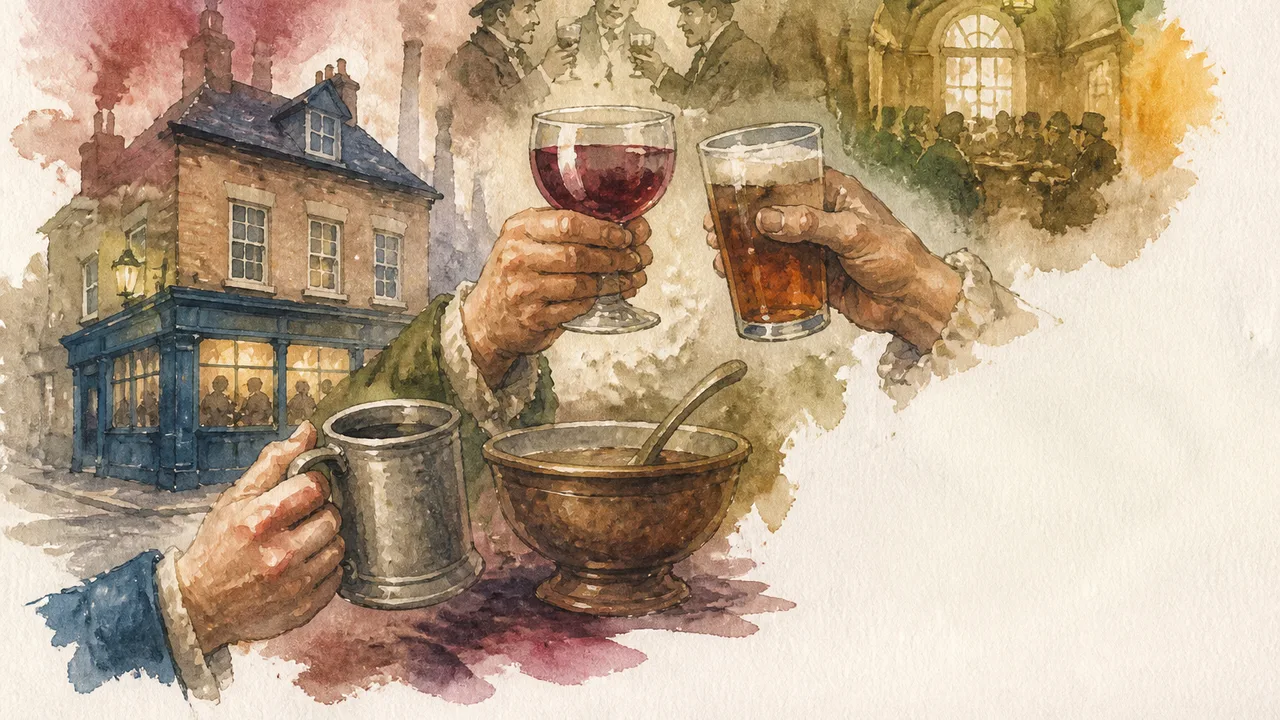
England’s shared drinking customs reach back at least to the early Middle Ages. The familiar acts of passing a cup, offering a toast and singing over drink belong to a long history of people making company around a table. They also raise a question that survives the end of any evening: who got to set the terms of that company?
A drink could welcome a guest, recognize a friend or mark an occasion. The same gathering could carry expectations about who poured, who spoke first and whose health deserved public recognition. Those expectations made drinking a social ritual as well as a private pleasure. Hospitality had its choreography, even when nobody thought to write down the steps.
That is a useful way to read the modern toast. Its words may sound spontaneous. Its timing rarely is. Someone proposes it, others respond, and the group briefly agrees on whom or what it will honor. English communities have repeatedly adapted that small procedure as their meeting places, vessels and ideas of good conduct changed.
What a Cup Can Tell Us
Wooden and leather drinking containers, ceramic tankards and jugs, and the modern pint glass belong to different settings and methods of making things. Materials shaped what people could carry, pour, share and keep. They also offer clues about craft and class: a vessel costs labor and resources before anyone fills it.
The object alone cannot identify the rules of the gathering around it. Wear on a jug may suggest repeated use; it cannot name the people who used it or settle whether a guest felt welcome. Shape may suggest how a container was handled, while written accounts and archaeological context help place it among actual practices. A decorated vessel might have belonged at a conspicuous occasion, but decoration by itself cannot supply the occasion’s guest list.
That restraint allows a fuller history to emerge. A tankard deserves attention alongside the words spoken over it. Where the two meet, the ordinary business of drinking becomes a record of how people organized a room.
Consider the difference between passing one vessel and serving drinks in separate glasses. A common cup brings the act of sharing into view. Individual glasses give each person a portion while leaving room for a collective toast.
The Rules Inside the Gesture
A toast asks a group to pay attention at the same moment. It gives one voice temporary authority and invites everyone else to acknowledge a person, a cause or an occasion. That arrangement can be generous. It can also reveal an order of precedence. When a gathering repeatedly honors some people and overlooks others, recognition becomes part of its hierarchy.
Passing a cup poses its own questions. Who offers it? Who receives it? Does everyone participate on equal terms? The questions do not require a single answer across centuries of English life. Their value lies in making the ritual visible. Good manners often appear effortless to people who already know them; a newcomer has to learn when to speak, when to wait and how to respond.
Singing over drink adds another layer. Shared words can draw people together, particularly when joining the song signals that a person knows the company’s habits. The same words may leave an unfamiliar guest listening from the edge. Participation and belonging overlap, but a room can make room for one while withholding the other.
Institutions that prize continuity can preserve formal drinking customs even as vessels and manners change. Such persistence should be read carefully. A custom survives because successive groups find a use for it, whether that use is welcome, ceremony or recognition of rank. Its age alone says little about how fairly any one gathering treated the people present.
When the Room Changed
English drinking history also includes a change in the spaces built to sell drink. An account reproduced in Drinking Customs of the English: From Gin Palaces to Pubs describes small, dusty shops giving way to spacious premises with prominent lettering, carpets, pillars and more glass. The details concern architecture and display, but they also bear on social conduct. A place with conspicuous fittings presents a different entrance to the public from a modest shop.
Bigger windows make the interior easier to see. Gold lettering announces the business to people outside. Carpets and pillars shape a visitor’s impression before a drink reaches the counter. It does show that the setting for drinking could change dramatically while the older questions about company and standing remained.
Architecture can announce an invitation; it cannot guarantee one. A spacious establishment may serve more people, yet admission through the door leaves open what happens at the counter or around a table. Who feels at ease, who understands the local rules and who receives attention are questions about people as much as premises. The vessels and furnishings supply part of the setting in which those decisions occur.
This shift from cup to room is more than a change of scale. A drinking custom depends on practical arrangements. People need somewhere to gather, a way to obtain a drink and enough common understanding to follow what happens next. Alter the space or the service, and the same words spoken in a toast can take on a different public character.
The Pint Glass and the Older Questions
Today’s pint glass can make the history seem settled. Its familiar shape suggests a familiar occasion: a drink, some company and perhaps a toast. Earlier containers disrupt that easy picture. They bring craft, cost and use back into view, and they remind us that a social habit can outlive the objects through which people first practiced it.
The strongest case for seeing continuity in English drinking customs rests on recognizable actions. People still gather, offer drinks, speak for the group and acknowledge one another. The strongest caution concerns the meaning of those actions. An early medieval gathering, a later commercial drinking room and a present-day table cannot be treated as one uninterrupted social scene. Each has its own arrangements for who enters, who serves and who commands attention.
History gains something when it follows these arrangements through ordinary encounters. Laws and leaders can tell us who held formal power. A shared vessel or a proposed toast directs our attention to the smaller decisions through which people practiced hospitality and marked status. Their consequences were immediate: a place at the table, a turn to speak, an invitation to join in.
The next time someone raises a glass, the movement may last only seconds. The choice of whom to honor, and who gets to make that choice, belongs to a much longer history.
More Like This

The KGB's Cyanide Newspaper Gun That Almost Worked
How a KGB poison weapon hidden in a rolled newspaper killed Ukrainian nationalist Stepan Bandera in 1957—and why one mistake unraveled the whole operation.

LIDAR Is Rewriting What We Know of Ancient Cities
Anthropologist Luke Caverns is planning the largest LIDAR scan ever done in the Amazon. What the technology finds may force a rewrite of ancient history.

Bodmin Moor's Bronze Age Village and Its Neolithic Cairn
Archaeologists confirm a Bronze Age village on Bodmin Moor—and find a 6,000-year-old cairn that may have outlasted the community that built it.
The Medici and the Borgia: Power, Banking, and Renaissance Italy
The Medici-Borgia rivalry was no simple feud. A look at how banking, papal power, marriage, and armies shaped Renaissance Italy's contested politics.

The Crusades: Two Centuries of Holy War Explained
From Pope Urban II's 1095 call to arms to the fall of Acre in 1291, the Crusades reshaped Christianity, Islam, and the medieval world permanently.
Gettysburg's Command Failures and What They Still Cost Us
Dr. Roy Casagranda's Gettysburg lecture reveals how four command archetypes from 1863 shaped the battle's outcome—and what they still tell us about military leadership today.