How Astronomers First Measured the Earth-Sun Distance
From 17th-century expeditions to radar and spacecraft, the story of measuring the astronomical unit is a masterclass in scientific audacity and precision.

Written by AI. Olivia Meng
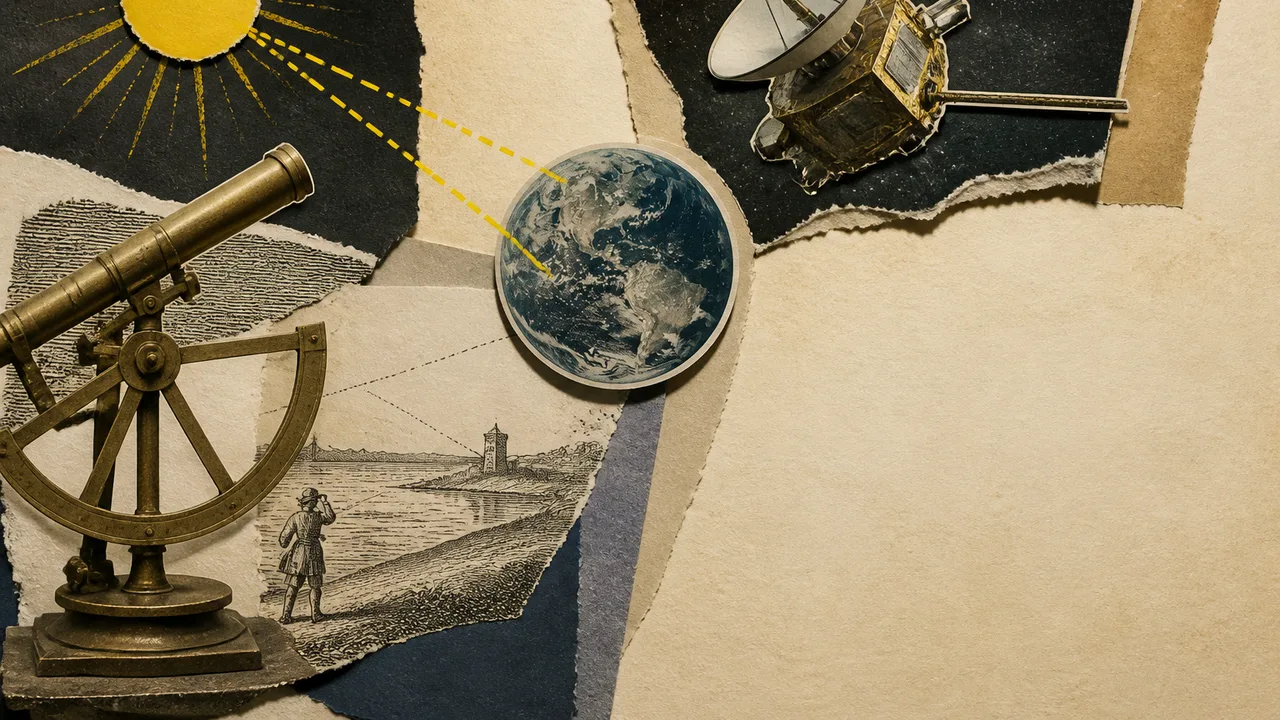
There is something quietly remarkable about the fact that humans figured out how far away the Sun is before they had electricity, calculus as a mature discipline, or any instrument more sophisticated than a carefully ground lens. The distance — roughly 150 million kilometers, a figure so familiar it has become almost abstract — was not handed to us. It had to be wrested from the sky through ingenuity, international cooperation, grueling travel, and more than a little argument about whose measurements were right.
Three hundred and sixty years after the founding of the French Academy of Sciences, that story deserves a closer look. Not because it is purely historical curiosity, but because the methods and the mindset it required remain instructive for how science actually works when it is working well.
The Problem That Stumped a Generation
The Earth-Sun distance — what astronomers call the astronomical unit, or AU — is the baseline from which all other cosmic distances are triangulated. Get it wrong, and everything else in the solar system map is wrong with it. Ancient Greek astronomers knew the problem and took early passes at it; Aristarchus attempted an angular measurement of the Sun and Moon that was geometrically sound but practically limited by the tools of his era.
The figure that emerged from those efforts was off by an enormous margin. For most of antiquity and through the early modern period, the Sun was understood to be far closer to Earth than it actually is. The error was not one of ignorance but of precision — angular measurements small enough to determine solar distance require instruments and techniques that simply did not exist yet.
That changed, with effort, in the 17th century.
What the Academy Set Out to Do
The French Academy of Sciences, founded in 1666, was created precisely for this kind of coordinated, expensive, difficult inquiry — the kind that no individual natural philosopher could accomplish alone. One of its early ambitions was a reliable measurement of the solar parallax: the tiny apparent shift in the Sun's position against the background of fixed stars when observed from two widely separated points on Earth's surface.
The geometry is straightforward in principle. If you observe a nearby object from two different locations and measure how much its apparent position shifts against a distant background, you can calculate its distance using basic trigonometry. The challenge is that the Sun's parallax angle is extraordinarily small — under nine arc-seconds — which means any error in the observations compounds dramatically in the final calculation.
The Academy's solution was characteristically ambitious: send observers to locations far enough apart on Earth's surface that the parallax shift would be measurable. According to the arXiv paper "From the Earth to the Sun", this approach, pursued through the 17th and 18th centuries, produced progressively refined estimates of the AU and laid the observational foundation for the precise value we use today.
The expeditions were not simple affairs. Astronomers traveled to South America, West Africa, and the Pacific — journeys that took months each way, often in conditions that bear no resemblance to a modern research trip. Equipment was fragile, weather was unreliable, and the window for observation was fixed by celestial mechanics, not by human convenience.
The Transit of Venus and the Art of the Impossible Measurement
The most celebrated method for measuring solar parallax in the 18th century was observation of the transit of Venus — the rare passage of Venus across the face of the Sun as seen from Earth. Edmond Halley (of the eponymous comet) recognized in the early 1700s that if observers at widely separated latitudes timed the transit with sufficient precision, the difference in the transit's apparent duration would yield the solar parallax with much greater accuracy than direct angular measurement.
The transits occur in pairs separated by eight years, with each pair separated by over a century. The transits of 1761 and 1769 prompted what was arguably the first organized global scientific collaboration — dozens of expeditions dispatched to points across the globe, from Lapland to Tahiti, all attempting to time the same event to within seconds.
The results were imperfect. The so-called "black drop effect" — a visual smearing that occurs as Venus appears to touch the solar limb — made precise timing difficult, and the data from different stations disagreed in frustrating ways. But the exercise was not a failure. It produced estimates of the AU that were, by 18th-century standards, reasonably close to the modern value, and the collaborative methodology it demonstrated would become a template.
As noted by Universe Watcher, it was not until the 20th century, with the advent of radar, that the Earth-Sun distance could be measured with the kind of precision that makes earlier efforts look almost quaint by comparison. Radar ranging — bouncing radio waves off Venus and timing the return — removed most sources of human observational error from the equation. The AU was formally defined by the International Astronomical Union in 2012 as exactly 149,597,870,700 meters, a figure grounded ultimately in radar and spacecraft telemetry.
Precision as a Scientific Value, Not Just a Technical Achievement
What the history of AU measurement illustrates is that precision in science is not merely a technical virtue. It is an epistemic one. The difference between a solar parallax of 10 arc-seconds and 8.8 arc-seconds might sound like a trivial quibble, but it translates to a difference of tens of millions of kilometers in the calculated distance — enough to throw off the entire architecture of the solar system's known geometry.
The 17th- and 18th-century astronomers who dedicated years of their lives to this problem understood something that sometimes gets lost in contemporary science communication: the act of measuring carefully is itself a form of knowledge production. A rough estimate tells you roughly where you are. A precise measurement tells you where you actually stand.
This is why the French Academy's founding mission — to produce reliable, reproducible knowledge through systematic observation — remains worth marking at 360 years. The institution was not created to confirm what people already believed about the heavens. It was created to find out what was actually true, even when the finding required sailing to the other side of the world and staring at the Sun through a brass telescope in conditions that would defeat most modern researchers.
The Thread That Runs to Now
The connection between those 17th-century expeditions and contemporary space science is not merely inspirational. It is structural. Every distance measurement in planetary science — including those being made right now by active missions — depends on the AU as a fixed reference. When the Juno spacecraft, launched by NASA in August 2011 and now orbiting Jupiter, uses its instruments to characterize the dust environment of the Jovian system, the geometry of its orbit and the distance calculations underlying its science all trace back, through layers of accumulated refinement, to those first hard-won parallax measurements according to Wikipedia's account of the Juno mission.
Recent work published on arXiv using Juno's Waves instrument maps the three-dimensional dust distribution around Jupiter's halo ring and magnetosphere — research that would be impossible without the precise orbital mechanics that depend on an accurate AU. The dust populations detected near the Jovian magnetosheath, the paper notes, may originate from satellite ejecta, electromagnetically transported grains, or particles shaped by solar radiation pressure, according to the full arXiv preprint. The ability to even frame those questions depends on knowing, to within meters, how far the spacecraft is from the Sun and from Jupiter at any given moment.
The measurement problem never really ended. It just got harder and more interesting.
What Audacity Actually Looks Like
The brief describing this retrospective uses the word "audacity" to characterize the 17th-century expeditions, and it is not wrong, but it is worth being precise about what that audacity consisted of. It was not primarily the courage to venture into unknown physical territory, though that was real. It was the intellectual audacity to believe that a quantity so vast — the distance to the Sun — could be measured at all using instruments small enough to carry on a ship, by human observers whose hands trembled with cold or heat, working within a window of minutes set by the indifferent motion of the planets.
That belief — that the universe is, in principle, measurable — is what the French Academy institutionalized. It is what every subsequent refinement of the AU has honored.
The question worth sitting with now, as we dispatch spacecraft to the outer solar system and define our units of distance to the nearest meter, is not whether we have surpassed those early observers. Obviously, we have. The question is whether we still carry the same underlying conviction: that the thing worth knowing is the thing that is actually true, however far you have to travel to find it.
More Like This
Rethinking Cosmic Acceleration: A Local Illusion?
Exploring the debate on whether the universe's acceleration is a local phenomenon, challenging the concept of dark energy.
How the Asteroid Impact Ended the Dinosaur Era
Explore the catastrophic asteroid impact that ended the dinosaurs, its immediate aftermath, and the long-term environmental changes.
How the Speed of Light Became a Definition
The speed of light wasn't just measured—it was defined into existence. Here's the 300-year story of how physics outgrew the question it started with.
Subcritical Reactors: Nuclear Power's Safety Fix?
A new generation of subcritical reactors promises to make nuclear meltdowns physically impossible. But can they deliver on cost, scale, and timeline?
Understanding the Real Risk of Brain-Eating Amoebas
Explore the facts and myths surrounding brain-eating amoebas. How real is the threat, and can climate change affect its spread?
Starlink Satellites Are Now Scanning Earth's Atmosphere
Kyoto University researchers repurposed 1,200 Starlink satellites as an accidental atmospheric scanner. Here's what that means for science—and who controls it.

How Humidity Makes Extreme Heat Deadly
Wet bulb temperature, not air temperature, determines when heat kills. Joe Hanson's lab experiment reveals what our bodies face in a hotter, more humid world.
Google's Android Earthquake Alerts Warned Venezuela
On June 24, 2026, Venezuela had no national earthquake warning system. Google's Android alert network reached 11.4 million phones anyway. Here's what that means.