How Archival Images Confirmed the Youngest Known Planet
Elias 2-24 b was confirmed through archival telescope images. Its record age shows how detection limits shape what astronomers know about infant planets today.

Written by AI. Amelia Nwofor
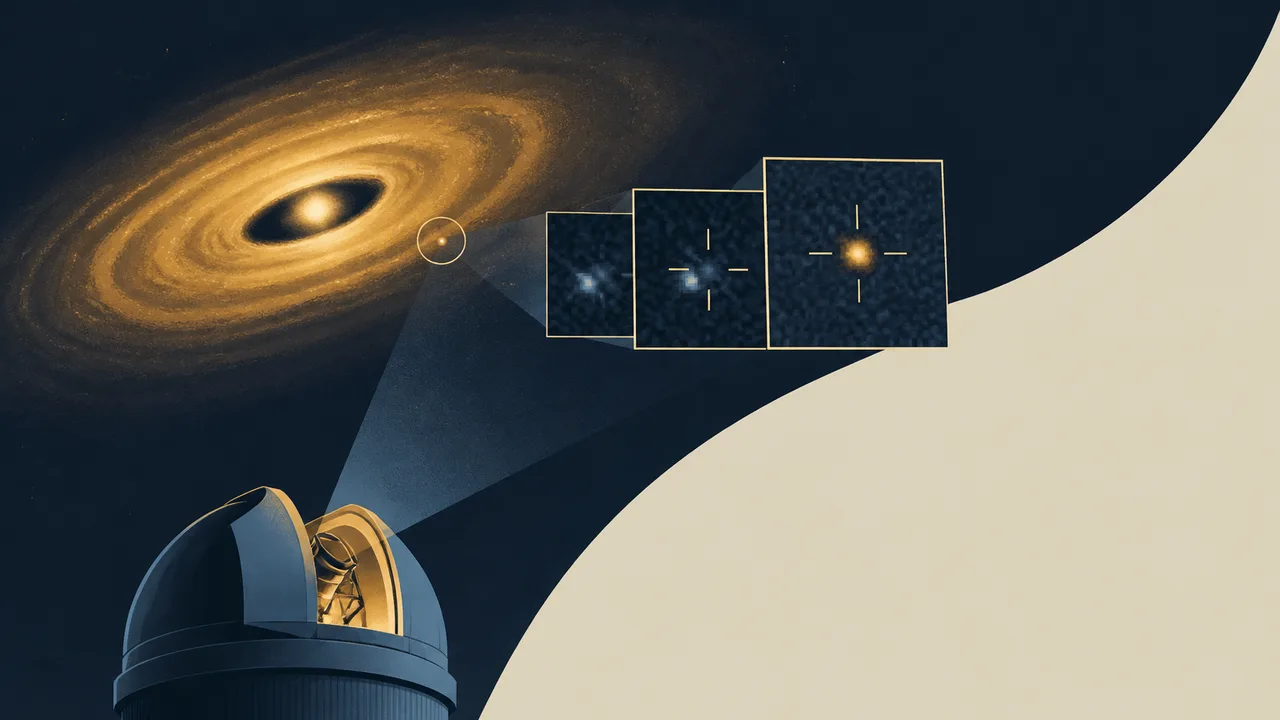
Elias 2-24 b spent nearly a decade as a persuasive clue rather than a confirmed planet. A gap in a dusty disk suggested that something was clearing material around the young star. A faint point of light appeared in the right place. Neither observation could carry the claim alone.
Confirmation came from combining observations across years and telescopes, including Keck images that were already sitting in an archive. That history is more useful than the record-setting headline. It shows how astronomers turn a suspicious dot into a planet, and why the catalogue of infant worlds reflects the limits of our instruments as much as the contents of the galaxy.
A Gap is an Address, Not an Identification
Elias 2-24 is a young star about 450 light-years away, surrounded by the gas and dust from which planets can form. In 2017, ALMA observations resolved three partially separated gaps in that disk, including a middle gap centred at roughly 52 astronomical units from the star. One astronomical unit is the average Earth-Sun distance.
A planet could produce such a gap by gathering and displacing nearby material. Other disk physics can also create rings and gaps, including changes in grain growth, pressure, chemistry and dust trapping. The gap therefore supplied a promising address for a search, not proof of an occupant.
The European Southern Observatory’s Very Large Telescope later detected a faint point of light inside it. The position fitted the planet hypothesis, but a single faint source near a bright star can be an imaging artefact or an unrelated background object. The system remained disputed because the apparent planet was also implausibly precocious under standard growth calculations.
NASA’s account of the research places the object about 55 astronomical units from its star. The agency gives roughly five million years as a representative model time for building a Jupiter-size planet at Jupiter’s orbit, and says formation should take longer farther out. Elias 2-24 and its disk are less than one million years old.
That comparison identifies a problem for models, but it does not confirm an object. The confirmation required another test.
The Decisive Observations Were Already on Disk
Andrea Bernardi, a doctoral candidate at Universidad Diego Portales, led a team examining archived coronagraph observations of seven young stars. A coronagraph suppresses the overwhelming light of a star so that much fainter nearby objects become visible.
The researchers found the Elias 2-24 point source in Keck observations from 2018 and 2020. By combining those images with observations from other telescopes, they tracked how its position changed over time. Its motion behaved more like an object associated with Elias 2-24 than a background star or an imaging defect, according to the published study summary. That accumulated evidence established Elias 2-24 b as a planet.
This is what confirmation often looks like near the edge of detection: several imperfect views, separated in time, eliminating rival explanations one by one. No single image supplied a cinematic reveal. The archive supplied a baseline.
The method also explains why old observations can acquire new scientific value. An image records the sky at one moment; a sequence records motion. Better analysis, a new hypothesis or a comparison with another observatory can turn stored data into evidence that its original programme never extracted.
The Age Record Doubles as an Instrument History
Elias 2-24 b is now described as the youngest known planet, at less than one million years old. The recent progression of the record suggests a second interpretation: astronomers are pushing through an observational boundary.
For years, some of the youngest known forming planets were around five million years old, including worlds in the PDS 70 system. Reports then placed TIDYE-1b at about three million years in 2024 and AB Aurigae b at possibly two million years in 2025, although these objects do not all carry identical observational histories or confirmation claims. Elias 2-24 b takes the reported boundary below one million years.
That sequence accompanied improvements in telescopes and data analysis. It would be a mistake to read it as evidence that progressively younger planets have suddenly appeared in nature. The safer inference is that astronomers have become able to see stages that were previously hidden.
The dominant exoplanet search method helps create the blind spot. Transit surveys detect a planet when it crosses its star and slightly dims the starlight. Dust can obscure that signal in young systems, while planets on wide orbits transit infrequently. Direct imaging faces its own problem: the star can outshine a nearby planet by an absurd margin, and the disk must have a favourable orientation for its structure to be seen clearly.
NASA notes that most of the roughly 6,000 confirmed exoplanets are billions of years old and close to their stars. That catalogue is a sample filtered by geometry, brightness, dust and observing time. It cannot, by itself, tell us how common infant planets are.
The downward march in the age record therefore resembles an instrument log. That is an inference from the detection history, not a measured census of unseen planets. Astronomers would need a larger and more systematically selected sample before concluding that systems like Elias 2-24 are common.
“Jupiter-Mass” Needs a Pencil Annotation
The planet’s existence is better established than its mass or exact age. NASA describes Elias 2-24 b as about as massive as Jupiter. A more detailed analysis reports that comparisons with one-million-year evolutionary tracks produce an estimated range of 1.9 to 4.0 Jupiter masses.
That range is model-dependent rather than a dynamical measurement of the planet’s gravitational pull. A newborn planet can glow because it retains heat from formation and because material falling onto it releases energy. Atmospheric opacity, accretion history and surrounding material can all alter the relationship between brightness and mass. The reported estimate also excludes extra light from ongoing accretion.
Age enters the same calculation. Previous estimates cited in reporting on the study put the host star near 400,000 years old or possibly 200,000 years old, while the planet modelling assumed an age of one million years. Those figures support the broad conclusion that the system is extraordinarily young. They do not provide a stopwatch reading for the planet’s formation.
The formation mechanism remains open to refinement as well. The study’s title identifies Elias 2-24 b as a core-accretion planet, and its position in a narrow disk gap is compatible with a planet interacting with surrounding material. Core accretion builds a solid core that later captures gas. Gravitational instability offers a faster alternative in a sufficiently massive disk, where part of the disk fragments under its own gravity. The present observations place a planet in the gap, but they do not by themselves quantify every step by which it formed.
Roman Can Test the Hidden-Population Inference
NASA’s Nancy Grace Roman Space Telescope, launched on August 30, carries a coronagraph designed to suppress starlight more effectively than existing space-based instruments. Reported performance targets would let it detect planets 100 million times fainter than their stars, improving contrast by a factor of 100 to 1,000 over existing space coronagraphs.
Better contrast should make searches around young stars easier and may expose planets on smaller orbits. Yet sensitivity alone will not erase every bias. Disk orientation, dust, distance, observing strategy and the difficulty of estimating newborn planets’ masses will still shape the sample.
Roman’s contribution will be statistical as well as visual. If it finds many systems resembling Elias 2-24, the current age record will look like the first breach in an old detection wall. If such planets remain scarce, Elias 2-24 b may instead mark an unusual route through the first million years of planet formation. Either result begins with the same discipline that confirmed this planet: keep the old images, add time, and make the faint dot survive every alternative explanation.
More Like This
Tabby's Star Mystery: A Super-Jupiter May Be the Culprit
Ten years after its discovery, Tabby's Star may finally have an explanation—a massive hidden planet flinging comets toward the star. Here's what the evidence actually shows.
Precision Burn Could Extend NASA's Roman Mission to 22 Years
A precise engine burn could let NASA's Roman telescope operate for 22 years, expanding its science horizon if fuel, hardware, instruments and support hold up.
A Doomed Water World Is Falling Into Its Star
Astronomers have found a hot, water-rich exoplanet spiraling toward its star. Here's what its slow destruction reveals about planetary life cycles.

How Astronomers First Measured the Earth-Sun Distance
From 17th-century expeditions to radar and spacecraft, the story of measuring the astronomical unit is a masterclass in scientific audacity and precision.
Black Holes: Destroyers, Organizers, and Open Questions
Black holes destroy worlds and organize galaxies—but what does the science actually show? A look at Sagittarius A*, adaptive optics, and the limits of what we know.
Intelligence Beyond the Brain: Michael Levin's Radical Rethink
Biologist Michael Levin argues intelligence exists on a continuum reaching down to cells and molecules. Here's what the evidence actually supports—and where it gets murky.
The Messy, Brilliant History of Divergence and Curl
How Hamilton's quaternion obsession, Maxwell's electromagnetism, and a self-taught telegraph operator gave us the vector calculus we use today.