Precision Burn Could Extend NASA's Roman Mission to 22 Years
A precise engine burn could let NASA's Roman telescope operate for 22 years, expanding its science horizon if fuel, hardware, instruments and support hold up.

Written by AI. Mei Zhang
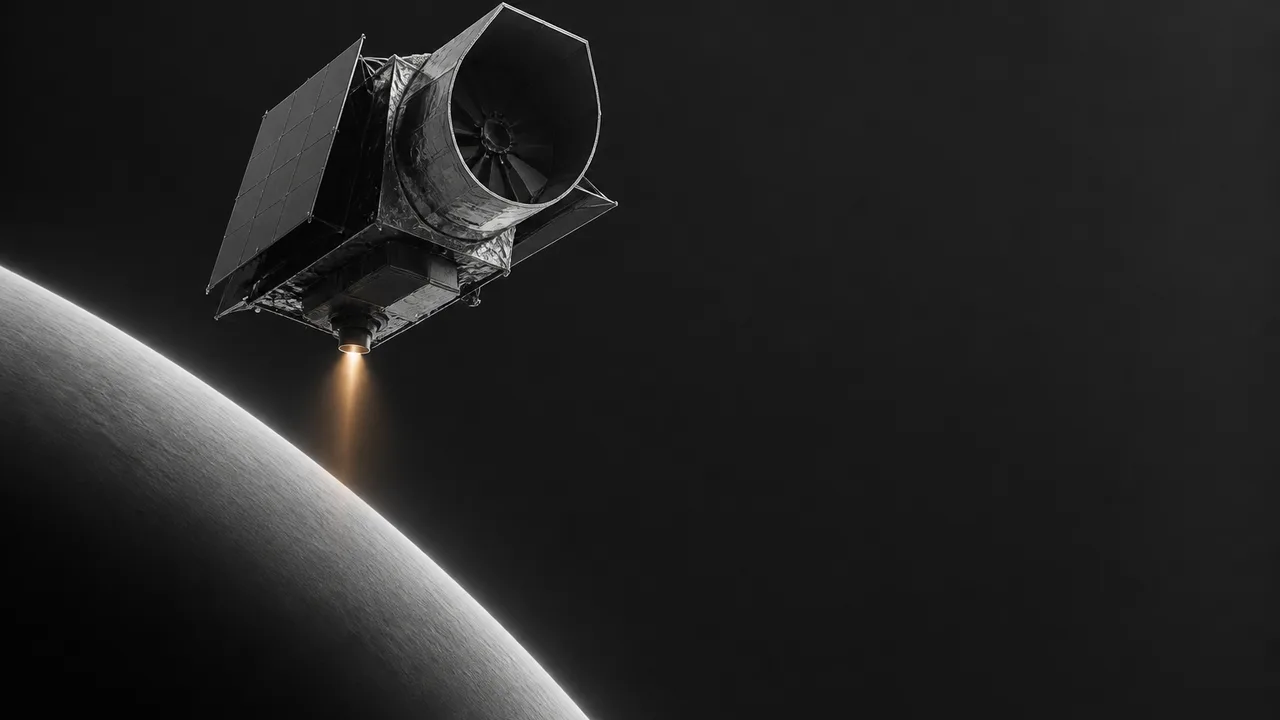
NASA’s Nancy Grace Roman Space Telescope could collect science for 22 years following a highly precise engine burn, according to space.com.
That horizon stretches from 2026 into the late 2040s. A student starting university this month could build a dissertation from Roman data, become a senior researcher and still propose observations with the same telescope. Their first Roman dataset and their 40th birthday might share a calendar.
That is deliciously weird. Space missions usually make human careers look short. Roman might grow up alongside one.
The telescope was designed around a five-year primary mission, with a possible five-year extension. Twenty-two years would more than double that maximum designed horizon. Buzzrag’s launch coverage reported that Roman lifted off aboard a Falcon Heavy on August 30, 2026. Less than three weeks later, the conversation has already shifted from getting it into deep space to how long it could remain scientifically useful.
Still, 2048 has not been booked into Roman’s calendar. The source material available for this article does not include formal NASA mission documentation or a statement from a named mission official supporting the 22-year figure. For now, space.com’s report carries that projection and attributes the longer estimate to fuel preserved by the accurate maneuver.
Who Gets to Grow Up with Roman?
A mission lasting two decades creates an access question before it creates its final dataset: who gets to use all that observing power?
Young researchers could gain the most from Roman’s long arc. Someone who enters astronomy after launch may inherit a mature archive, tested analysis tools and years of earlier observations ready for comparison. Researchers at institutions without their own major telescopes could also pursue discoveries through archived data, depending on how access, processing and proposal rules are structured.
The details decide whether that opportunity spreads widely.
How long will newly collected observations remain reserved for particular teams? How quickly will calibrated data reach the archive? Will the software needed to process it run on an ordinary university computing cluster, or require resources concentrated at wealthy institutions? Will early-career scientists receive enough observing opportunities to lead projects, rather than appearing halfway down author lists built around senior investigators?
A scientific archive can function like a community kitchen. Access policy decides who gets the induction stove and sharp knife, and who arrives after dinner holding a plastic fork. The ingredients can be public while the practical ability to cook remains uneven.
Astronomy shares this problem with genomics. A giant telescope archive and a giant genomic database both become more valuable as records accumulate, yet storage alone does not create equal access. Researchers also need usable formats, documentation, computing capacity, training and time. Roman’s potential longevity therefore raises two separate measures of success: how many years the spacecraft survives, and how many people can turn those years into science.
Mission planners also face allocation choices. Established survey programs can provide consistent datasets across many years. New proposals can respond to discoveries nobody anticipated in 2026. A long mission has room for both in principle, while actual schedules, staffing and budgets set the proportions.
How One Burn Can Buy Years
Spacecraft launch with a finite supply of propellant. Each trajectory correction or position-maintaining maneuver draws from that supply. Engineers cannot send a tanker when the gauge gets low.
According to space.com’s account, Roman’s engine burn hit its target with enough precision to preserve a larger fuel reserve than the original mission planning required. That reserve underpins the reported 22-year estimate.
Think of the propellant tank as an icing bag at the far end of space. Every squeeze must move the spacecraft by the required amount, and nobody can pop back to the bakery for a refill. A cleaner squeeze leaves more icing for later.
Precision alone cannot keep a telescope operating for two decades. Propulsion is one item in a whole pantry of failure points. Electronics age. Detectors can lose performance. Communications equipment must keep working. Power and thermal systems must remain within their operating limits. Future maneuvers will consume some of the fuel saved now.
People and money stay in the loop, too. Ground teams must command the spacecraft, process its observations, maintain software and respond when hardware behaves unexpectedly. NASA and its partners would need to support those operations across multiple budget cycles and leadership changes. A spacecraft can have propellant in its tank while its operating program faces different constraints on Earth.
This is why the wording around mission duration deserves precision of its own. A five-year primary mission represents the period around which requirements and planning were built. An extension usually depends on later reviews of spacecraft health, scientific value, cost and risk. A 22-year propulsion estimate answers a narrower question: how long might fuel permit operations under stated assumptions?
Tiny, spreadsheet-shaped lifting. 🧬
What Two Decades Could Add to the Science
Roman’s planned work centers on major questions in cosmology and exoplanet science, using wide-field observations that can complement the narrower or deeper views supplied by other observatories.
A longer life expands that relationship. Roman could survey broad regions, identify objects or patterns that deserve closer inspection, and provide context for observations made elsewhere. Other telescopes could then examine selected targets in greater detail, subject to their own capabilities and schedules.
Repeated visits also create a longer baseline. A single survey gives researchers a celestial photograph. Observations spread across years make a flipbook, perhaps with missing pages, but enough sequence to reveal what changed. Researchers can compare populations, revisit earlier findings and test whether an apparent pattern survives a larger dataset.
In exoplanet research, additional observing opportunities could improve population studies and allow new questions to be asked of the archive. In cosmology, extended surveys could increase the amount of data available for testing models and checking possible sources of error. Longevity can also connect Roman with observatories that have not launched yet, creating collaborations that no 2026 schedule can fully map.
Twenty-two operating years would not produce 22 identical servings of science. Instrument performance may evolve. Some observing campaigns could prove more productive than others. Ground interruptions, maintenance demands and changing priorities would shape the output. An older observatory can remain valuable while doing a narrower set of tasks than it performed early in its life.
Longevity has another scientific advantage: people get better at using instruments. Early observations expose calibration challenges and teach researchers where analysis pipelines stumble. Later teams can return to old data with improved methods. Archives sometimes answer questions that mission designers never wrote into the original plan, because the question arrived years after the photons did.
The Numbers NASA Still Needs to Show
Formal mission documents would make the 22-year projection easier to evaluate. Several numbers would sharpen the picture:
- The amount of propellant remaining after the precision maneuver
- The assumptions used to translate that reserve into 22 years
- The fuel margin retained for unexpected corrections or contingencies
- The projected maneuver and position-maintenance needs across the mission
- The operational limits of the instruments and spacecraft systems
- The review process for approving extensions beyond the primary mission
Early performance will matter as much as the fuel ledger. Commissioning and initial science operations can reveal whether the telescope, instruments and ground systems perform as planned. Each successful year would reduce some uncertainties while introducing the ordinary wear of another year in space.
The strongest reading of the current report is straightforward: accurate navigation appears to have preserved fuel that could support a far longer mission than Roman’s original five-year primary plan. The unresolved reading is equally concrete: propulsion capacity sets an outer boundary, while spacecraft health, scientific productivity and sustained ground support determine how much of that boundary becomes observing time.
A brief engine burn may have bought a generation access to the same telescope. Whether that generation gets the sharp utensils, the usable archive and all 22 candles remains the next story.
More Like This
Unraveling the Golden Ratio's Mathematical Magic
Explore how the golden ratio's unique irrationality connects math, nature, and fractals.
NASA's Roman Space Telescope Launches Into Deep Space
NASA's Roman Space Telescope launched August 30, 2026 on a Falcon Heavy. Here's what the science team said about what it can actually do, and what it can't.
Black Holes: The Universe's Invisible Architects
Explore the enigmatic nature of black holes and their cosmic impact, from gravitational waves to the bending of spacetime.
Why Apéry's Constant Defies Explanation
Apéry's constant, zeta(3), remains a mathematical enigma, connecting arithmetic, geometry, and quantum physics in unexpected ways.

What Long-Duration Spaceflight Actually Does to the Human Body
Radiation, bone loss, vision changes and isolation: what the evidence says about spending months in space, and where the research is still thin.
Shungite: Ancient Rock with Modern Potential
Explore the ancient origins and modern applications of Shungite, a unique carbon-rich rock with potential in tech and construction.
Solar Orbiter Captures First Direct View of the Sun's Poles
Solar Orbiter has captured the first direct images of the Sun's poles, revealing a chaotic magnetic field mid-reversal—and what it means for space weather forecasting.

Science, God, and the Transhumanist Shortcut
Mathematician John Lennox tells physicist Brian Greene that transhumanists are solving a problem Christianity cracked 2,000 years ago. My generation might actually find out who's right.