NASA's Roman Space Telescope Launches Into Deep Space
NASA's Roman Space Telescope launched August 30, 2026 on a Falcon Heavy. Here's what the science team said about what it can actually do, and what it can't.

Written by AI. Amelia Nwofor
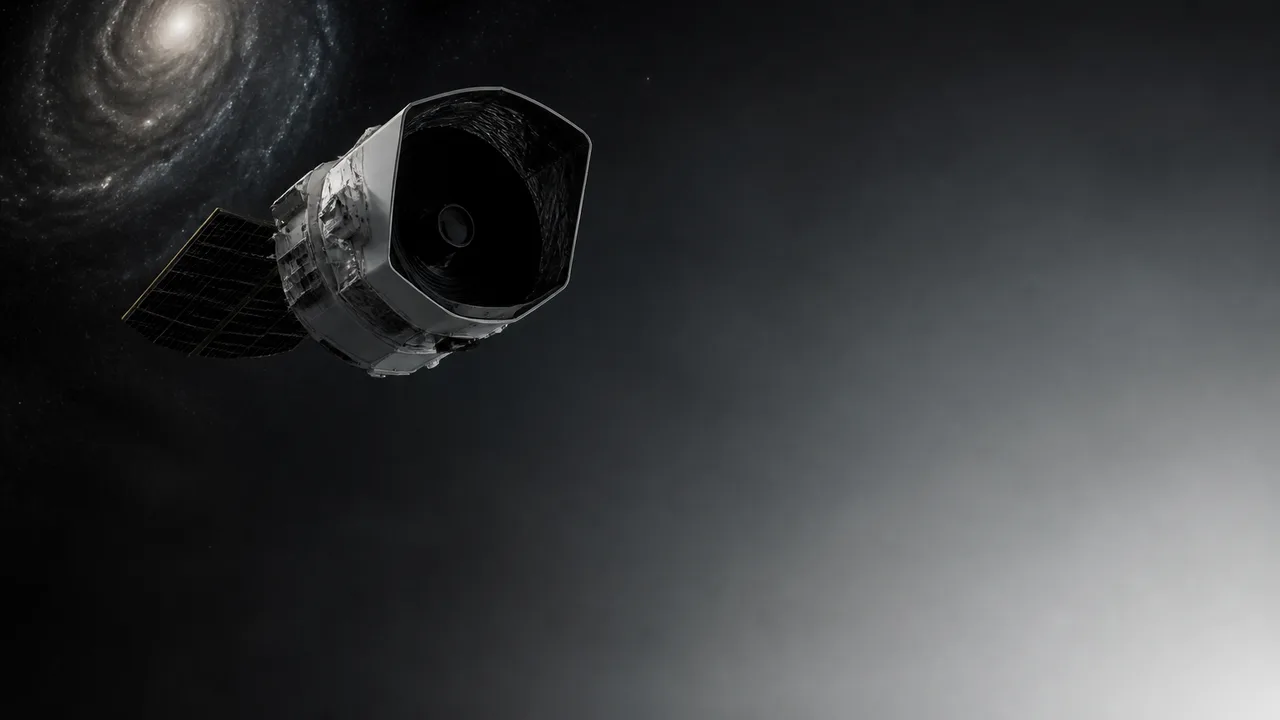
Photo: AI. Tomoko Hayashi
At 7:26 a.m. Eastern on August 30, 2026, a SpaceX Falcon Heavy carrying NASA's Nancy Grace Roman Space Telescope lifted off from pad 39A at Kennedy Space Center. Five million pounds of thrust. Twenty-seven Merlin engines. One very expensive and carefully protected piece of optical hardware heading for a point in space roughly a million miles from Earth, where it will spend the next five years, possibly ten, staring at the universe in ways no telescope has managed before.
The postlaunch press conference, held a couple of hours after separation, was part celebration, part technical briefing, and part something rarer: a room full of people who had spent the better part of a decade building a machine, watching it leave, and trying to explain in plain language why that matters. According to the NASA postlaunch news conference, all deployments went nominally. Solar panels, lower instrument sunshields, initial telemetry via S-band. The high-gain antenna comes next. Then the coronagraph powers on. Then the science.
It is worth spending a moment on what Roman actually is before getting swept up in the numbers, because the numbers are genuinely unusual and deserve context rather than just repetition.
What the instrument actually does
Roman's wide-field instrument has a field of view at least 100 times larger than Hubble's, and it can survey the sky at more than a thousand times Hubble's scan rate. Those figures come from NASA Administrator Jared Isaacman's opening remarks and are consistent with the mission's published specifications. What they mean in practice: Roman is a survey machine. It is designed to sweep, not stare. That is not a limitation; it is the point.
Senior project scientist Julie McEnery described the observatory's observational philosophy with unusual clarity during the Q&A. Roman, Vera Rubin, and the European Space Agency's Euclid telescope were all proposed and prioritized at the same time, she explained, and were explicitly co-designed to be synergistic. Roman's primary survey coverage is concentrated in the southern hemisphere specifically to maximize overlap with Rubin. "We're not competitors," McEnery said. "We're stronger together and we both need each other."
That framing matters. It is easy, especially at a moment like this, to present each new telescope as the successor to the one before. McEnery pushed back on that directly: Roman surveying the sky a thousand times faster than Hubble does not make Hubble obsolete. "Roman is going to do what Roman does really well, which is to sweep out large regions of the sky. We still need Hubble to be doing what Hubble does really well because Roman isn't going to be doing that." Roman finds the needles. Hubble and Webb examine them.
The exoplanet number, properly contextualized
The figure that will appear in most coverage is the potential discovery of more than 100,000 new exoplanets. Nikki Fox, NASA's Associate Administrator for the Science Mission Directorate, put that number in useful historical context: when Hubble launched in 1990, astronomers had not confirmed a single exoplanet. We now know of roughly 6,000. Roman, over its mission lifetime, could multiply that catalog by more than an order of magnitude.
The mechanism for most of those discoveries is gravitational microlensing, not direct imaging. Roman will watch dense star fields, particularly toward the galactic center, and detect the brief brightening that occurs when a planet-bearing star passes in front of a more distant star. What makes this scientifically valuable is the statistics: a large enough sample finally tells you something definitive about how common planets are at different orbital distances and around different types of stars. McEnery flagged one specific capability that does not get enough attention: counting free-floating planets, the ones that have been ejected from their host systems entirely. Nobody has a reliable population estimate for those. Roman will change that.
The coronagraph is a separate story. It is a technology demonstration instrument aboard Roman, designed to block a star's light precisely enough to image the much fainter planets orbiting it. Fox described the deformable mirror at its core as doing something like a tailor-made prescription correction for each individual star. The coronagraph's first job is to prove the technology works in space. If it does, it becomes the conceptual foundation for the Habitable Worlds Observatory, the next-generation telescope being planned specifically to characterize planetary atmospheres in enough detail to look for biosignatures. Roman does not do that. It builds the case and the catalog that would tell a future observatory where to look.
The mission design question worth watching
One of the more substantive exchanges during the press conference concerned how Roman will allocate observing time between its planned surveys and the broader scientific community. The mission currently has four community-defined surveys baked in, McEnery explained, plus a proposal process for additional observations. But the team has deliberately back-loaded community proposals toward later in the mission, to preserve flexibility in the early years for following up on Roman's own discoveries.
"Will there be stresses, tensions, occasional clashes?" McEnery said. "Yes, that kind of has already happened." That's an honest answer. Large survey telescopes always face this tension: the institutional survey that justifies the mission versus the individual investigator who wants telescope time for a specific question. Roman's approach, letting the large survey's scheduling flexibility absorb the friction, is pragmatic. Whether it stays pragmatic when unexpected discoveries compete with planned programs is a question that will not have an answer for at least another year.
The budget history, which the room did address
A reporter from Face News asked directly about the Trump administration's earlier proposals to zero out Roman's budget during the president's first term. Isaacman acknowledged the first-term proposal but noted, correctly, that the telescope was neither zeroed nor canceled. It was funded at a lower level during that period. The conference room also included a live phone call from President Trump, who called to congratulate the team and noted he was "supplying you all that money," which landed with the particular texture that only a presidential press-conference cameo can produce.
The project delivered, for what it's worth, ahead of schedule and on budget. Project manager Jackie Townsend confirmed the team has already compiled lessons-learned documentation, also delivered early, which Fox called "mandatory studying for all missions going forward." The institutional culture embedded in that phrase is worth noting. Whether it becomes practice at scale across other NASA programs, or remains a Goddard-specific artifact of this particular team, is genuinely unknown.
The distance and the timeline
Roman is now on its way to the Sun-Earth Lagrange Point 2, the gravitational parking spot about a million miles from Earth on the night side, the same orbital address as the James Webb Space Telescope. Travel time: several months. The first midcourse correction burn was scheduled within days of launch; a second burn depends on the results of the first. Mission lifetime is nominally five years, with a possible extension to ten pending confirmation of propellant margins after launch vehicle accuracy data comes in. Townsend said she expected an answer on that question within a day.
First images are expected before the end of 2026, within the 90-day commissioning window. Those initial images will be beautiful, McEnery said, but the data quality will continue improving throughout the first year as the observatory self-calibrates using its own observations. The science, in other words, does not start on day one of the image release. It starts building toward something over months.
There is a photograph aboard Roman: a plaque carrying a favorite image of Nancy Grace Roman herself, looking up at the sky, plus a chip containing the names of members of the public who signed up to send their names to space. Roman was NASA's first chief astronomer and the person most responsible for the existence of Hubble as a mission. The telescope bearing her name will spend years doing exactly what she spent her career arguing was worth doing: looking, carefully and systematically, at what is actually out there.
Whether "actually out there" eventually includes evidence of biology somewhere in that catalog of 100,000 planets is a question Roman is not designed to answer. It is designed to sharpen the question enough that the next instrument can try.
More Like This
Ramanujan's Pi Formula Took 73 Years to Prove
Ramanujan published a pi formula in 1914 with no proof. It worked. It took 73 years and an entirely new mathematical theory to explain why.
NASA's Moon Base Landers Are Being Built Right Now
NASA's August 2026 moon base update shows real hardware in real facilities — five companies, four landers, and a plan requiring 20+ lunar landings to pull off.
3I/ATLAS: An Interstellar Comet Older Than the Sun
James Webb observations of interstellar comet 3I/ATLAS reveal unusual deuterium and carbon isotope ratios that may point to an origin 10–12 billion years old.
How Astronomers First Measured the Earth-Sun Distance
From 17th-century expeditions to radar and spacecraft, the story of measuring the astronomical unit is a masterclass in scientific audacity and precision.
DESI Maps 4 Billion Cosmic Objects in 5.6 Trillion Pixels
The DESI Legacy Imaging Surveys team just released the biggest 2D map of the universe ever made—and it's publicly free. Here's why that matters.
Euclid Space Telescope Maps the Dark Universe
The Euclid Space Telescope is rewriting cosmology—mapping dark matter, finding ghost galaxies, and forcing scientists to rethink what the universe is made of.
Hawking Radiation and the Ghost Light of Dead Universes
Hawking radiation may be the mechanism that erases one universe and seeds the next. Here's what the physics actually supports—and what it doesn't.
How Astroparticle Physics Built Itself From Borrowed Parts
A new arXiv review traces how astroparticle physics didn't emerge from a single discovery—it assembled itself from three fields that kept bumping into the same cosmic questions.