A White Dwarf's Chemistry Points to a Newborn Planet
An unusual mix of elements in white dwarf HS 0209+0832 points to a planet formed from stellar debris, but its orbit and formation history remain unresolved.

Written by AI. Priya Sharma
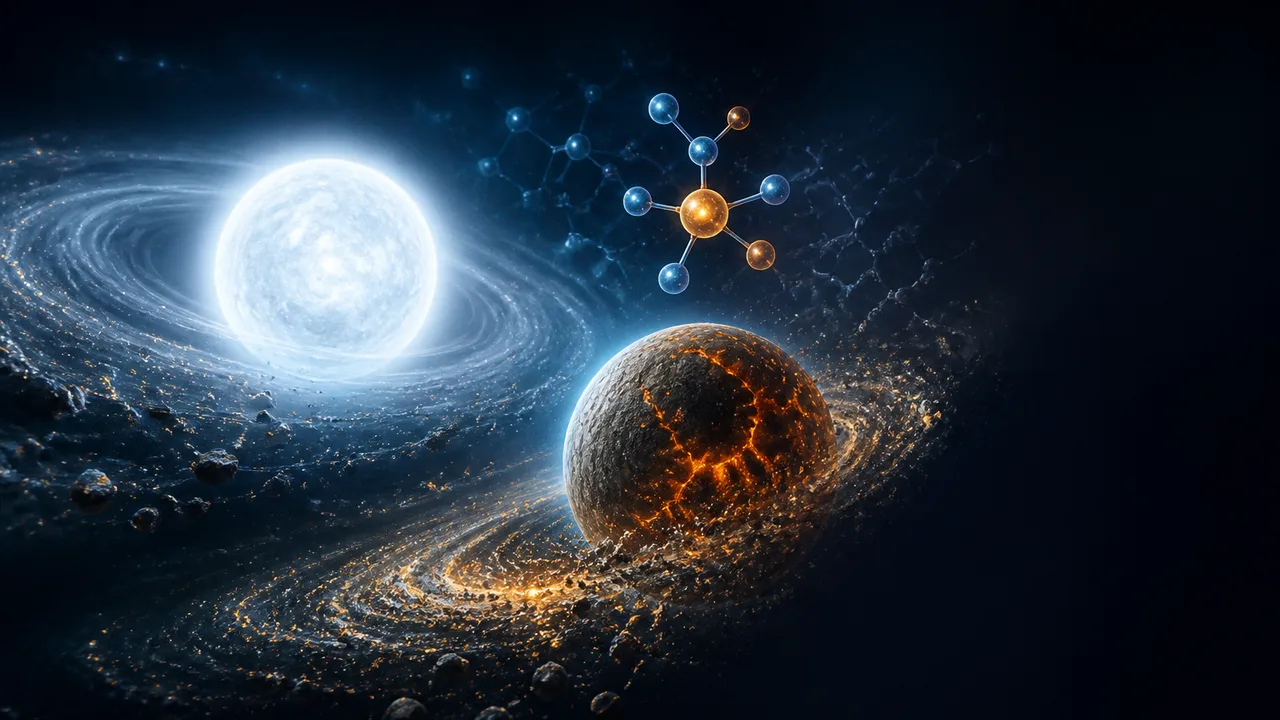
HS 0209+0832 has niobium in its atmosphere, and researchers think a planet born from its dying star's discarded material may be supplying it. That is an unusual route to a planet: the planets of our solar system formed from material left over when the Sun was young. A study published October 5 in Nature Astronomy proposes that this white dwarf, the exposed remnant of a star, is instead drawing material from a second-generation planet. The proposed planet remains a candidate. Its existence and origin are inferred chiefly from what is falling onto the star, rather than from a direct view of the planet.
The finding began with an old spectrum, a record of which wavelengths of light the star absorbs. Hubble observed HS 0209+0832 in 1999. Many chemical features in those observations initially went unidentified; a later analysis using improved atomic data matched numerous features to niobium. Data from the retired Far Ultraviolet Spectroscopic Explorer also showed strong niobium signatures. The striking result is therefore about the star's atmosphere. It does not require anyone to have photographed a silver planet.
White dwarfs give astronomers a useful, if indirect, way to examine planetary material. Heavier elements can sink out of their visible atmospheres, while infalling debris can replenish them. Ordinary cases of this atmospheric “pollution” often point to material resembling bodies in our solar system. HS 0209+0832 presents a different chemical puzzle. The researchers find niobium especially abundant relative to the pattern expected from familiar planetary material; their comparison of accreted material with solar abundances puts niobium more than three orders of magnitude higher. They also examine enhancements in other elements, including nickel and zinc. The useful question is not simply whether a metal is present. It is what mixture is arriving, and what could have made it.
A Chemical Clue with a Stellar History
An aging star can manufacture elements through slow neutron capture, often called the s-process, before shedding its outer layers. The study compares HS 0209+0832 with models of this late stellar phase. Those models frequently produce substantial niobium enhancement in expelled material, while predicting a different pattern for elements such as iron and calcium. A planet assembled from some of that ejecta could acquire a chemical history unlike that of a planet formed alongside a young star. If the hot white dwarf were then stripping and accreting material from such a planet, its atmosphere would become a record of the proposed planet's composition.
That chain has several links: stellar production, retention of expelled gas, planet formation, and subsequent transfer of planetary material back to the remnant. The niobium-rich atmosphere addresses the composition of material arriving at the white dwarf most directly. The formation story is the researchers' explanation for that composition, rather than a sequence of events astronomers watched unfold.
There is a second clue. NASA's TESS spacecraft recorded a small, repeating brightness change. The researchers measured a period of 4.399 ± 0.026 days and an amplitude of 0.120% ± 0.018%. A close-orbiting planet could produce periodic changes in the light, including variations associated with its heated face. The study also considers a comet-like tail of escaping material crossing the line of sight. Those are different ways a proposed planet might affect the light, so the periodic signal alone does not specify the planet's appearance or establish how its material reaches the star. The chemical pattern carries much of the argument for its origin.
The composition has a complication of its own. Niobium and strontium can both be associated with the s-process, yet the researchers did not detect strontium in HS 0209+0832. They discuss variation among aging stars and chemical processing within a planet as possible ways to account for the mismatch. They also examine a more direct alternative, material falling back from a disk of stellar ejecta. Spitzer did not detect the infrared excess expected from a large fallback disk of the kind seen in some evolved systems, and the simultaneous enhancement of zinc and niobium does not match the paper's model of how such disk material would accrete. These tests make the planetary interpretation more specific; they leave the detailed composition of any proposed planetary atmosphere to future modeling.
An Old Proposal Meets an Unusual Star
The idea that planets can form after stellar evolution predates this object. In a 2010 theoretical paper, Hagai Perets explored how an evolving star in a binary could transfer material to its companion. Under suitable conditions, that material could make a disk resembling the birth disk of a planetary system. The paper also considered how a new supply of material might alter planets that had survived an earlier phase. These possibilities gave astronomers several ways to think about planets around old stars, but an old star with a planet does not, by that fact alone, tell us when the planet formed.
HS 0209+0832 adds a different sort of clue to that history. Its researchers identify a chemical pattern they associate with material processed by an aging star, arriving now at a white dwarf. Zifan Lin, a planetary scientist who was not involved in the study, called it “the first time we’ve seen evidence for that process,” in comments to Science News. The careful word is evidence: the proposed birthplace lies in the star's past, while the measurements come from its present atmosphere and changing light.
The old binary proposal also exposes a practical problem for this candidate. A star shedding an envelope in all directions may lose too much material to leave a planet-forming disk nearby. The HS 0209+0832 team describes ways a binary companion could help create a disk, including an interaction in which a close companion enters the dying star's envelope. That is a proposed route for this system, not an observation of a companion or a reconstruction of one particular event.
A 2026 model of disks around post-AGB binaries, by Ali Pourmand and colleagues, sharpens the comparison. In its core-accretion calculations, planetesimals in higher-mass disks can grow rapidly if the conditions for forming them are met; growth in lower-mass disks is too inefficient to proceed as far during the modeled disk lifetime. The authors conclude that sufficient disk mass and locally enhanced dust relative to gas are needed. This is a calculation about what certain disks could produce. The HS 0209+0832 study also considers formation through direct gravitational collapse, a different pathway. A model that permits planets in one type of evolved-star disk cannot identify which pathway, if any, operated here.
Together, the comparison and the chemistry put the discovery in proportion. Theory has long offered ways to make planets from material released late in a star's life. The new observation supplies a candidate whose apparent chemical ingredients fit that broad possibility, while leaving open how the ingredients gathered and whether a planet is the body delivering them. Further ultraviolet studies of hot white dwarfs, which the researchers propose as a way to search for similar carbon and s-process signatures, could show whether HS 0209+0832 is one example of a recognizable population or an exceptionally awkward chemical case.
More Like This
How Archival Images Confirmed the Youngest Known Planet
Elias 2-24 b was confirmed through archival telescope images. Its record age shows how detection limits shape what astronomers know about infant planets today.

How the Brain Decides What Is Real and What Is Not
UCL neuroscientist Nadine Dijkstra explains how the brain constructs reality, why imagination isn't hallucination, and what breaks when the system fails.
Texas Chupacabra Sighting Explained by DNA Analysis
A Texas police dash cam captured a bizarre creature in 2008. DNA testing later revealed what it actually was — and the answer is stranger than fiction.