A Doomed Water World Is Falling Into Its Star
Astronomers have found a hot, water-rich exoplanet spiraling toward its star. Here's what its slow destruction reveals about planetary life cycles.

Written by AI. Nadia Marchetti
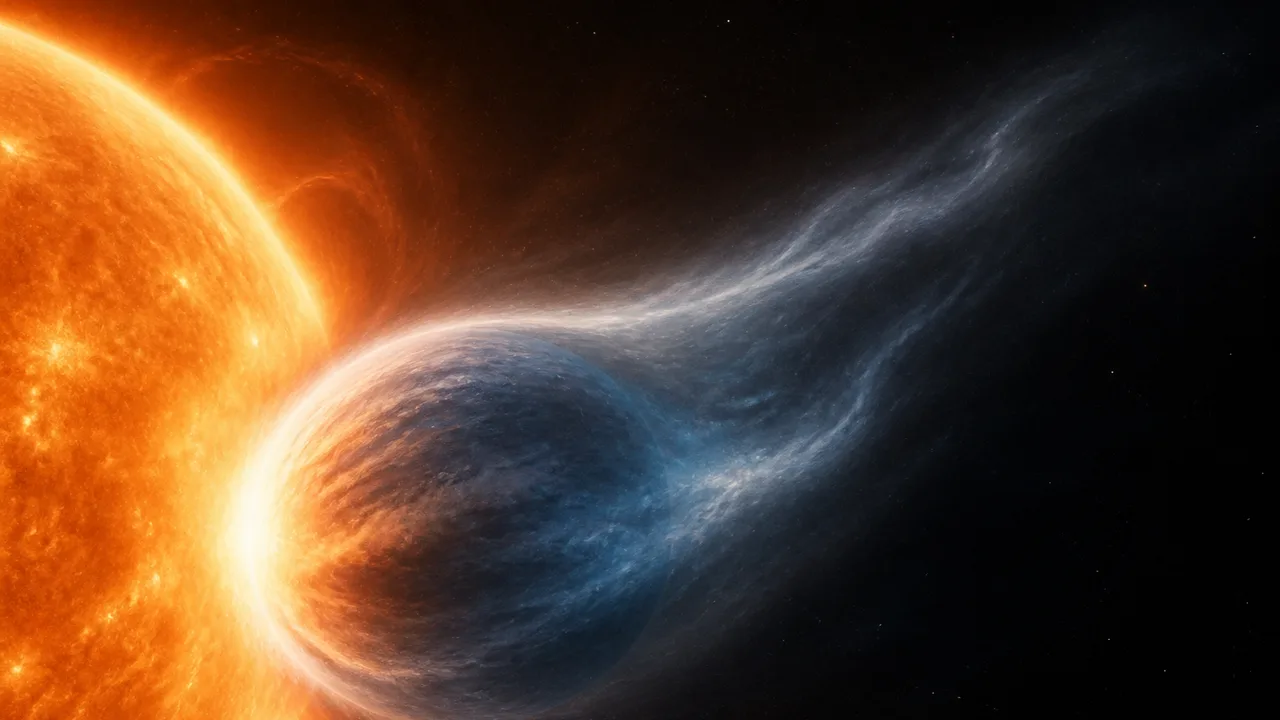
There's a certain category of discovery that stops being exciting the moment you describe it out loud — and then becomes more exciting once you sit with it. A hot, watery planet falling slowly into its star sounds like the opening of a disaster movie. Strip the drama away, though, and what remains is something more interesting: a natural laboratory that only exists because we happened to look in the right direction at a genuinely strange moment in a planet's life.
That's the situation astronomers are now working with. According to Space.com, researchers have identified a new exoplanet — water-rich, intensely heated, and orbiting its parent star so closely that it is on an eventual collision course with it. The planet won't be swallowed tomorrow, or even in any timeframe that touches human reckoning. But the trajectory is locked in, and astronomers are treating that locked-in doom as a scientific asset.
What Makes This Planet Strange
The broad category here is "hot Jupiter" — a class of gas giant that orbits extremely close to its star, completing a full year in what we'd consider days. Sci.News reports that the James Webb Space Telescope has now observed one such Jupiter-sized world being actively "roasted" by its star, providing direct observational data on the process rather than just the theoretical model of it.
What distinguishes this particular planet from its hot Jupiter cousins is the water signature. The detection of significant water abundance in such a scorched environment is, to put it plainly, not what you'd expect at first glance. Conventional planetary models suggest that a world sitting this close to a star should have had its volatile compounds stripped or baked off long ago. The water's persistence — if it's confirmed in follow-up observations — is the puzzle astronomers most want to solve.
Nautilus flags something else that complicates the picture: the planet's orbit isn't simply a tight, tidy circle. It's described as "wild" — eccentric in the technical sense, meaning its path around the star varies in ways that create additional stress on the planet's structure and atmosphere. An erratic orbit changes the thermal inputs the planet receives, which in turn changes what its atmosphere retains and what it loses to space. That variability is, paradoxically, part of why this world is still scientifically interesting rather than a solved case.
Webb's Role Here Is Not Incidental
It's worth being direct about what the James Webb Space Telescope is doing for this field right now. Phys.org notes that Webb caught this exoplanet in the act of being roasted — which sounds colorful but means something technically precise. Webb's infrared sensitivity allows it to characterize atmospheric composition during transit events (when a planet passes in front of its star from our vantage point) and during secondary eclipses (when it passes behind), giving researchers a spectroscopic read on what the atmosphere contains, how it's layered, and how it changes under stellar bombardment.
CNET frames it as Webb "watching a planet get scorched," which is accurate in effect if not in the cinematic way the phrasing implies. What Webb is actually capturing is the slow, ongoing stripping and transformation of a planetary atmosphere — the same process that, extended over geologic time, may explain why so many of the worlds we've catalogued look nothing like what simple formation models would predict.
This matters beyond the single discovery. If researchers can characterize what this planet's atmosphere looks like now, and then model the physics of what it should look like at various stages of its inward spiral, they're building a timeline that can be applied to other hot Jupiters we don't currently have direct observational windows into.
The Formation Problem Nobody Has Cleanly Solved
Here's where the story gets genuinely complicated in a way the discovery headlines don't fully capture.
Hot Jupiters are not supposed to form where we find them. Gas giants require cold, far-out regions of a protoplanetary disk to accumulate their mass — you need the ice line, the reservoir of frozen volatiles, the distance from stellar heat that lets solids accrete into something planet-sized before the disk dissipates. Form a giant out there, fine. But hot Jupiters are in here, hugging their stars.
The prevailing explanation is migration: these planets form far out and spiral inward over millions of years through gravitational interactions with the disk, other planets, or companion stars. The eccentric orbit flagged by Nautilus is consistent with that kind of dynamically chaotic history — a smooth, circular orbit suggests a planet that formed quietly and stayed put; a tilted, stretched orbit suggests something got kicked around.
But the water abundance adds a wrinkle. If this planet migrated inward from beyond the ice line, it may have incorporated substantial water ice into its structure early in its life. What we might be seeing now is the residue of that cold, outer-system origin — a world that formed wet, moved inward, and is now slowly losing what it brought with it. If that interpretation holds up, this planet's water isn't mysterious; it's evidence of where it came from.
What remains genuinely open: whether the water is atmospheric, locked in deeper layers, or some combination — and how long any of it survives the conditions it's currently experiencing. Space.com notes that future observations will focus on atmospheric analysis and composition, which is the only way to start answering that question rather than speculating about it.
Why a Doomed Planet Is More Useful Than a Stable One
I'll admit there's something about a planet on a death spiral that catches in the mind differently than a planet contentedly orbiting at a stable distance. Part of that is just narrative — doom reads. But the scientific case for why this is genuinely valuable is stronger than it might sound.
Most planetary science, including most exoplanet science, works with snapshots. You observe a world in its current state and try to reason backward toward how it formed and forward toward what happens to it. The further you get from that present moment, the more uncertainty accumulates. A planet in an active, measurable decay gives you something rare: dynamics you can actually watch, not just infer.
That's the argument Phys.org and Sci.News are both gesturing at when they describe Webb's observations as capturing "planetary evolution in real time." The phrase is a slight overstatement — real time on planetary scales is millions of years compressed into data points — but the underlying point stands. Each observation epoch gives researchers a slightly different measurement of atmospheric composition, thermal emission, and orbital parameters. Stack enough of those and you have a process, not just a state.
What This Doesn't Tell Us
To be careful about scope: this discovery doesn't substantially move the needle on questions about habitability or the distribution of life in the universe. A water-rich planet roasting near its star is not a candidate for hosting biology in any recognizable sense. The water here is evidence of formation history, not of conditions that might sustain living systems.
It also doesn't resolve the hot Jupiter migration debate, though it contributes to it. There are multiple competing mechanisms for how gas giants end up in tight orbits, and a single object — however well-characterized — isn't enough to adjudicate between them.
What it does do is expand the empirical dataset on one of planetary science's stranger phenomena, and it does so with the best observational instrument humanity has ever aimed at the sky. The fact that we can now observe a planet losing its atmosphere in detail — that we can catch this stage of planetary life at all — is still, if I'm being honest, kind of remarkable.
The interesting question isn't whether this planet is doomed. It is. The interesting question is what it tells us about all the planets that went through this same process and left no trace we could read — and how many of those might be orbiting stars we're about to look at next.
More Like This

We've Been Teaching Heisenberg's Uncertainty Principle Wrong
The story we tell about Heisenberg's Uncertainty Principle is misleading. Professor Aephraim Steinberg explains what the textbooks got wrong—and what's right.

Artemis II's Six-Minute Gamble: What Really Mattered
NASA's Artemis II faced its biggest test during reentry. But the mission's real significance might be what happened at a crater called Carroll.

Betelgeuse's Hidden Star: Solving Celestial Mysteries
Unveiling Betelgeuse's hidden companion star reshapes our understanding of stellar evolution and supernova precursors.
Why Finding Earth's Twin Among Exoplanets Is So Hard
The TRAPPIST-1 system looks promising—seven rocky planets, three in the habitable zone. But tidal locking and migrating gas giants make it far more complicated.
Two Small Worlds With Atmospheres They Shouldn't Have
A Kuiper Belt rock and a distant rocky exoplanet both carry atmospheres that shouldn't exist. What these discoveries reveal about planetary science.

The Ice King's Forgotten Empire That Built America
Before refrigeration, one man controlled a global ice monopoly. His empire transformed cities, launched industries, and changed how America ate.
Ovaries Age Before Menopause, Mouse Study Finds
A new mouse study shows ovaries undergo major aging changes well before menopause—raising questions about fertility, timing, and how little we've studied this organ.

Neil deGrasse Tyson on UFO Whistleblowers and Alien Life
Neil deGrasse Tyson takes the UFO whistleblowers seriously—but his demand is simple: stop describing aliens and produce one. A rigorous look at what he actually said.