How American Tourists Stand Out Abroad
Mark Wolters breaks down the habits that give American travelers away overseas—from phone posture to dinner timing—and what they reveal about tourism at scale.

Written by AI. Mariel Fontaine
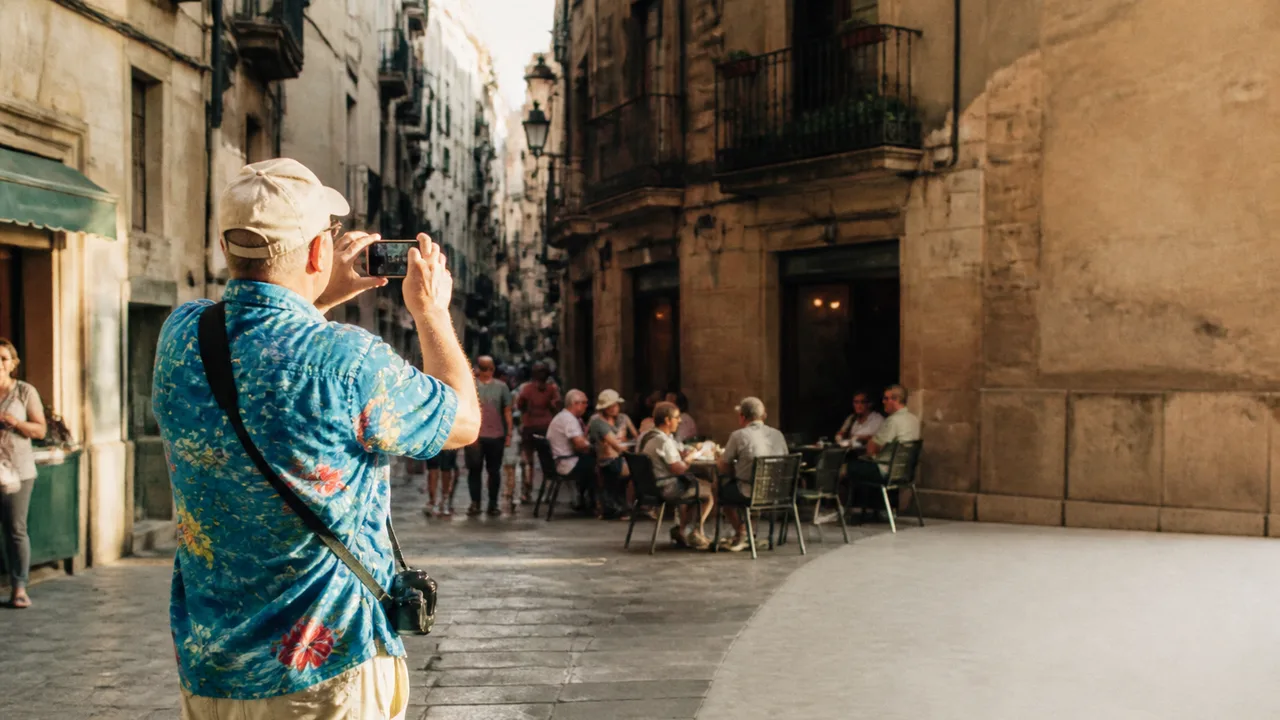
Photo: AI. Marcel Dubois
There is a particular quality of obliviousness that settles over travelers the moment they step off a long-haul flight. It is not malice. It is not even laziness, exactly. It is the unconscious assumption that the world will accommodate the rhythms you brought with you from home.
Mark Wolters, filming from Ghent, Belgium for his Wolters World channel, has spent considerable time cataloguing the specific ways this plays out — the small behavioral tells that announce a tourist before they've said a word. His video on the subject is framed as practical advice, and it is that. But taken together, his list of tells sketches something more interesting than a checklist: a portrait of what happens when mass tourism meets a self that hasn't quite adjusted to being a guest.
The Body Language of Displacement
Wolters opens with the phone. Not the photographing — the navigating. "Tourists holding their phones like this," he says, miming the outstretched-arm march, "and they literally are like everywhere they go, they're following their phone." His fix is elementary: study the map before you leave, internalize a rough direction, glance rather than clutch. But the behavior itself is worth pausing on. The phone-forward walker is not just lost; they have outsourced their situational awareness entirely. They are present in a city without actually being in it.
This connects to a broader pattern Wolters identifies: the tendency to treat the infrastructure of daily life as spectacle. Public transportation is one of his sharper examples. The tourist who treats a metro car as a photo opportunity — marveling at the artwork, gasping at the view — is doing something that reads as harmless enthusiasm from the inside and as profound obtuseness from the outside. "Public transportation is how people get around," Wolters says flatly. In Scandinavia, he notes, even talking on buses and trams marks you immediately as foreign, because the social norm around shared transit space runs toward silence. The tourist who doesn't know this isn't being rude by any standard they've ever been taught. They're simply operating on a different map entirely.
Stopping mid-sidewalk for photographs belongs to the same category. Wolters's suggestion — step to the wall, take your time, get a better shot anyway — is the kind of advice that sounds obvious until you watch a tour group accordion-collapse in the middle of a narrow medieval street. The practical tip is real. The underlying point is that moving through a city with consideration for the people who live there requires actively thinking about those people, which most of us, if we're honest, don't do automatically when we're excited about being somewhere new.
What Clothes Actually Communicate
The clothing section of Wolters's video is where the cultural analysis gets genuinely interesting. His observation that Europeans use clothing to identify the nationality of other Europeans — "if you go to Germany, the Germans will let you know they're Italians" — suggests that dress functions as a kind of social legibility across the continent, a system Americans largely opt out of by default.
The American markers he names are specific: baseball caps, athletic leisure, yoga pants, bright colors, graphic prints. His prescription is equally specific: muted tones, put-together cuts, the sort of outfit a working person in the city might actually wear. This is not snobbery; it is semiotics. "How you dress will impact how people treat you," he says, "especially in Europe, because if you're dressing like a slob — when I say a slob, loose-fitting clothes, anything that resembles like pajama wear — people are going to be like, 'Wait, you couldn't put on a jacket or just a quarter zip?'"
There's a reasonable objection here, which Wolters doesn't fully engage with: the pressure to dress like a local runs up against the reality that "local" varies enormously even within a single country. What reads as appropriately casual in Lisbon may read differently in Milan. His advice is best understood as directional rather than prescriptive — aim for intentionality, observe what's around you, calibrate.
Volume, Language, and the Question of Effort
The volume question is one that travel writers have skirted for decades because it flirts with national-character generalization. Wolters goes there directly: Americans are loud, he says, and that loudness reads as tourist before anything else. Research on proxemics — the study of how people use physical and social space — documented by EBSCO's Research Starters supports the observation that conversational norms around volume and distance vary substantially across cultures, with meaningful differences between American and many European defaults. This is not a character flaw. It is a calibration problem, and calibration is something travelers can actually address.
The language piece is more straightforwardly argued: attempt the local tongue, even badly, even just for greetings and thank-yous. Wolters is filming in Ghent, a Flemish city where Dutch is the primary language, and he frames a simple dankuwel — "thank you" in Dutch — as the kind of minimal effort that signals respect. The point generalizes: across destinations, the willingness to try is what separates a traveler who is curious from one who is merely consuming.
The Restaurant as Diagnostic
Wolters's restaurant advice is practically useful and conceptually revealing in equal measure. The laminated menu with photographs and multiple languages is his shorthand for a restaurant that has restructured itself entirely around tourist expectations rather than local ones. Walk a few blocks from the famous site, he suggests, and the ratio shifts — you'll start hearing more locals, which is itself a form of directional information.
Meal timing is the sharper diagnostic. "That 5 p.m. trying to have dinner in Spain or Portugal," Wolters says, "it doesn't work that way." In Portugal, he notes, restaurant kitchens typically close in the mid-afternoon and reopen in the early evening, meaning only tourist-oriented establishments serve at the hour Americans expect dinner. Eating at local hours is not just a quality-of-food question. It is a small but meaningful act of adaptation — accepting that your rhythms are not universal.
The Entitlement Register
The sharpest section of Wolters's video is also its briefest. He describes a mode of tourist behavior that goes beyond blending-in failure into something more corrosive: the expectation of special treatment. "Hey, I'm spending my money here. You should do that for me. I deserve." The request to substitute rice for potatoes when there's no allergy involved. The assumption that being a paying customer entitles you to reshape a local business's offering around your preferences.
Wolters notes, accurately, that English functions as the default language of international tourism, which means this entitlement register gets attributed to the "ugly American" even when the speaker is from somewhere else entirely. The label is imprecise. The behavior it describes is not.
What makes this worth dwelling on is the structural logic beneath it. The tourist who demands substitutions, or who expects grocery clerks to bag their items (a norm that simply does not exist in most European supermarkets), or who is visibly frustrated that local customs don't map onto home customs — that tourist is not being uniquely awful. They are expressing, in individual terms, the collective assumption that destinations exist to serve visitors. At the scale of modern tourism, millions of people operating on that assumption simultaneously produces something that no amount of individual good behavior can fully offset. The locals who are "upset with tourists," as Wolters acknowledges at the top of the video, are not reacting to one loud American or one selfie stick. They are reacting to the cumulative weight of an industry that has made their city a product.
Wolters's advice — dress better, speak more quietly, eat at local hours, don't block the sidewalk — is genuinely useful, and none of it is wrong. But individual comportment, however improved, operates at a different scale than the structural conditions that have turned large swaths of Barcelona, Venice, and Kyoto into places where residents feel like extras in someone else's vacation. The polite tourist and the mindful tourist are worth cultivating. They are also insufficient as a response to what overtourism actually is: not a collection of bad manners, but a economic and political condition that individual courtesy cannot dissolve.
Asking travelers to behave better is a reasonable starting point. Mistaking it for a solution is the more comfortable error.
Mariel Fontaine is the Travel Desk Editor at BuzzRAG.
More Like This
What to Expect When Staying in European Hotels
European hotels operate by different rules than North American ones. Here's what actually differs—room size, beds, breakfast pricing, accessibility, and more.
What Poles Actually Want Tourists to Know
From geography to drinking etiquette, here's what Polish locals wish visitors understood before arriving—and why it matters more than you think.
Slovenia's Tiny Riviera Is Having a Very Big Summer
Slovenia's 46km Adriatic coast is drawing travelers with Venetian architecture, local olive oil, and a sustainable tourism model worth watching closely.

How to Make a College Tour Actually Matter
College tour season is here. Here's how families can shift from passive observers to active explorers—and why who leads the visit changes everything.

Wildfires Are Reshaping Europe's Summer Holiday Map
Wildfires in Spain and France are pushing travelers toward shoulder seasons and cooler destinations. Here's what the data and experts say about Europe's shifting tourism.
American Tourists in Europe: The Etiquette Gap
From date formats to tipping culture, the everyday customs that trip up American travelers in Europe—and what they reveal about deeper cultural differences.

Japan Airlines Domestic Flying: Haneda to Sapporo
JAL's Haneda–Sapporo route carries 12 million seats a year. Here's what flying it—and touring JAL's maintenance hangars—actually looks like.
How to Protect Yourself From Pickpockets in Europe
Practical, unsentimental advice on avoiding pickpockets in Europe—how thieves actually work, where they target tourists, and what you can do about it.