How 911 Became America's Uneven Emergency Lifeline
From fire boxes and funeral-home ambulances to Haleyville's first call, the history of 911 shows why a simple number required decades of public investment.

Written by AI. Margaret "Maggie" Holloway
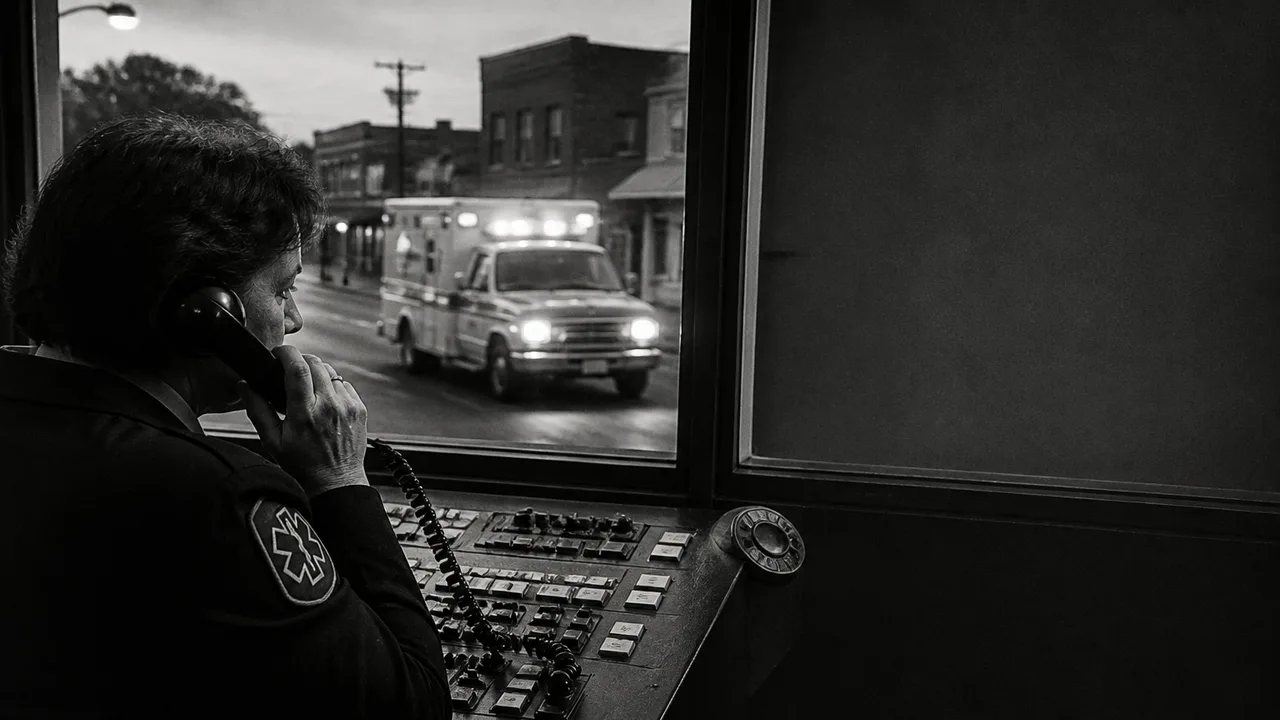
Photo: AI. Atticus Ferenczi
AT&T announced 911 as the United States' universal emergency number on January 12, 1968, but an announcement could not build the dispatch centers, telephone equipment, jurisdictional agreements, or ambulance services required to answer it.
That gap between designation and delivery defines the history of 911. The number looks almost weightless: three digits, learned in childhood, available without consulting a directory. Behind it sits a local and regional apparatus of call takers, telecommunications networks, police and fire departments, medical responders, maps, databases, radios, and public budgets. Americans created the memorable doorway in 1968. Building the rooms behind it took decades, and renovation continues.
The first 911 call was placed on February 16, 1968, in Haleyville, Alabama, from the town's mayor to its police chief. It was a ceremonial call, made possible by the independent Alabama Telephone Company shortly after AT&T's announcement. Haleyville had won a small-town sprint to demonstrate a national idea.
The ceremony makes a tidy historical marker. The system does not make tidy history.
Three Digits as Public Architecture
Before 911, callers confronted a directory of institutions at the worst possible moment. Police precincts, fire stations, hospitals, ambulance operators, and telephone exchanges maintained separate numbers. A resident might know the correct one; a visitor, child, or person in panic might not. Dialing zero brought an operator into the chain, often with the additional task of determining which agency served the caller's location. Emergency access depended upon geography, local knowledge, telephone service, and the institutional arrangements of a town or county.
A universal number reduced cognitive friction. It also concealed jurisdictional complexity from the caller. Someone reporting smoke should not need to know whether a municipal department, volunteer company, county sheriff, or neighboring ambulance district owns the response. Good infrastructure turns that organizational thicket into one action.
Yet basic 911 initially solved only the first step. Early systems could route a voice call without automatically displaying the caller's number or location. Enhanced 911 added those capabilities. Mobile phones complicated location again because a handset could no longer be associated with one fixed street address. Text messages, rural dead zones, aging switching equipment, and incompatible local systems have kept the supposedly finished invention under construction.
The Emergency Before the Number
The strongest case for 911 came from the condition of American emergency medicine. In 1966, the National Academy of Sciences published Accidental Death and Disability: The Neglected Disease of Modern Society. The report described inconsistent ambulance standards, inadequate equipment, poor coordination, and attendants who often lacked training.
Funeral homes provided many ambulance services because hearses could carry a person lying flat. That arrangement reflected the available vehicles and local businesses, rather than some national design for medical care.
A phone number could summon only what a community had available. Where the responder was an undertaker's employee driving an unequipped vehicle, faster contact did not produce modern prehospital medicine. The 1966 report therefore belongs to the broader history of emergency medical services, highway safety, training, vehicle standards, and trauma care. A three-digit access code became one component of that reconstruction.
Federal pressure followed. President Lyndon Johnson's Commission on Law Enforcement and Administration of Justice recommended a single emergency number in 1967. As Gallatin County's history of the system recounts, federal officials worked with AT&T before the company selected and announced 911. The digits were short, distinctive, and compatible with the North American telephone system.
Selection was the easy meeting. Implementation required local money and cooperation from agencies accustomed to controlling their own calls, personnel, and territory. A police department and fire department might agree that citizens needed help while disagreeing over who would answer first, where dispatchers would sit, how costs would be divided, and whose radio system would carry the message. Infrastructure has a habit of turning philosophy into invoices.
Kitty Genovese and the Danger of a Useful Myth
The 1964 murder of Kitty Genovese in Queens became attached to the campaign for better emergency access. The New York Times initially reported that 38 witnesses had watched or heard the attack without intervening, a narrative that entered psychology textbooks as an illustration of the bystander effect.
Later examinations challenged that account. Witnesses had different, partial views; some did not understand what they heard; some attempted to act. Sophia Farrar went to Genovese and remained with her as she lay dying. Any history that uses Genovese only as a symbol repeats the old erasure in a new form, converting a murdered woman and her neighbors into pieces of civic folklore.
The emergency communications question remains relevant, but the evidentiary line should stay visible. The Genovese case helped focus public attention on access to police, yet it did not single-handedly create 911. Fire chiefs had already called for a universal fire-reporting number in 1957, and the highway death crisis supplied extensive quantitative evidence for reform.
Public policy often acquires one unforgettable story after years of neglected reports. The story gives the problem a face; it can also flatten disputed facts and hide the people who had been documenting the system's failures all along.
An Older Idea in a New Device
The operating principle behind 911 predates the telephone. During the 19th century, telegraph fire-alarm boxes allowed a person to pull a mechanism that transmitted a coded location to a central station. William Francis Channing and Moses Farmer developed an early working network in Boston in 1852. Later Gamewell boxes became familiar pieces of street furniture in American cities.
Those iron boxes reveal something the telephone initially lost. Each box possessed a known location. Its code told the fire station where the alarm originated, even if the person pulling it could provide no address. Basic 911 offered a voice connection but could leave dispatchers asking a frightened or injured caller to identify the scene. Enhanced 911 restored location as a system feature, while mobile service forced engineers and policymakers to solve the problem again.
The boxes also served primarily one emergency: fire. Telephone-based 911 promised a common entrance for police, fire, and medical calls. That consolidation made access simpler for the public while increasing the coordination expected behind the switchboard.
A National Number with a Local Map
Today, dialing 911 generally connects a caller to a public safety answering point, the dispatch office responsible for routing the emergency. The word “universal” can obscure how local the service remains. Geography determines the center receiving the call, the agencies available, the technology in use, and the time required to send help.
Rural coverage exposes the old problem in modern equipment. A person may remember the number and carry a phone, yet lack a reliable signal or provide a location that software cannot identify accurately. Text-to-911 can widen access for people who cannot safely speak or who have hearing or speech disabilities, but availability depends on the jurisdiction's capabilities. New interfaces still arrive county by county, budget by budget.
That unevenness does not cancel the achievement of 911. It identifies what the achievement actually was. America standardized the public's request for emergency help, then spent decades assembling local institutions capable of honoring it. Haleyville's first call proved that three digits could ring a telephone. Every call since has tested whether the larger system knows where the caller is, who should respond, and what help will arrive when the line goes quiet.
More Like This
George Washington: The Man Behind the Monument
From battlefield defeats to a death made worse by his own doctors, Washington's life is more complicated than the marble monument version suggests.

Homer's Odyssey and Mycenaean Religion: Fact vs. Myth
Homer set the Odyssey in the Bronze Age but wrote it 500 years later. How accurate is his religion? Linear B tablets reveal a startling gap.