How Old Copper Phone Lines Became Broadband
ADSL was built to stream movies, not browse the web. The accidental pivot that followed helped bring hundreds of millions of people online.

Written by AI. Margaret "Maggie" Holloway
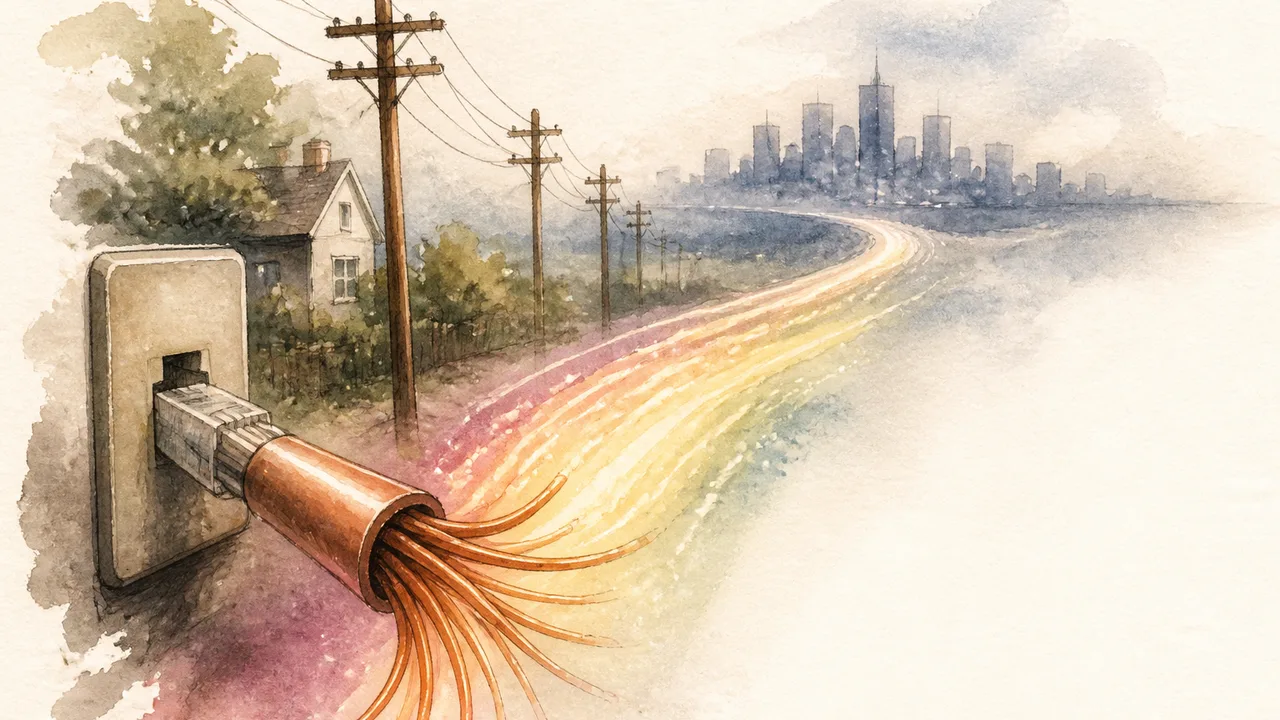
Photo: AI. Júlia Almeida
The copper wire running into your grandmother's house was probably installed before she was born. AT&T's twisted-pair telephone cables — two insulated copper wires wound around each other to reduce electromagnetic interference — have been a fixture of American infrastructure since the earliest days of the telephone. Decades of voice calls. Miles and miles of the stuff, buried under streets and strung between poles, almost none of it touched since installation.
What happened next is the kind of story that infrastructure nerds — and honestly, anyone who ever waited four minutes for a JPEG to load over a dial-up connection — should find genuinely remarkable. Engineers figured out how to take that antique copper and push millions of digital bits per second through it. The technology was called ADSL: Asymmetric Digital Subscriber Line. And as a recent Asianometry video details, it was built for entirely the wrong purpose.
The Wrong Problem
The origin story starts not with the internet, but with cable television.
Through the 1980s, cable companies built out their coaxial networks at extraordinary speed, and the Baby Bell telephone companies — spun off after AT&T's federally mandated breakup — watched with unease. Cable had a direct pipe into people's living rooms. It wasn't hard to imagine that pipe eventually carrying phone calls too. The telecoms needed to get into video delivery, and they needed to do it using the infrastructure they actually had: copper.
In 1992, the FCC allowed the Baby Bells to offer what they called "video dial tone" — essentially, pick up your telephone and have a movie stream to your home. The catch was that the telecoms couldn't own the content, only transmit it. A reasonable enough constraint, except that it immediately created a dependence on movie studios who had little incentive to play along.
The harder problem was physics. Coaxial cable can carry a lot of signal. Copper twisted pairs, designed for voice, could barely manage 144 kilobits per second under the best conditions, using the ISDN standard that engineers had spent years developing. ISDN was slow enough that industry wags mocked the acronym as standing for "Innovation Subscribers Don't Need."
The Asymmetry Insight
The breakthrough came from a researcher named Lechner — referred to in the Asianometry account as "Lech Leed" — who noticed something structurally odd about telephone networks. At the carrier's central office, dozens or hundreds of copper pairs all converge. That convergence creates electromagnetic noise: signals from neighboring pairs bleeding into each other, a phenomenon called near-end crosstalk. The household end of the wire, by contrast, typically has just one or two pairs coming in. Much quieter.
The implication: the household can receive far more data than it can send, because the noisy, interference-prone environment at the carrier end limits upstream transmission. So rather than splitting frequencies evenly between upstream and downstream — the obvious approach — why not give the downstream direction a much larger share? You'd sacrifice upload speed, but you'd dramatically increase how much data could flow into the home.
When this asymmetric concept was first proposed, the Asianometry video notes, nobody considered it especially practical. Then the telecoms decided they needed to stream movies to households, and suddenly an asymmetric design made perfect sense. Video streaming is almost entirely downstream traffic. The insight went from theoretical curiosity to engineering priority almost overnight.
The Bake-Off
Once the asymmetric architecture was settled, the next contest was over how to encode digital data onto the copper signal — what engineers call a line code. In 1993, Bellcore, the research consortium shared by the Baby Bells, held a competition that became known informally as the Bellcore Shootout. Three competitors entered.
AT&T put forward CAP (Carrierless Amplitude Phase). A young company called Broadcom — not the semiconductor giant that name later became, but an earlier wireless and broadband firm — entered QAM (Quadrature Amplitude Modulation). CAP and QAM were technically similar: both used a single broad frequency band, both drew on well-understood algorithms. The safe choices.
The dark horse was DMT: Discrete Multi-Tone. Championed by a Stanford professor named John Cioffi and his startup Amati, DMT worked by splitting the available copper frequency spectrum into hundreds of narrow sub-channels — 256 slices, each roughly 4 kilohertz wide — and transmitting data across all of them simultaneously. Where the copper was noisy at higher frequencies, DMT could simply dial back the data rate on those channels. Where the wire was clean, it could push harder. The system effectively interviewed each individual copper loop and optimized for its particular quirks.
DMT won. The Asianometry video describes the resulting speed as "shocking" — up to 6 megabits per second, far beyond what CAP or QAM could achieve. The downsides were real: DMT was computationally intensive, engineers were less familiar with it, and Amati had only produced a prototype. Someone would need to turn this into deployable hardware at scale.
Alcatel's Pivot
That someone turned out to be Alcatel, then among the world's largest telecommunications firms. A small team at their research center in Antwerp had been quietly exploring DSL possibilities since 1992, initially working on single-carrier approaches like CAP. When DMT won the Bellcore competition, Alcatel's Wim Verbiest recalled the moment with notable candor: "I had a meeting in the United States concerning CAP technology and standardization. We were developing CAP in cooperation with Bellcore, and we were certain that the CAP technology would become the standard. After the meeting, I left to travel back to Belgium. And when I arrived in Belgium, I heard that DMT was chosen as the standard instead of CAP. This meant we had developed the wrong technology."
The response was to pivot immediately. Alcatel licensed DMT, expanded the team to over a hundred people, and by 1995 had produced the first DMT-based ADSL chipset — built before the final ADSL standard had even been published. By mid-1997, they had a video streaming product ready to sell.
The telecoms, however, no longer wanted it.
Regulation Kills the Product, Saves the Technology
The 1996 Telecommunications Act — passed by Congress to reshape the entire competitive landscape of American communications — removed the restriction that had prevented telecoms from buying cable operators in their own service areas. Video dial tone had existed precisely because the Bells couldn't own cable. Once they could, the rationale for video dial tone dissolved. The product died before it reached the market.
Bell Atlantic CEO Ray Smith had been enthusiastic about ADSL as recently as 1995, telling Wired magazine: "ADSL is not an interim technology, at least not in the sense that it's second best or doesn't work well. It has excellent quality. You can do the virtual VCR over it." He wasn't wrong about the technology. He was wrong about where demand was actually headed.
Because by 1996, somewhere around 20 million American households were trying to get onto the internet — mostly through dial-up modems that commandeered the phone line, maxed out around 28.8 kilobits per second, and made it impossible for anyone else in the house to make a call. A Pacific Telesis study cited in USA Today found that in one region, 16% of local calls were failing to connect due to internet traffic. Historically, the failure rate had been around 1%.
The telephone companies had accidentally built a technology capable of solving exactly this problem. ADSL didn't touch the voice band at all — it operated at higher frequencies, leaving ordinary phone calls completely undisturbed, while delivering internet speeds that made dial-up look absurd.
The Accidental Broadband Standard
The pivot from video to internet required relatively little technical renegotiation. Streaming video downstream, browsing the web downstream — the physics were similar. The asymmetric design that had seemed perfect for movies turned out to be equally well-suited to how people actually used the internet: lots of downloading, comparatively little uploading.
Competition eventually pushed the reluctant Baby Bells to commit. Cable companies, under pressure from satellite TV, had begun offering cable modem internet and gaining subscribers. The 1996 Act had also created a new class of competitive local exchange carriers — startups that could lease the Bells' copper infrastructure and resell internet access through it. The incumbents moved.
Four Baby Bells — Ameritech, BellSouth, Pacific Bell, and SBC Communications — formed a joint purchasing consortium in 1996 to standardize equipment and drive down costs. Alcatel won the contract on price and completeness of solution. Commercial deployments in the United States began in 1999.
Globally, ADSL found an even more receptive audience. Korea's dense apartment infrastructure and legacy copper loops were particularly well-suited to what ADSL could do; South Korea counted over 10 million DSL users by 2002, according to Asianometry's account. Europe, where cable internet had never taken deep root and regulators pushed incumbents to open their lines to DSL-only startups, became ADSL's most important market. At its peak, DSL claimed roughly 360 million lines worldwide.
Later iterations of the technology — pushed by continued engineering refinement — achieved speeds that would have seemed impossible to the engineers who designed the original twisted pair for voice calls in the 1880s. The VDSL2 standard is capable of reaching up to 200 megabits per second.
What the Wire Knows
The question ADSL's history poses isn't really a technical one. It's a question about how transformative technologies actually happen.
The clean story — brilliant inventors see a need, design a solution, change the world — almost never holds up under examination. ADSL was designed for a product that was killed by regulation before it launched. The technology survived by being repurposed for a use case that barely existed when development began. The engineers who built it were often working on the wrong standard until a competition result landed while they were traveling home from other meetings. The company that ultimately commercialized it most successfully had to pivot from a technology it had spent years developing.
There are an estimated 100 million or more DSL subscribers still getting their internet over copper wire. The infrastructure those lines run through was in many cases installed before their users' parents were born. As Asianometry notes: "DSL's near miraculous repurposing of existing copper infrastructure smoothly brought hundreds of millions of people online." The miraculousness is real. So is the accident.
The wire didn't know what it was going to carry. It just carried it.
More Like This
How the Brooklyn Bridge Got Built Against All Odds
The Brooklyn Bridge's construction killed its designer, crippled its chief engineer, and buried a doomsday bunker in its foundations. Here's what it actually took.

Unveiling Rome's Gladiator Underworld
Explore the hidden world beneath ancient Rome's arenas, unveiling gladiator training, underground tunnels, and cultural practices.

Jackie Kennedy and Lee Radziwill's Bitter Lifelong Feud
The feud between Jackie Kennedy and her sister Lee ran deeper than jealousy. A look at the betrayals—plural—that made it permanent.
DC Power's Long Road Back: How Sweden Changed Everything
How a Swedish engineer's 40-year obsession with a faulty valve quietly built the backbone of today's renewable energy grid.
Dual Internet Connections Are Still Needlessly Hard to Set Up
IPv6 multihoming could let you plug two ISPs into one network and get automatic failover. Here's how close we actually are—and what's still broken.

The Science and Stories Behind Earth's Fiercest Winds
Explore the science of deadly winds, from hurricanes to tornadoes, and the people dedicated to understanding and surviving them.
Homer's Odyssey and Mycenaean Religion: Fact vs. Myth
Homer set the Odyssey in the Bronze Age but wrote it 500 years later. How accurate is his religion? Linear B tablets reveal a startling gap.

Ten Scientific Discoveries Nobody Saw Coming
From Fleming's contaminated petri dish to Hubble's blurry mirror, accidental observations have repeatedly reshaped what we know about life and the cosmos.