The Gulf Stream's History and Its Uncertain Future
From Ponce de León's journals to modern oceanography, the Gulf Stream has shaped history—and its potential weakening could reshape the world.

Written by AI. Olivia Meng
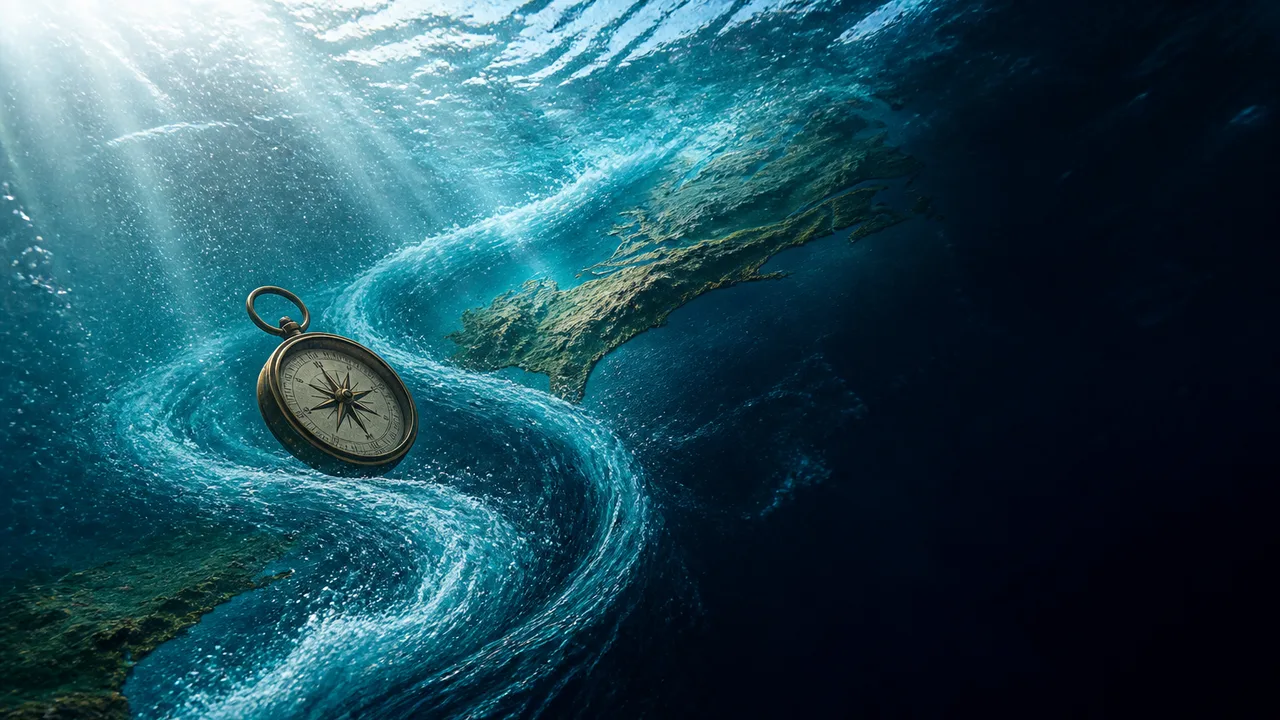
Photo: AI. Sela Marin
On April 22nd, 1513, Juan Ponce de León recorded something in his ship's journal that he almost certainly did not understand. His vessels, sailing with favorable winds off the coast of what he had just named La Florida, could not make headway. One ship was pushed backward. He had stumbled into a current more powerful than the wind itself — the Gulf Stream — and he noted the encounter without grasping what it was.
That gap between observation and understanding is, in a way, the whole story of the Gulf Stream. Sailors navigated it for centuries before anyone mapped it. Benjamin Franklin named it before oceanographers could fully explain it. And today, we have instruments, satellites, and decades of submersible data — and we are still arguing about what, exactly, is happening to it.
An Ocean Highway That Built the Modern World
The Gulf Stream's role in history is not incidental. It is structural.
Once Spanish mariners grasped what Ponce de León had encountered, the current became an ocean highway. Ships laden with wealth from the Caribbean could ride it northward, pick up the westerly winds at mid-latitudes, and sail home to Spain. As the Geographics video on the stream's history puts it, the route "drew the attention of less honest mariners in the 17th and 18th centuries. Piracy flourished in Florida, the Carolinas, Virginia, and in the islands passed by the current. It was like a highway bringing their prey to their lairs."
The stream didn't just enable piracy. It shaped the transatlantic slave trade's triangle routes, contributed to the Pilgrims landing in Massachusetts rather than at the mouth of the Hudson River (the current's opposing force frustrated their attempts to sail south from Cape Cod), and gave German U-boats a convenient exit lane from the American coast during World War II. The Tirpitz, moored near Tromsø in northern Norway for much of the war, owed its ice-free berth in part to the North Atlantic Drift — the Gulf Stream's northern extension.
None of this was coincidence. It was geography expressing itself through fluid dynamics.
What the Stream Actually Is
The popular understanding of the Gulf Stream contains at least one significant error: it is not driven by warm water pouring out of the Gulf of Mexico. As oceanographer Henry Stommel observed in 1958, very little Gulf of Mexico water is actually in the stream. What drives it is wind stress on the ocean's surface, heat transfer, and the Coriolis effect — the deflecting force generated by Earth's rotation.
The current itself originates from the Atlantic North Equatorial Current, which crosses from Africa toward South America, splits, and eventually funnels through the Florida Straits. It begins its northward journey moving about 30 sverdrups (one sverdrup equals one million cubic meters of water per second). By the time it reaches the waters below Newfoundland, that volume has grown to roughly 150 sverdrups — dwarfing the combined flow of every river draining into the Atlantic from Africa, Europe, and both Americas, which together contribute a comparatively modest 6 sverdrups.
At its northeastern branch, the North Atlantic Drift carries warm water into northern European latitudes that have no business being as temperate as they are. The United Kingdom, France, Scandinavia — all of them sit considerably north of the continental United States. Tromsø, Norway, lies above the Arctic Circle on an island off the Norwegian mainland. Its harbor remains ice-free year-round. Its coldest recorded temperature, reached in February 1966, was -8.1°C — roughly equivalent to a brisk winter day in parts of the American Midwest.
That is not a coincidence of geography. It is a consequence of the stream.
A System Under Scrutiny
Here is where the picture becomes genuinely complicated, and where honest reporting requires holding multiple findings at once without forcing them into a single narrative.
A 2023 study published in Nature Communications, covered by The Guardian, suggested that the broader Atlantic current system — formally known as the Atlantic Meridional Overturning Circulation, or AMOC — could collapse as early as 2025 and likely before 2050. The mechanism cited was the melting of Greenland's glacial cap, which floods the North Atlantic with fresh water, disrupting the salinity-driven density differences that help power deep ocean circulation.
That study drew significant attention and significant skepticism. In the same year, the Woods Hole Oceanographic Institution released findings from more than two decades of submersible measurements. Their conclusion was different in character: the Gulf Stream is warming faster than the surrounding ocean and shifting closer to the U.S. East Coast — but the forces that create it, wind patterns and Earth's rotation, aren't going anywhere. Woods Hole stopped well short of predicting collapse.
Then, in January 2025, a joint U.S.-Swiss research team added another data point. According to SciTechDaily, that study found that AMOC has not declined over the past six decades — but projects that it will weaken as global temperatures continue rising. Not collapse. Weaken. The distinction matters, even if the downstream effects of significant weakening would themselves be severe: disrupted rainfall across Europe and East Asia, agricultural failures, and the end of ice-free harbors that northern economies depend on.
A separate line of inquiry involves what researchers have called a "cold blob" — an anomalous patch of cool water in the North Atlantic that some scientists interpret as a fingerprint of AMOC slowdown. Reporting from Science News suggests this feature may be evidence that the circulation is already weakening, even if the signal hasn't yet crossed the threshold of irreversibility.
What the Disagreement Actually Means
It would be tempting to read the scientific disagreement here as uncertainty about whether the Gulf Stream matters. It doesn't mean that. The disagreement is about rate and mechanism — how fast, through which pathways, triggered by what precise thresholds. The underlying physics are not in dispute: add enough fresh water to the North Atlantic, disrupt salinity-driven circulation, and the system that has kept northern Europe temperate for millennia begins to fail.
The Geographics video frames the stakes plainly: "If the North Atlantic Gyre were to collapse, as is believed now to be likely sometime this century, the effects would be catastrophic. Forget Yellowstone erupting. This would be way worse."
That framing is somewhat rhetorical, but the substance isn't wrong. What's at stake is not an abstraction. It is the agricultural viability of northern Europe. It is the habitability of cities at latitudes that only function because a ribbon of warm water has been doing invisible work for 2.5 million years.
The stream's own history offers a useful lens here. Ponce de León encountered something he couldn't explain. British sea captains, when Franklin published his chart in 1770, largely ignored it — "widely ignored it," as the video notes — because it challenged what they already believed about Atlantic navigation. The cost of that institutional indifference was slower mail delivery. The cost of the current institutional indifference is of a different order entirely.
Whether the tipping point for AMOC has already been passed, as some climate scientists now argue, or whether meaningful intervention remains possible, is a question the data cannot yet definitively answer. What the data does answer is that the current is changing — warming, shifting, behaving in ways outside its historical range. A system that quietly underwrote five centuries of human history is no longer quietly doing anything.
More Like This
How Humidity Makes Extreme Heat Deadly
Wet bulb temperature, not air temperature, determines when heat kills. Joe Hanson's lab experiment reveals what our bodies face in a hotter, more humid world.
Venice Is Sinking and Emptying at the Same Time
Venice faces two accelerating crises: rising seas and a vanishing population. Neither MOSE nor a €5 tourist fee comes close to solving either one.
Unveiling the Trench Effect: Lessons from King's Cross
Explore the King's Cross fire, the trench effect, and vital fire safety reforms reshaping public infrastructure.
Lab-Grown Mini Brains and Climate Solutions
Exploring the ethical and practical implications of lab-grown brain organoids and solar geoengineering.
Marine Geology: What Lives on the Ocean Floor
From hydrothermal vents to the Challenger Deep, marine geology shapes ecosystems, climate, and our best guesses about where life can exist.
Whales Are Moving Into Ice-Free Greenland Waters
As Arctic sea ice retreats, baleen whales are staging seasonal feeding frenzies off East Greenland—signaling a profound marine ecosystem shift.
Arctic Sediment Flows Are Rewriting Climate Science
NASA imagery of Russia's Severny Island reveals how Arctic sediment flows are becoming one of science's most precise—and alarming—climate change indicators.

Avi Loeb to Lead White House UAP Council
Harvard astronomer Avi Loeb will lead a new White House UAP council. What the council's structure reveals about whether it's built for science or optics.