Green Bank's 1988 Telescope Collapse, 38 Years Later
The 1988 collapse of Green Bank's 300-foot radio telescope ended an instrument's work. Thirty-eight years later, it highlights the hidden engineering behind astronomy.

Written by AI. Nadia Marchetti
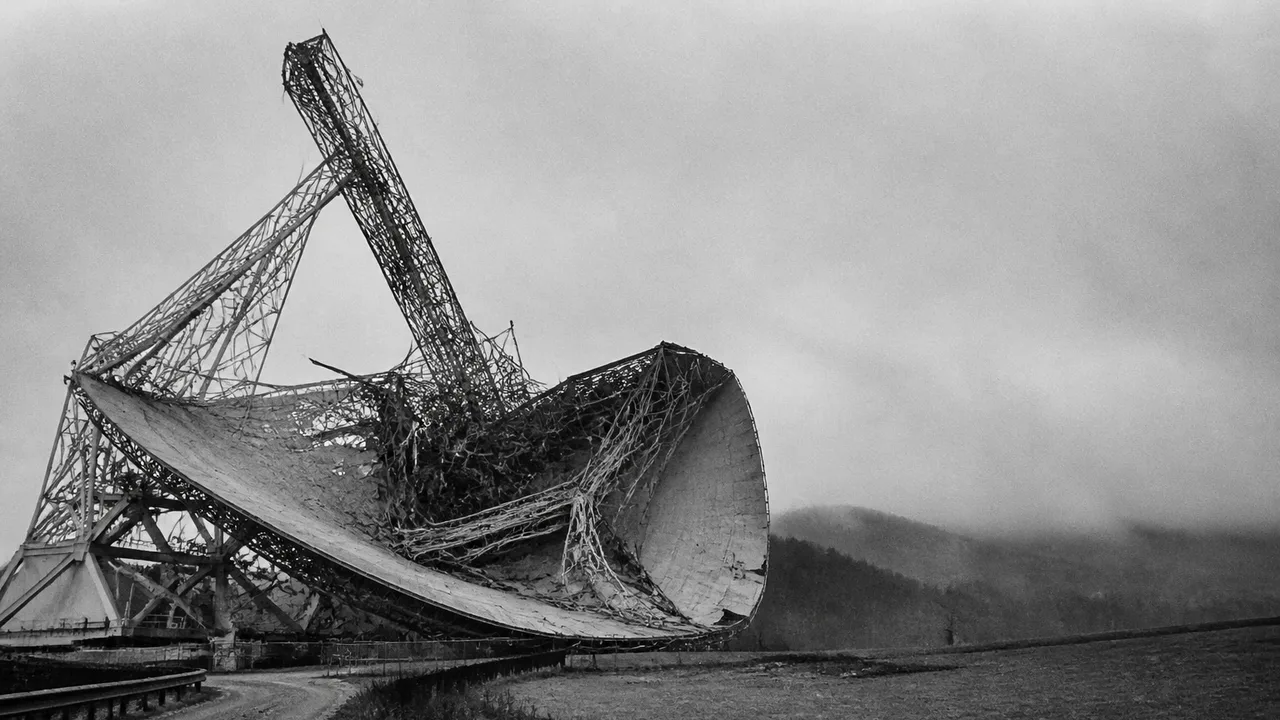
On November 15, 1988, the 300-foot radio telescope collapsed at Green Bank, West Virginia. The National Radio Astronomy Observatory says it happened at night; daylight revealed the extent of the damage. A structure built to collect signals from the sky had become a pile of metal on the ground.
The collapse occurred at 9:46 p.m. on a clear night without strong winds. Those details make the event unsettling, but calm weather is no diagnosis.
Thirty-eight years on, the firmest account is also the most useful starting point: Green Bank lost a working radio telescope. Astronomy depends on records of past observations, but it also depends on instruments capable of making the next observation. The collapse ended that instrument’s ability to do its job.
What a Telescope Collapse Takes Away
A radio telescope gathers radio waves from space and directs them toward equipment that can turn a faint signal into measurements. Its size is part of the scientific proposition. So are its supports, the machinery that positions it and the procedures that keep it fit for use. If the structure fails, researchers cannot simply carry on with the same instrument and the same observing plan.
That consequence is narrower than saying the collapse erased the observatory’s science. Measurements already recorded do not disappear because the telescope that collected them falls. Other instruments can continue their work. Yet a lost telescope also means lost opportunities to gather new measurements with that telescope. An observation planned for a particular date cannot always be recreated later: a target may change, or the question a researcher hoped to answer may depend on measurements taken at a particular time.
That is a general consequence of losing observing capacity, rather than a claim that any named Green Bank project missed its chance in 1988. The distinction keeps the scale of the loss clear without assigning outcomes to researchers whose plans are not documented here.
The anniversary of the collapse also draws attention to an easily overlooked feature of scientific progress. Discoveries often enter public memory through an image, a signal or a striking conclusion. The instrument’s working life includes many less visible tasks: maintaining a structure, checking how it performs and deciding when repairs must take priority over observations. Those tasks produce fewer memorable headlines than a new finding. They determine whether the instrument can produce one at all.
The Name that Can Mislead
Green Bank later became home to the separate 100-meter Green Bank Telescope. The facility that collapsed in 1988 was the 300-foot telescope, not that later instrument. The similar names make it easy to compress different chapters of the observatory’s history into a single story, especially when a photograph of wreckage circulates without a date.
The distinction has practical consequences for anyone trying to understand the event. A picture of the collapsed 300-foot telescope documents the loss of that structure. It says nothing by itself about the condition of the later 100-meter telescope. Likewise, the existence of a later, large instrument does not restore the observations the earlier telescope could no longer make.
The names can also obscure the question behind the anniversary. Green Bank’s story did not stop in 1988, but continuity at an observatory does not make individual instruments interchangeable. Researchers design observations around what a telescope can do and when it can do it. Replacing capacity at an institution is a different matter from preserving a particular instrument’s scheduled work.
A Failure that Demands Better Questions
After a structural accident, a natural question is: Which part broke first? Answering it requires more than a photograph of the aftermath or an account of the weather. Investigators would need to examine the structure and its history, the loads it carried, records of maintenance and any direct evidence of the failure sequence. Each step has a purpose. A damaged component might have initiated a collapse, or it might have broken during one; the wreckage alone can invite a persuasive but backward story.
For the Green Bank anniversary, that leaves a useful boundary around the engineering discussion. It is reasonable to ask how a large scientific structure is inspected, maintained and reviewed as it ages. It would be a leap to name a neglected inspection, a design defect or a particular maintenance decision as the explanation for this collapse. A clear evening may rule out some casual guesses about a storm; it cannot select the correct engineering explanation.
The broader maintenance problem is easier to describe without pretending to solve the 1988 investigation. A large telescope needs structural support through repeated movements and changing conditions. Keeping it usable takes time, labor and money that an observatory might otherwise put toward observations or new equipment. Inspection can interrupt science in the short term while protecting the ability to conduct it over years. That trade-off is familiar across research infrastructure, from telescopes to laboratory facilities, even though the right schedule and safeguards depend on the machine.
An accident can prompt demands for more oversight, but oversight is only useful when it can detect a problem and lead to action. What components receive attention? How does an institution track changes over time? Who decides that an unusual finding requires a pause? Those are questions a safety review can address. A dramatic anniversary photograph cannot answer them.
The NRAO photograph of the collapsed telescope remains a record of the physical loss, even if readers cannot infer a cause from the metal in the frame. Its power comes partly from the reversal it shows. A telescope meant to extend human reach across space depended, every observing night, on people keeping a structure on Earth intact.
Green Bank’s 300-foot telescope fell on November 15, 1988. Its measurements made before that night belong to the scientific record; the future measurements it might have made required a structure that was no longer standing.
More Like This
Neil Turok's Case for Quantum Gravity Without Strings
Neil Turok argues quadratic gravity—a 1970s idea—may solve quantum gravity without strings or extra dimensions. Here's what that claim actually rests on.

Statins May Cut Dementia Risk in Type 2 Diabetes
A major study finds early statin use after a type 2 diabetes diagnosis is linked to up to 15% lower dementia risk. Here's what the evidence actually shows.
America Wants Nuclear Cargo Ships by 2028: The Real Obstacles
A MARAD-Core Power agreement targets nuclear merchant ships laid down from 2028. The reactor is the easy part; lawyers, insurers and ports are not.
SpaceX Hits 600 Falcon 9 Booster Reuses
SpaceX reached 600 flight-proven Falcon 9 booster launches on July 13-14, 2026. Here's what that number actually means for spaceflight economics.

Ramstein Air Show Disaster: Response and the Long Aftermath
The 1988 Ramstein air show crash killed 70 people. Its emergency response, differing injury counts and survivors' long aftermath raise questions about public safety.
NASA's Swift Telescope Will Crash to Earth Uncontrolled
NASA's Swift telescope will reenter Earth's atmosphere uncontrolled after a private rescue mission failed. Here's what it reveals about how we design—and don't design—for endings.
The Physics of Sound: Ocean Acoustics and Musical Scales
A Royal Institution talk with Helen Czerski and Philip Ball asks whether underwater sound and the musical scale we use are governed by physics or cultural habit.
Gravitational-Wave Astronomy's Next Frontier
Space-based optical clock networks could unlock the millihertz band, opening a new chapter in gravitational-wave astronomy beyond what LIGO and Virgo can reach.