America Wants Nuclear Cargo Ships by 2028: The Real Obstacles
A MARAD-Core Power agreement targets nuclear merchant ships laid down from 2028. The reactor is the easy part; lawyers, insurers and ports are not.

Written by AI. Nadia Marchetti
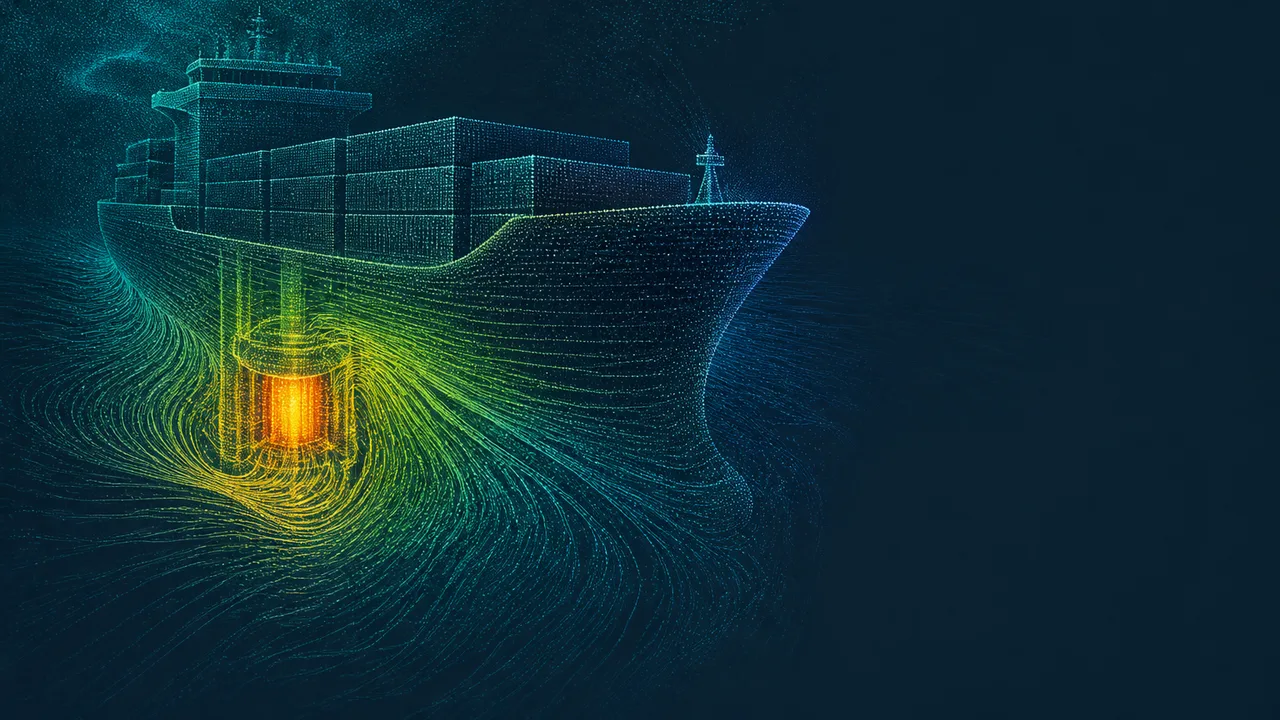
Photo: AI. Dexter Bloomfield
On 25 August 2026, the U.S. Maritime Administration signed a memorandum of cooperation with a company called Core Power, and the goal written into it reads like science fiction filed as paperwork: a fleet of American merchant ships that carry a reactor instead of a fuel tank, with the first vessel meant to be laid down in 2028.
Not sailing in 2028. Laid down. The distinction matters, because the interesting part of this story is not the reactor. It is everything that has to be true before a shipyard can weld anything.
What the Agreement Actually Does
The memorandum follows a request for information that Transportation Secretary Sean Duffy and MARAD published in the Federal Register on 7 May 2026, working alongside the Coast Guard, the Nuclear Regulatory Commission, and the Department of Energy. According to the IE Explains video, MARAD deliberately did not ask for a one-off demonstration ship. It asked for a system-centric small modular reactor: something repeatable, built in American yards, with liability rules, port acceptance, trained crews, and the back end of the fuel cycle worked out in advance.
Then ports started signing. Long Beach, which moved nearly 9.9 million TEU in 2025, signed on 23 July. Corpus Christi, the largest petroleum export port in the country, followed on 24 August.
Why a Reactor Suits a Ship
A large container ship runs one enormous engine at near-constant load for weeks at a time. The video's example is the Emma Maersk, whose main engine is rated at 81 megawatts and burns around 14,000 liters of heavy fuel oil per hour at full power. Reactors are poor at chasing a fluctuating grid and excellent at sitting at one steady output forever, which is almost exactly what ship propulsion asks for. The fuel arithmetic is lopsided: a kilogram of reactor fuel releases on the order of 100,000 times the energy of a kilogram of diesel. Remove the bunker tanks and you get cargo volume, deadweight, and range back at once.
Naval submarines already run reactors, but they are pressurized water reactors, which hold water above 150 atmospheres to stop it boiling. That demands a thick steel pressure vessel, heavy containment, and a plant designed around sudden pressure loss. Core Power's design, developed with TerraPower and Southern Company, is a molten chloride fast reactor instead. The fuel dissolves in chloride salt; the hot liquid salt is both fuel and coolant, circulating at high temperature and close to atmospheric pressure. If the salt overheats, it expands, the fuel spreads out, and the chain reaction slows on its own. Lose all power and the salt drains into passively cooled tanks and freezes solid. Modern designs pair this with an all-electric ship layout: the reactor generates electricity, motors turn the propellers, and no long mechanical shaftline runs to the stern.
The Caveat Nobody Gets to Skip
No molten chloride fast reactor has ever gone critical. Anywhere. What exists today is the Integrated Effects Test in Everett, Washington, a non-nuclear rig that heats and pumps chloride salt at up to 1 megawatt, reportedly the largest such system the nuclear sector has built. A 180-megawatt demonstrator reactor is planned for the early 2030s.
So the first ship would be powered by a reactor type that has never once been switched on. That is a development risk stacked on top of every other risk in the program, and it deserves more attention than any speed claim.
The Ghost of 1962
America has run this experiment before. The NS Savannah entered service in 1962 as a floating advertisement for Atoms for Peace, and by all accounts she was beautiful, which was rather the point. She was not a failure of safety. She failed on arithmetic.
Per the historical record kept by the Maritime Administration, Savannah cost $46.9 million to build, of which $28.3 million went to the reactor and fuel, and she operated at a loss of roughly $2 million a year compared with an equivalent oil-fired Mariner-class ship at a time when oil was cheap. Her reactor and shielding ate cargo space, leaving her carrying a poor load for her size. Australia, New Zealand, and Japan refused her entry to their ports. She retired in 1972.
All three of those problems are still on the list today.
The international rules for nuclear merchant ships date to a 1981 IMO resolution written around pressurized water reactors. A molten salt ship does not fit the document, and at its MSC 110 session in June 2025 the IMO agreed to revise the code and the relevant SOLAS provisions. Revisions of that size take years.
Liability is harder. The 1962 Brussels Convention on the Liability of Operators of Nuclear Ships never entered into force because too few countries ratified it. No global regime exists saying who pays if a nuclear merchant ship has an accident in someone else's harbor. No insurer underwrites unbounded liability, and no port accepts a ship whose emergency planning zone was sized for a land-based power station.
Then there is fuel. These reactors need HALEU, uranium enriched between 5 and 20 percent, and American supply is thin; the video notes Centrus's facility in Piketon, Ohio as essentially the only licensed source, with output so far measured in hundreds of kilograms where a fleet would need tons. Even leaving the precise production figures aside, the gap between what exists and what a fleet requires is plainly large.
The China Context
The political push behind this has a scoreboard. In 2000, China built under 5 percent of the world's ships. In 2025, it built more than 53 percent and holds over 60 percent of the global order book. The United States accounted for 0.11 percent in 2024. China is also ahead on paper in nuclear shipping: on 5 December 2023, Jiangnan shipbuilders revealed the KUN-24AP, a 24,000 TEU container ship concept driven by a thorium molten salt reactor, which received approval in principle from the classification society DNV. Approval in principle means a class society found no showstopper in the concept. No steel has been cut.
A commentary in Nature argues that plans for nuclear-powered merchant ships must confront these risks directly, and that regulatory, liability, and environmental questions cannot be treated as afterthoughts to the engineering. That reading matches what the Savannah already demonstrated sixty years ago.
Where Skepticism Should Land
Secretary Duffy has said in public statements that nuclear ships could travel up to 75 percent faster and run 20 years without refueling. The endurance claim is plausible for a fast reactor with a long core life. The speed claim deserves a calculator: propulsion power rises roughly with the cube of a vessel's speed, and ships slow down today precisely to save fuel. A 75 percent faster ship would need several times the power, which chews into every efficiency advantage the reactor provides. Speed is an operational choice, not a free capability.
Core Power's own numbers serve as the reality check. The company targets a $10 billion order book by 2030, first orders in 2028 to 2029, and deliveries between 2030 and 2035 at roughly $700 million per ship, several times the cost of a conventional box ship. Whether anyone orders at that price depends on fuel savings, cargo premiums, and a liability regime that currently does not exist.
Nuclear propulsion at sea has always been possible. It has never been commercially and legally possible. What changed in August 2026 is that the U.S. government started working on the second half of that sentence. Whether a nuclear cargo ship exists by 2035 will depend far more on lawyers, insurers, and port authorities than on physicists.
Which, for once, might be the more interesting engineering problem.
Nadia Marchetti covers the claims the mainstream skips and the evidence behind them.
Sources: IE Explains, "The US wants nuclear cargo ships by 2028. Here's how they'd work"; Nature, "Plans for nuclear-powered merchant ships must confront risks".
More Like This

We've Been Teaching Heisenberg's Uncertainty Principle Wrong
The story we tell about Heisenberg's Uncertainty Principle is misleading. Professor Aephraim Steinberg explains what the textbooks got wrong—and what's right.

Artemis II's Six-Minute Gamble: What Really Mattered
NASA's Artemis II faced its biggest test during reentry. But the mission's real significance might be what happened at a crater called Carroll.
Project Pele: The Pentagon's Portable Nuclear Reactor
The Pentagon's Project Pele aims to power remote military bases with a containerized nuclear reactor. Here's what the technology promises—and what it can't yet answer.

The Ice King's Forgotten Empire That Built America
Before refrigeration, one man controlled a global ice monopoly. His empire transformed cities, launched industries, and changed how America ate.

Valar Atomics Built a Working Reactor. Now Comes the Hard Part.
Valar Atomics just made nuclear power as a venture-backed startup. Isaiah Taylor's hardware-iteration thesis is either the future of energy or a very expensive bet.
Europe's Grid Nerve Center Is Getting a Private Battery
Switzerland's Flexbase project will bury a 1.2-gigawatt vanadium flow battery under Laufenburg. But who governs critical infrastructure owned by private investors?

The Quantum Fourier Transform Explained
Dr. Katie McCormick's Qiskit breakdown of the quantum Fourier transform reveals the strange mathematical object powering Shor's algorithm and quantum phase estimation.

Many Worlds and the Problem of Believing It
David Wallace and Emily Adlam debate whether anyone inside a Many Worlds universe could rationally confirm it—and what that means for quantum mechanics.