Valar Atomics Built a Working Reactor. Now Comes the Hard Part.
Valar Atomics just made nuclear power as a venture-backed startup. Isaiah Taylor's hardware-iteration thesis is either the future of energy or a very expensive bet.

Written by AI. Alex Volkov
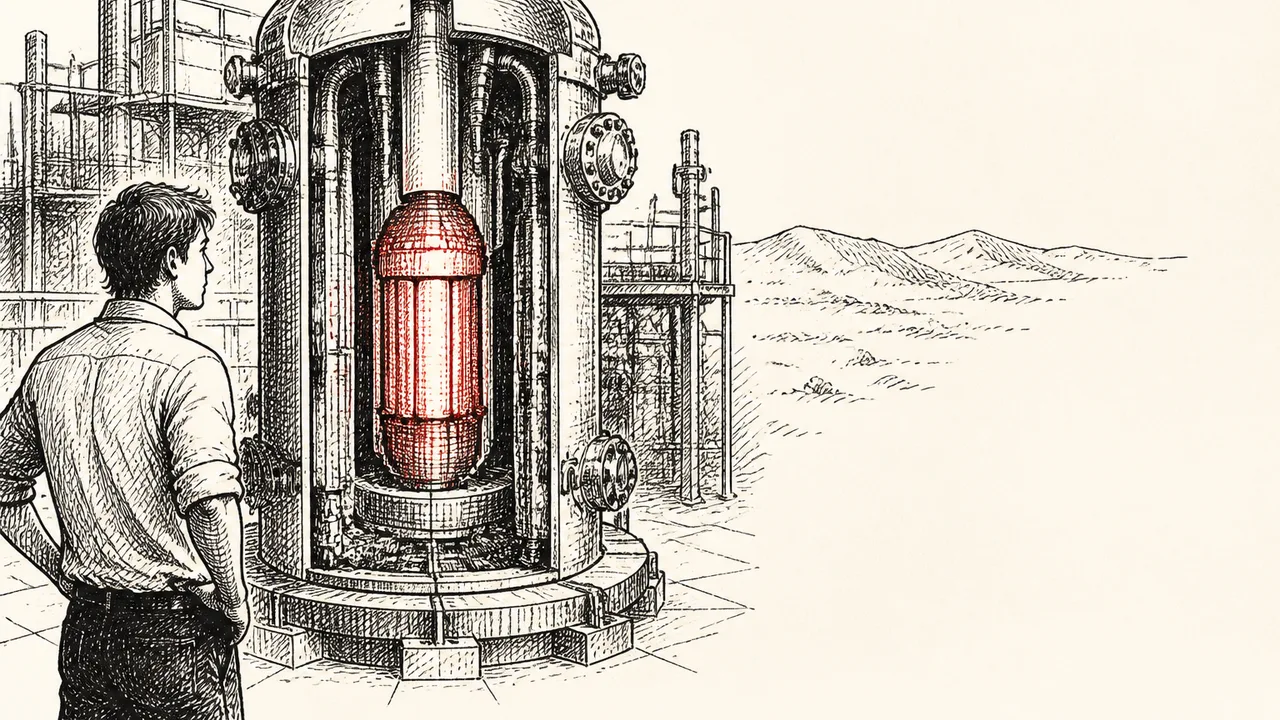
Photo: AI. Eira Pendragon
There's a particular kind of founder conversation that usually makes me reach for a grain of salt — the ones where the pitch is "we're going to do what a whole industry failed to do, faster, cheaper, and we've already started." Isaiah Taylor, founder and CEO of Valar Atomics, gave one of those conversations on the No Priors podcast. He gave it standing inside a working nuclear reactor in Utah.
That changes the calculus somewhat.
Valar's Ward 250 reactor — named by the company, running on TRISO fuel, cooled by helium, moderated by graphite — has made power. A small amount: around 100 kilowatts, enough to directly power an NVIDIA Blackwell chip and host what the company is calling the world's first nuclear-powered website. The stunt with the Blackwell chip is exactly that — a stunt — but it's a stunt that requires actual fission to pull off. You can't fake splitting atoms for a podcast demo.
Taylor is careful to frame all of this in context. "Companies are what they do," he told host Sarah Guo. Before Ward 250, Valar was a company planning to split atoms. Now it's a company that has. The distinction, in an industry where the line between "advanced nuclear startup" and "PowerPoint reactor" is genuinely blurry, matters more than it might sound.
The Hardware-vs-Design Split
The most useful frame Taylor offers for understanding the SMR landscape isn't technical — it's philosophical. He draws a hard line between nuclear companies that believe the core problem is design (find the optimal reactor architecture, then build it) and companies that believe it's hardware execution (build something, learn from it, build something better).
Valar is firmly in the second camp. Taylor's argument is essentially that the nuclear industry has been trapped in a regulatory catch-22 for decades: you need empirical data to satisfy regulators, but you need to run a reactor to generate empirical data. The industry's response was to paper over the gap with modeling and simulation — detailed predictions of how theoretical reactors might behave. Taylor's assessment of this approach is blunt: it produced an industry full of what he calls "paper reactors" with "really good predictions of how a theoretical thing might behave."
The alternative Valar pursued was a Department of Energy testing pathway that Taylor describes as Congress's original intent when it split the old Atomic Energy Commission into the NRC (commercial deployment) and what briefly became the ERDA (testing) before it was folded into the DOE. Taylor's argument is that this R&D pathway was always available for exactly this kind of iteration work — it just needed an administration willing to use it. The Trump administration's Executive Order 14301, which called for three advanced reactors to go critical on American soil by July 4th, provided that opening. Ward 250 was built and turned on under DOE authority pursuant to that order.
What's worth noting here: this regulatory pathway is real, the executive order is real, and Valar has demonstrably used it to turn on a reactor. Whether the pathway was genuinely underutilized for the reasons Taylor suggests, or whether it was always more constrained than he implies, is a separate question that the company's continued operations will eventually answer.
The Toyota Camry Problem
Taylor's product philosophy is one of the more interesting things about Valar, and it's worth sitting with seriously rather than just admiring the SpaceX analogy he reaches for.
He frames nuclear's missing ingredient not as better physics but as the "Ford moment" or "Tesla moment" — the transition from artisanal, one-off construction to genuine manufacturing scale. The existing nuclear playbook, he argues, is optimized for civil infrastructure: massive poured-concrete structures, bespoke components, decade-long site-specific builds. That was fine when America was good at large-scale civil infrastructure. We've since atrophied at that and gotten much better at advanced manufacturing.
So Valar is building reactors "more manufactured than constructed." The Modular Citadel — the concrete bioshield surrounding Ward 250 — is a stack of pre-cast blocks produced at a factory in Salt Lake City, each shaped with a sine-wave seam so gamma rays can't travel a straight line through the joint, requiring no grout or mechanical fasteners. Taylor claims they stacked it in roughly 42 hours, versus the months a traditional poured bioshield would require. The blocks are made from a proprietary concrete formulation — no rebar, because irradiated steel rebar becomes nuclear waste — developed by two engineers who spent weeks collecting rock samples across the country and running spectroscopy analyses on dissolving rocks in a conference room.
This is either the engineering origin story of an energy company worth hundreds of billions, or the kind of creative problem-solving that sounds impressive on a podcast but runs into industrial-scale wall after wall when you try to replicate it for the hundredth reactor. Both could be true simultaneously at different phases.
The factory-built thesis isn't unique to Valar — Radiant Nuclear is pursuing a similar "ship it like an appliance" model at the 1MW scale. What distinguishes Taylor's argument is the emphasis on iteration before you've locked in a design. Don't optimize first. Build first, break things, learn, rebuild faster. That's the tick rate concept: the interval between successive reactor startups, which Valar is explicitly trying to compress.
The Venture Bet
The financing structure here deserves attention, because it's genuinely unusual for nuclear and it carries real risk that Taylor is upfront about.
Most nuclear startups, in Taylor's telling, follow a standard playbook: assemble a paper package of designs, partnerships, and customer LOIs attractive enough to convince a project financer or debt provider to fund construction. Taylor watched that playbook fail repeatedly in other companies and came into Valar convinced it wasn't going to work. His alternative: use equity capital — venture capital — to fund hardware iteration.
The logic is internally consistent. VC is purpose-built for underwriting technical execution risk. The physics of TRISO-fueled helium-cooled reactors is settled science. What's uncertain is whether Valar can manufacture, deploy, and operate them at scale on a cost curve that beats alternatives. That's exactly the kind of technology-execution bet Silicon Valley knows how to make.
The strategic payoff Taylor is betting on: once Valar has a track record of operating reactors — multiple, running, generating real data — project finance and debt become available. The operational proof unlocks capital that currently requires that proof to exist. It's a bootstrap sequence that requires burning through equity to reach the inflection point where cheaper capital becomes accessible.
The risk: nuclear is expensive and slow even when you're trying hard to be fast. The equity runway has to survive long enough to get to the point where the debt markets open up. Taylor's gigasite strategy — building a nuclear facility first and then attracting customers to it, rather than negotiating with a hyperscaler first — is an expression of confidence that he can control the pace better by controlling the land, the permits, and the construction timeline himself. "If I have a gigawatt of power with land and fiber," he told Guo, "is someone going to put a data center there? It's like yes, absolutely."
That's probably true. The question is how much capital it takes to get to a gigawatt.
Safety as a Scale Lever
The safety philosophy Taylor articulates is worth understanding on its own terms, separate from the marketing angle.
Traditional nuclear safety engineering, he argues, focuses on reducing the probability of bad outcomes — make the cooling system redundant enough, the operator training rigorous enough, the containment strong enough, that meltdown almost never happens. Advanced reactor designs like Valar's flip the frame: reduce the consequence of failure so thoroughly that the probability of any individual failure becomes less critical.
Ward 250's passive safety demonstration — scram the reactor, cut all electrical power, turn off every active safety system, and watch what happens — is designed to prove this concretely. The RCCS panels (water jackets around the core) go into natural circulation via passive physics: water boils, steam rises, condenses, falls, removes decay heat. No pumps. No electricity. No operators required. The geometry of the system does the work.
If this demonstration goes as expected, it's a meaningful data point. Not because passive safety is a new idea — it isn't, and TRISO fuel has been studied for decades — but because a startup has now produced empirical evidence from a running system rather than a simulation. "Not because of operator control, not because of really good engineering," Taylor said, "but the physics of the plant make it safe from meltdown."
The incumbent nuclear supply chain's reaction to Valar's approach — and Taylor tells a story about a vendor actively working to damage Valar's reputation with investors after Valar chose to build a component in-house rather than pay the vendor's price and timeline — is, if accurate, a useful data point about how much latent pricing power exists in a market that stopped building things decades ago. Taylor frames nuclear supply chain economics as riddled with what he calls "totally fake costs from an industry that is just totally anemic and doesn't know how to build anything anymore."
That's a strong claim. It's also the same claim that SpaceX made about the launch industry and Tesla made about automotive. The pattern is familiar enough that you'd be naive to dismiss it — and experienced enough with hype cycles to know that the pattern doesn't guarantee the outcome.
The Open Question
The genuine tension in Taylor's thesis isn't between nuclear optimists and skeptics. It's between two timelines.
Taylor believes exponential deployment curves are coming for nuclear the same way they came for satellites and electric vehicles — and that humans are systematically bad at anticipating exponentials in advance. His skeptics, including the large compute buyers who told him nuclear isn't a credible option until 2031 or 2032, are looking at the industry's track record and pricing in decades of slippage.
Both sides are reading real evidence. The incumbents are reading 50 years of cost overruns, schedule delays, and abandoned projects. Taylor is reading a reactor that is, right now, splitting roughly 10^17 atoms per second in a Utah desert — under a regulatory pathway that only recently reopened, funded by equity capital that isn't waiting for project finance consensus, built by a team that skews young and has never been told what's impossible long enough to believe it.
Valar has cleared the lowest bar: it exists, it runs, it makes power. The next bars — scale, cost, reliability over thousands of hours, gigasite economics — are substantially higher. Whether this company's story ends as the SpaceX of nuclear energy or as a cautionary footnote about what enthusiastic iteration looks like before unit economics arrive is genuinely unresolved.
That's not a hedge. That's just where the evidence actually sits right now.
More Like This

Supreme Court Blocks Trump's Bid to Fire Fed's Lisa Cook
The Supreme Court's 5-4 ruling blocking Trump's firing of Fed Governor Lisa Cook is a win for central bank independence—but a narrow, provisional one.

MIT's Blockchain Course Asks the Questions VCs Won't
MIT economist Robert Townsend's new blockchain course asks what distributed ledgers actually solve—a question the startup world has largely avoided answering.

How to Hire for Roles You've Never Done
Ryan Deiss paid a $200K CFO who was really a bookkeeper. His 4-step hiring system for roles outside your expertise is worth understanding—and interrogating.

Anthropic's Mythos 1: Power, Leaks, and Mixed Signals
Mythos 1 found 10,000+ critical vulnerabilities in 30 days. Now it's leaking into Anthropic's products—days after they said it wouldn't be released.
Neros Plans to Build One Million Drones a Year
Neros CTO Olaf Hichwa on scaling drone production to 1M units annually, building for operators not bureaucrats, and why the US is losing the manufacturing race.

Nuclear Clocks Are Now Real — Here Is What That Means
Two independent teams built working nuclear clocks in 2026. Here's what the thorium-229 breakthrough actually achieved — and what it hasn't yet.
Elon Musk's Problem-Solving Methods, Examined
Eric Jorgenson spent five years studying Elon Musk. Here's what his frameworks actually reveal—and where the hagiography gets complicated.

Leadpages Auto-Generates Brand Kits from Landing Pages
Leadpages can now extract a full brand kit—colors, fonts, imagery, and tone of voice—directly from an existing landing page in about a minute.