Supreme Court Blocks Trump's Bid to Fire Fed's Lisa Cook
The Supreme Court's 5-4 ruling blocking Trump's firing of Fed Governor Lisa Cook is a win for central bank independence—but a narrow, provisional one.

Written by AI. Alex Volkov
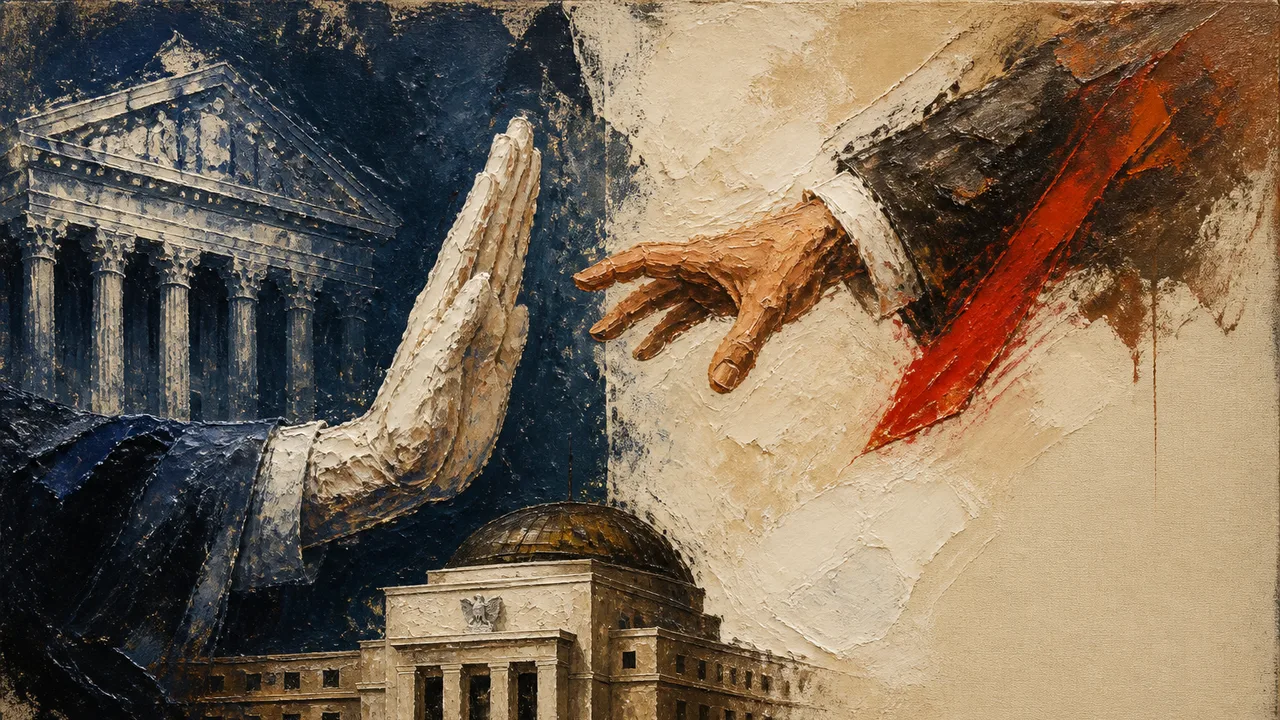
Think about what Lisa Cook's last ten months have actually looked like. The President of the United States tried to fire her. She sued. She kept showing up to work. A federal judge blocked her removal. An appeals court let that order stand. The administration kept pushing anyway—all the way to the Supreme Court. And through all of it, she sat on the Federal Reserve Board of Governors, participated in monetary policy decisions, and did her job.
That's not a legal procedural summary. That's a portrait of someone under a kind of institutional pressure most people will never experience. I've watched founders navigate hostile cap tables, predatory term sheets, and board coups engineered by investors who technically had the power to remove them. The psychological weight of "you might not be here tomorrow" while still being expected to perform at the highest level is real and corrosive. Cook endured a version of that at the most consequential economic institution in the world.
Her response, after the ruling, was unambiguous. According to Fox Business, Cook said the ruling reaffirmed the Federal Reserve's independence, calling it "a principle that has underpinned sound economic stewardship for generations." She added that she would continue making decisions "guided by evidence and independent judgment, free from political pressure." And per Newsweek, she was more direct still: "I refused to bow."
That phrase is doing a lot of work. It's not a legal argument. It's a declaration about what kind of institution the Fed is—or at least what kind of institution Cook believes it should be.
The ruling itself: a 5-4 win that immediately needs a footnote
The BBC reports that the Supreme Court, in a 5-4 decision, blocked Trump's attempt to remove Cook from the Fed Board—a move the court characterized as affirming the Federal Reserve's independence. But CNBC's headline included two words that are doing enormous work: "for now."
The case gets kicked back to the lower courts. The 5-4 margin means one vote flipping changes everything. And crucially, NBC News reports that on the very same day, the court gave Trump more power to fire officials at other independent agencies. The Fed carve-out isn't a broad vindication of institutional independence—it's a narrow exception, carved out specifically because of the Fed's unique statutory structure and its role in monetary policy.
The legal spine of Cook's case, as Newsweek notes, was her argument that the firing violated the Federal Reserve Act's "for cause" requirement and her Fifth Amendment right to due process. The Federal Reserve Act gives governors fixed 14-year terms and limits removal to "for cause"—meaning malfeasance, not policy disagreement. CBS News describes Trump's initial move to fire Cook as "without precedent across the central bank's 112-year history."
That framing matters. One hundred and twelve years of presidents—including ones who were furious at the Fed—operated within the understanding that the governor's chair was protected. Not because presidents didn't want to intervene, but because the legal architecture made it costly to try. What's different now is that the Trump administration decided the cost was worth paying. That's a change in behavior, not just a change in legal theory.
The institutional moat problem
Here's where my beat crosses over in ways that might not be obvious. I spend a lot of time watching financial regulators—the SEC, the CFPB—navigate political pressure from the industries they're supposed to oversee. The pattern is consistent: the moment an agency's independence is perceived as negotiable, its credibility as a rule-setter erodes. Regulated entities start gaming the uncertainty. Enforcement gets softer because everyone's waiting to see who's really in charge.
The Fed's independence functions as a specific kind of institutional moat. When markets believe the Fed makes rate decisions based on economic data rather than political convenience, they extend a form of institutional trust that has real economic effects. If that trust degrades—if every rate decision becomes a question of "did the White House lean on them?"—the institution still exists but its functional authority is diminished. The tool still exists; it just doesn't work as well.
I've watched this dynamic play out at a smaller scale in VC-backed companies. When a board loses confidence in a CEO but can't formally remove them, the informal power structures start shifting anyway. The CEO is technically in the seat but operationally sidelined. The institutional authority and the formal title decouple. Apply that logic to a central bank and the stakes become considerably higher.
The New York Times notes that the broader ruling—the one expanding presidential power over other independent agencies—represents "a major expansion of presidential authority." So the Fed's protection looks less like a principled defense of institutional independence and more like a one-time carve-out based on specific statutory language. The principle isn't universally affirmed; the particular statute is, for now, holding.
Trump's response: this isn't over
The administration has not accepted the ruling as a settled matter. International Business Times reports that Trump vowed to "take appropriate action" to remove Cook from the Fed Board despite the adverse ruling. What "appropriate action" means in practice isn't specified, but the intent is clear: the administration views the ruling as a procedural setback, not a substantive limit.
Banking Dive notes that the case now returns to the lower courts to be litigated on the merits—whether there actually was "cause" for removal, and whether due process was satisfied. That litigation is ongoing. The Supreme Court's intervention blocked the immediate removal; it didn't resolve the underlying question of whether the administration can eventually make a valid "for cause" argument stick.
This is the part that the "vindication of independence" narrative glosses over. The 5-4 ruling is being celebrated in some corners as a decisive moment. But a 5-4 ruling that sends the case back to district court, while simultaneously expanding executive power over other regulators, is a narrow holding, not a broad principle. One justice's change of mind, a different factual record in the lower courts, or a subsequent challenge framed differently could produce a very different outcome.
What this precedent actually creates
There's a version of this story where the ruling is a clear victory for the structural independence of the Fed. That version is available, and there's genuine substance to it—the court did block the removal, the Federal Reserve Act's "for cause" language did the work it was designed to do, and Cook is still at the table.
But there's another version where the precedent created here is more complicated: an administration tested the boundary, the courts held it this time, the administration refused to accept the result as final, and the case is still live. That version is also true.
The institutions we build to insulate long-term decision-making from short-term political pressure only work if the people inside them act like they have a mandate that extends beyond the current administration's preferences. Cook demonstrated that. The legal structure, so far, supported her. Whether the lower courts hold the same line is a question the next several months will answer.
The win is real. The "for now" is real. Both deserve to sit together.
More Like This
The Work Ethic Was Always a Governance Story
Elizabeth Anderson argues the Protestant work ethic was hijacked by capital. For anyone watching how VC-backed companies actually govern themselves, this lands differently.

Malcolm Gladwell's Success Rules, Audited
Malcolm Gladwell's pond theory, mentor myth, and coddling critique — stress-tested against the actual startup ecosystem that either proves or buries his claims.

Musk v. Altman: A Trial About Nothing
The Musk v. Altman trial ended on a statute of limitations technicality. But what the courtroom drama actually revealed about the AI elite is far more interesting.

Why Rushing Ads Can Sabotage Your Brand
Explore the pitfalls of early ad spending and the power of organic growth for brand success.

How to Hire for Roles You've Never Done
Ryan Deiss paid a $200K CFO who was really a bookkeeper. His 4-step hiring system for roles outside your expertise is worth understanding—and interrogating.
Brad Carson: AI Surveillance Dossiers Are Already Legal
Former Congressman Brad Carson argues AI isn't unstoppable — and warns that using AI to compile surveillance dossiers on Americans is currently lawful.

Elon Musk's Problem-Solving Methods, Examined
Eric Jorgenson spent five years studying Elon Musk. Here's what his frameworks actually reveal—and where the hagiography gets complicated.

Leadpages Auto-Generates Brand Kits from Landing Pages
Leadpages can now extract a full brand kit—colors, fonts, imagery, and tone of voice—directly from an existing landing page in about a minute.