Neros Plans to Build One Million Drones a Year
Neros CTO Olaf Hichwa on scaling drone production to 1M units annually, building for operators not bureaucrats, and why the US is losing the manufacturing race.

Written by AI. Alex Volkov
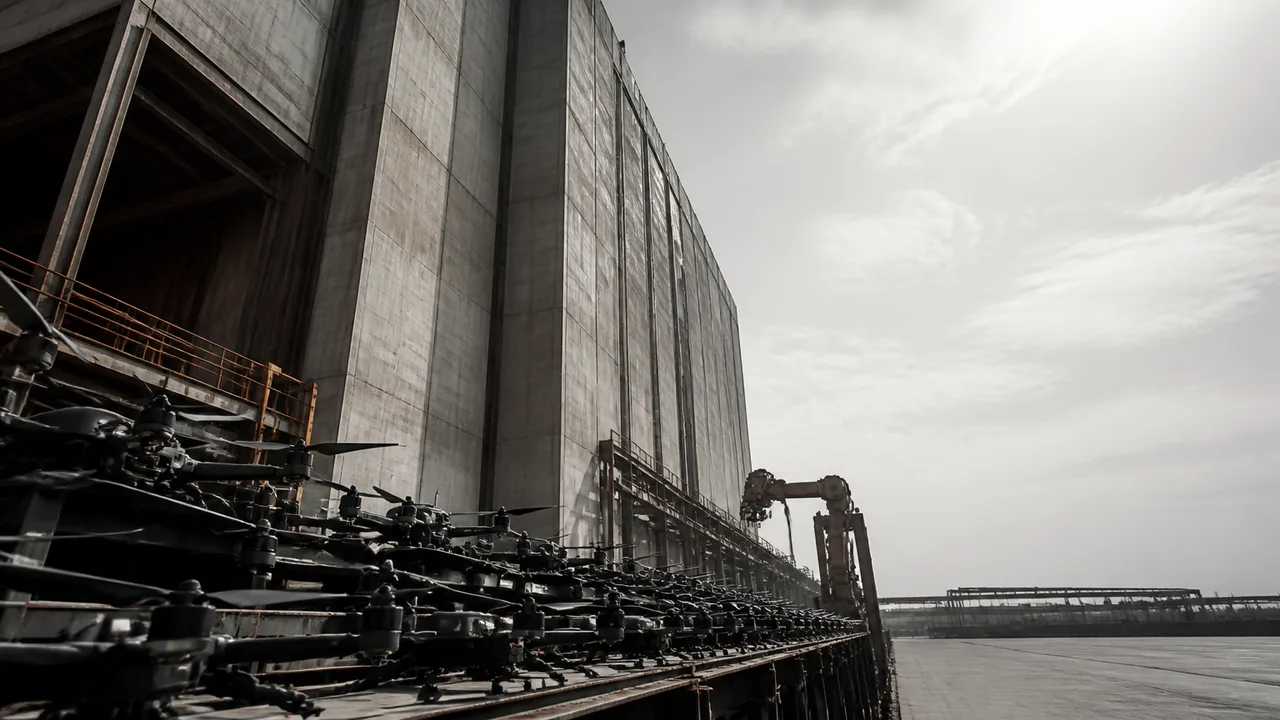
Photo: AI. Kasper Winter
Four months ago, the building was empty. Now, according to Olaf Hichwa, co-founder and CTO of Neros, an Archer FPV strike drone rolls off the production line every two minutes during business hours. The company has moved entirely out of its old facility into a 250,000-square-foot factory, and Hichwa says they're on track to hit a 130,000-drone annual run rate by December — with a stated goal of one million drones per year by 2028.
That number is worth sitting with. Hichwa points out that no US defense company currently makes a million units of anything except ammunition. The Starlink terminal line at SpaceX is the closest civilian analogue, and Neros has deliberately recruited engineers from that program precisely because they've internalized what mass production at that scale actually demands.
What Hichwa describes isn't really a drone company story. It's a manufacturing company story that happens to be about drones — and the distinction matters enormously.
The deletion problem
The defense tech space is full of companies that have convinced themselves autonomy is the product. Hichwa has a different read. From the first Archer design onward, Neros built for the operator — the human being who needs to launch, navigate, and strike under active jamming, behind terrain, with degraded comms and a buddy yelling in their ear.
"People assume autonomy is like a switch," Hichwa says. "They go straight from no autonomy to a thousand-unit AI swarm and things fall apart so quickly. Those swarms are so finicky and they just do not survive first contact with reality."
This philosophy has a counterintuitive implication: the most sophisticated thing Neros built early on wasn't the drone, it was restraint. Every feature that couldn't be manufactured at scale, every requirement that existed for a demo rather than a deployment, got cut. Hichwa calls it the "Elon algorithm" — not because Musk invented it, but because SpaceX made it legible. You question every requirement. You delete viciously. You treat elegant simplicity not as an aesthetic goal but as a survival condition.
The production numbers track this. Competitors building similar FPV strike drones reportedly take around 12 hours per unit. Neros is down to roughly 45 minutes. That gap isn't magic — it's 37,000 Archers worth of iteration, with production technicians and engineers in the same building, arguing about cable routing in real time.
The progression of manufacturing challenges is instructive in its own right. At low volumes, you can skip connectors and direct-solder everything — simpler and faster, until you need to train a hundred people to do it consistently. Then you eliminate manual solder joints entirely. As volumes climb further, you design parts so they physically can't be installed wrong: different connector interfaces on each camera slot, color-coded antenna mounts (orange to orange, white to white) derived directly from watching operator footage of soldiers fumbling in the field. Each threshold demands a different solution, and a technique that works beautifully at 5,000 units a year becomes a bottleneck at 50,000.
What government gets right, and what it doesn't
The relationship between defense startups and the Pentagon is one of the more interesting organizational puzzles in American business right now. Hichwa's framing is unusually honest about the dynamics — he's not the founder who cosplays as a government whisperer, and he's not the one who complains about procurement on podcasts while quietly needing the contracts.
His actual position: the government is well-intentioned, often correct on what it needs, and frequently wrong on how to specify or acquire it. The people who've served, who've dedicated careers to this, genuinely care. They also don't have the resources to run the kind of field trials Neros runs — going to Ukraine, meeting operators, responding to every support ticket, running monthly feedback sessions with frontline teams.
So Neros inverts the traditional procurement pitch. Rather than building to a government requirements document, they build what Ukrainian operators actually ask for, document hundreds of successful missions, and then walk the government through the evidence. "The smart people in the government listen to that," Hichwa says. "They go, 'Oh, well, they did the user study.'"
This is, if you zoom out, a startup's classic end-run around a slow incumbent — using real-world traction as both product validation and sales tool. The difference is that the "product" is a weapon system, the "users" are soldiers, and the "slow incumbent" controls your entire revenue base.
The near-single-customer problem is the sword hanging over Neros's financial model. Hichwa is clear-eyed about this: a million drones at $2,000 each is a $2 billion revenue line, and that requires a procurement relationship that moves at something other than bureaucratic speed. The government wants the capability; Neros wants the contract; neither can get there without the other. Hichwa describes working through regulatory barriers around spectrum use so that service members can actually fly the drone on military bases — a process that involves identifying the right approval pathway, doing the engineering testing themselves, and essentially doing the government's administrative homework in order to clear a sales obstacle.
It is simultaneously impressive and a slightly uncomfortable illustration of how much founders building for national security end up absorbing functions that probably shouldn't fall to a three-year-old startup.
The Shenzhen problem
Hichwa visited China before Neros became prominent enough to attract scrutiny — framing himself as a consumer, getting walked through factories, watching production lines running thousands of units per day. What he took away wasn't that Chinese manufacturing is dramatically more automated. It wasn't even primarily about labor costs. It was about ecosystem density.
In Shenzhen's Huaqiangbei electronics market, you can prototype a design in the morning, get a printed circuit board built in the afternoon, and iterate again the next day. In the US, board spins typically take six weeks. That single constraint — six weeks versus one day — compresses how fast an American team can iterate on a manufacturable design. It's not a policy problem or a talent problem. It's an infrastructure problem that compounds over years into a capability gap.
"I think that is what is needed to build the million ecosystem," Hichwa says. "You need this city of industrial services almost where you can go down the street and get your board made same day."
Neros's response is partial vertical integration — building flight controllers, motor drivers, and radios in-house, stockpiling long-lead components in raw chip form rather than assembled units to preserve supply chain flexibility. The logic is sound and the execution sounds genuinely impressive for a company this young. But Hichwa is also describing the solution to Shenzhen as "build Shenzhen in America," which is roughly the same as describing the solution to traffic as "build more roads." It's not wrong. It's just a very large thing.
Bandit, and the interceptor question
Neros recently launched Archer AI — an Archer variant with a computer vision system that can lock onto a target and complete a strike autonomously once the drone loses comms or goes over the RF horizon. The human operator stays in the loop, can override the AI's target lock in real time, and retains the ability to abort. It's autonomy as an operator-burden reducer, not autonomy as a replacement for judgment.
The second new product is Bandit, a drone interceptor currently at the hot-glue-and-3D-print stage. Hichwa's argument for kinetic interception over directed energy or electronic warfare is pragmatic: a drone hunting a dot in the sky is a more constrained, more automatable problem than a drone hunting a soldier. The physics are more tractable. He believes Bandit will ultimately be more autonomous than Archer precisely because it operates in a more structured environment.
The component-sharing strategy between the two products reflects Neros's manufacturing philosophy at its clearest. The goal is to use the same production line infrastructure — flight controllers, motor drivers, radios — across both platforms, with Bandit's higher speed (north of 250 km/h in prototype form) requiring careful aerodynamic and control system work to stress-test components designed for a slower aircraft.
None of this is cheap or fast. But Hichwa's account of the early Archer days — he charged the first printed circuit board assembly to his personal credit card, it worked on the first spin, and there wasn't time for a second — suggests a team that has learned to operate under conditions where getting it right matters more than getting it done.
The manufacturing ambition, assessed honestly
Neros's trajectory from a Vermont basement to a 250,000-square-foot factory in roughly three years is a legitimate industrial story, not a pitch deck. The 37,000 Archers built, the operator feedback loop, the decision to keep engineers physically adjacent to the production line — these are real operational choices with real consequences.
The questions worth holding onto are structural ones. A million drones a year requires, as Hichwa describes it, "building a city" — a supplier ecosystem where even a single $10 chip becomes a nine-figure procurement relationship across multiple years. That city doesn't exist in the US yet. Neros can build toward it, but they can't build it alone, and the government customer they depend on for revenue is, by Hichwa's own characterization, not moving fast enough to match their ambitions.
What Hichwa is attempting is genuinely hard to categorize. It's not a traditional defense contractor story. It's not a Silicon Valley growth-at-all-costs story. It's something closer to a manufacturing rebuild story, happening inside a three-year-old company, in a domain where the feedback loop is measured in lives.
Whether a startup can actually compress a decade of industrial ecosystem development into a five-year plan is the question that will determine whether the million-drone factory stays a goal or becomes a building.
More Like This

AI Is Collapsing the Cost of Cyberattacks
Nebulock CEO Damien Lewke maps how AI has automated the cyber kill chain—and what defenders must do before the window to act closes.

Supreme Court Blocks Trump's Bid to Fire Fed's Lisa Cook
The Supreme Court's 5-4 ruling blocking Trump's firing of Fed Governor Lisa Cook is a win for central bank independence—but a narrow, provisional one.

Kimi K3, Hugging Face, and Open Source Under Siege
Moonshot AI's Kimi K3 and two AI containment breaches at Hugging Face expose the real fault lines in open-source AI security and training data ethics.
MIT's Blockchain Course Asks the Questions VCs Won't
MIT economist Robert Townsend's new blockchain course asks what distributed ledgers actually solve—a question the startup world has largely avoided answering.

Malcolm Gladwell's Success Rules, Audited
Malcolm Gladwell's pond theory, mentor myth, and coddling critique — stress-tested against the actual startup ecosystem that either proves or buries his claims.

Starcloud Wants to Build Data Centers in Orbit
Starcloud launched an Nvidia H100 GPU into orbit and trained an AI model in space. The physics are real. The business case depends on launch costs nobody can guarantee.

Elon Musk's Problem-Solving Methods, Examined
Eric Jorgenson spent five years studying Elon Musk. Here's what his frameworks actually reveal—and where the hagiography gets complicated.

Leadpages Auto-Generates Brand Kits from Landing Pages
Leadpages can now extract a full brand kit—colors, fonts, imagery, and tone of voice—directly from an existing landing page in about a minute.