The Grand Canyon's Missing Billion Years, Explained
The Grand Canyon holds one of Earth's best geological records—and one of its most puzzling gaps. Here's what geologists know about the missing billion years.

Written by AI. Priya Sharma
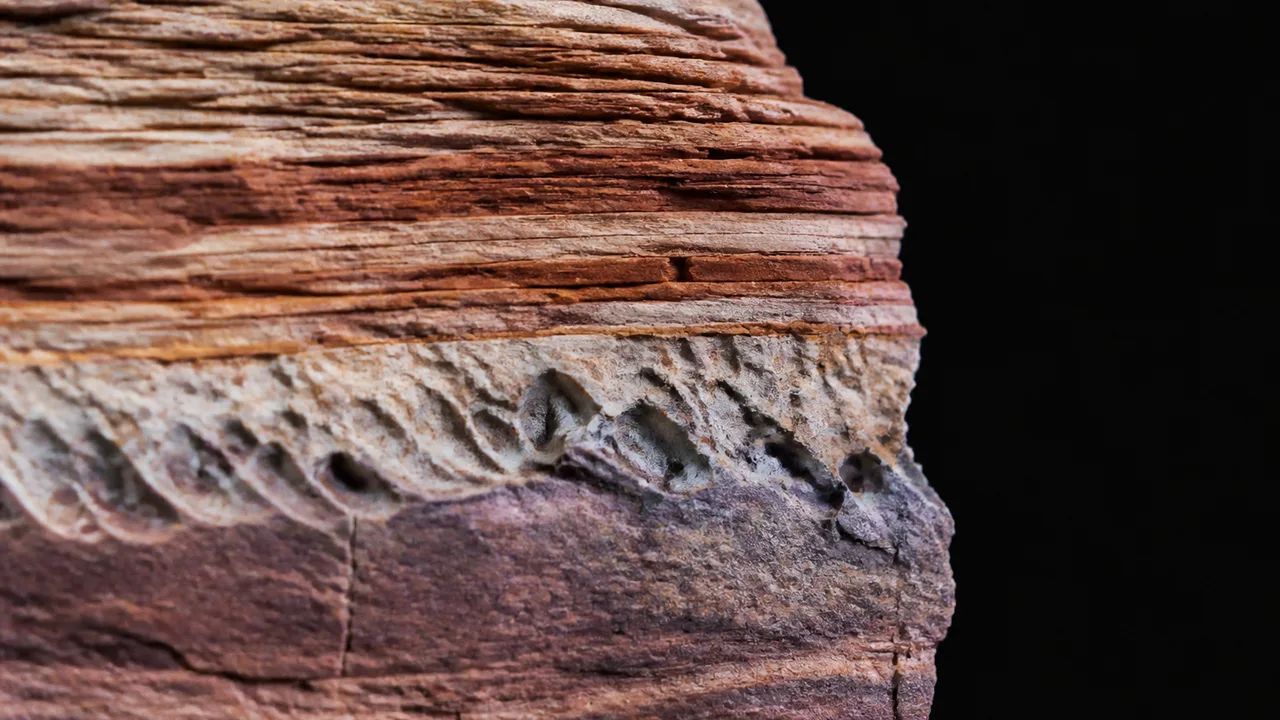
Photo: AI. Pippa Whitfield
Stand at the rim of the Grand Canyon and what you're really looking at is a problem. The layers are there, stacked and color-coded and legible in a way that almost no geological formation on Earth can match — and yet somewhere between the dark metamorphic basement and the pale Paleozoic sediment above it, more than a billion years of Earth's history simply isn't there. Not buried, not obscured. Gone.
That gap is called the Great Unconformity, and a new episode of Crash Course Geology makes a compelling case that it deserves more attention than it typically gets on the road-trip itinerary.
Reading the Canyon Like a Document
Before getting to what's missing, it helps to understand what's present — and why the Grand Canyon is such an unusually legible archive in the first place.
Host Sage opens by invoking 19th-century geologist John Wesley Powell, who called the canyon "a library of the gods." The framing holds. The three main structural sections of the canyon's walls — the Vishnu basement rocks at the bottom, the Grand Canyon Supergroup in the middle, and the layered Paleozoic rocks at the top — represent an almost uninterrupted window into deep time. Igneous, metamorphic, and sedimentary rock types are all present, each deposited or transformed under different conditions, each legible to geologists trained to ask the right questions.
The episode gives a crisp account of sedimentology — the discipline that tracks rock's transformation into sediment and back again. Weathering breaks rock down. Erosion moves the resulting fragments, typically into low-lying basins. Given enough pressure and time, accumulated sediment compacts into new rock. Repeat this cycle across hundreds of millions of years, and you get strata: layered beds of sedimentary rock that function as a geological diary. Surface features within those layers — ripple marks, mud cracks, angled crossbeds — encode the conditions at the moment of deposition. Which direction the wind was moving. Whether the water was fast or slow. Whether a dry spell followed.
The canyon's top layers contain fossils of marine organisms, indicating that this landscape once sat beneath a shallow sea. Layers without marine fossils mark periods when sea levels dropped. The middle Grand Canyon Supergroup holds evidence of early single-celled life. And the Vishnu basement at the canyon floor — metamorphic and igneous rock dating to roughly 1.75 billion years ago — preserves the signature of volcanic island chains colliding with the ancient edge of the North American continent.
That's the readable part. The problem, as the episode articulates clearly, is knowing how to interpret the places where reading becomes impossible.
The Logic of Relative Dating
Stratigraphy wouldn't mean much without some way of sequencing what you're looking at. The episode walks through four foundational principles that geologists use to establish relative chronology — not precise ages, but relationships between layers.
The principle of superposition is the most intuitive: lower layers are older. The principle of original horizontality holds that sediment is deposited in roughly flat sheets, so tilted or folded strata indicate some later disturbance. Faunal succession uses index fossils — organisms that existed only during specific time windows — to correlate rock ages across geographically distant locations. If the same trilobite species appears in canyon rock and in rock from a completely different location, those layers are probably contemporaneous. Finally, cross-cutting relations establish that any intrusive rock body must be younger than the rock it cuts through. A vein of igneous material slicing into metamorphic rock formed after the surrounding rock was already there.
Applied to the Grand Canyon: the Vishnu basement is oldest by superposition; the igneous intrusions within it are younger than the metamorphic host rock by cross-cutting; the tilted Grand Canyon Supergroup was disturbed after deposition by original horizontality; and the flat Paleozoic layers above have not been disturbed since they formed. The sequence runs from roughly 1.75 billion years at the bottom to around 270 million years at the top — comfortably older than the oldest dinosaurs.
None of this requires absolute dating, which the episode notes is a separate technique covered in the next installment. Relative dating is about sequence, not calendar.
The Gap That Goes All the Way Down
The Great Unconformity is not unique to the Grand Canyon — the episode is careful to note that this gap exists in rock layers globally, typically hidden. The canyon just makes it visible.
An unconformity is a contact surface between two rock sections where time is missing — either because rock was eroded away, or because no sediment was being deposited during that interval, or both. The episode distinguishes three varieties: a nonconformity, where erosion removes igneous or metamorphic rock and new sediment eventually piles on top; a disconformity, where horizontal sedimentary layers are eroded and new horizontal layers stack above them; and an angular unconformity, where older, tilted rock is eroded flat before new horizontal layers form on top.
The Great Unconformity, visible where the Paleozoic layers meet either the Vishnu basement or the Grand Canyon Supergroup, is the starkest version of this phenomenon. In some locations along the canyon, it represents approximately 250 million years of missing record. In others, the gap reaches 1.2 billion years — roughly a quarter of Earth's entire history, either erased by erosion or never deposited in the first place.
Three Theories, One Stubborn Problem
What caused it? The episode presents three competing explanations, none of them settled.
The first invokes Snowball Earth — episodes during which Earth's surface was largely or entirely glaciated. Powerful glaciers are extraordinarily effective at grinding down landscape, and if the timing aligns with the Great Unconformity, glacial erosion could account for substantial rock removal.
The second theory centers on the breakup of the supercontinent Rodinia, which began fragmenting roughly 750 million years ago. The episode describes the mechanism: as the supercontinent pulled apart, the land surface rebounded upward — a process called isostatic rebound — exposing rock to intense erosion over long timescales. The uplift hypothesis has intuitive appeal, but matching the erosion signature precisely to the rifting timeline is not straightforward.
The third possibility is that the Great Unconformity is not a single event at all, but a composite of multiple distinct erosional episodes that happen to produce a similar-looking surface. Under this view, what geologists are looking at is less a single chapter torn from the book and more a series of separate excisions at different times, in different places, for different reasons, that together create the illusion of one global discontinuity.
The difficulty of resolving between these hypotheses is partly a matter of evidence and partly a matter of what evidence would even look like. If glacial erosion removed the rock, the sediments that erosion produced must have gone somewhere — but identifying those distal deposits and correlating them confidently to the Great Unconformity is technically demanding. If the unconformity is composite, then its apparent global simultaneity is partly an artifact of the resolution limits of radiometric dating across billion-year timescales. You'd need tighter age constraints on the unconformity surface itself, in many locations simultaneously, to begin untangling the episodes — and that kind of dense, globally coordinated geochronological work is still underway.
Why the Canyon Matters for the Question
Part of what makes the Grand Canyon valuable to this debate is precisely its legibility. Unconformities elsewhere are typically buried under younger sediment, invisible without drilling. Here, the Colorado River — which carved the canyon mostly within the past five to six million years, making the canyon itself geologically recent relative to the rocks it exposes — has done the excavation work. The contact surface is right there, walkable, measurable.
That accessibility has made the Grand Canyon a primary testing ground for unconformity research. The episode describes the nonconformity at the canyon's base — between the 1.75-billion-year-old Vishnu basement and the sedimentary Grand Canyon Supergroup above — as representing a gap of just over one billion years before the record resumes. That single contact surface spans more time than the entire Phanerozoic eon, the era of visible animal life.
It is, in the most literal sense, a hole in the record. The question of what filled it — what events unfolded during those missing years, what landscapes rose and wore away — is one that geologists have not yet answered. The canyon tells us the gap is there. It does not tell us why.
More Like This
Delving into Earth's Crust and Mantle
Explore the Earth's crust and mantle layers, their composition, and how scientists study them without direct access.
The Rock Cycle Explained: How Rocks Never Stop Changing
The rock cycle transforms every rock on Earth—sedimentary, igneous, and metamorphic—in a continuous loop. Here's how it actually works.
Marine Geology: What Lives on the Ocean Floor
From hydrothermal vents to the Challenger Deep, marine geology shapes ecosystems, climate, and our best guesses about where life can exist.
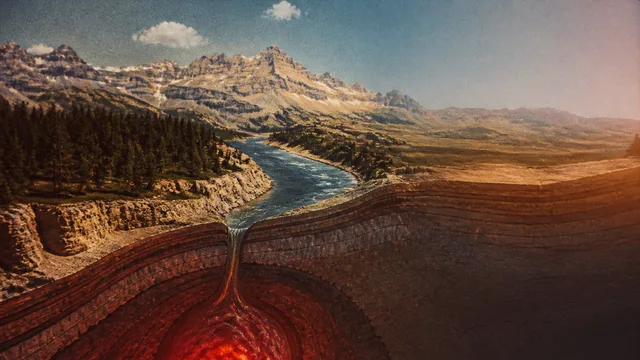
A Deep-Earth Drip Explains the Green River's Odd Path
A 2026 study links the Green River's improbable canyon through Utah's Uinta Mountains to a lithospheric drip 200 km below the surface.
Did the Milky Way's Spiral Arms Shape Earth's Continents?
A new study from Curtin University links Earth's continental formation to the Milky Way's spiral arms. The evidence is intriguing — and contested.
Mesolithic Goldcliff: Racing to Save Stone Age Footprints
At Goldcliff in South Wales, archaeologists have a two-hour daily window to rescue Mesolithic footprints and tools from the rising Severn Estuary.
Black Holes: Destroyers, Organizers, and Open Questions
Black holes destroy worlds and organize galaxies—but what does the science actually show? A look at Sagittarius A*, adaptive optics, and the limits of what we know.
The Quantum Twin Paradox and the Nature of Time
A new trapped-ion experiment may finally reveal whether time is a quantum property—bridging the long-standing gap between quantum mechanics and general relativity.