Garum: The Fermented Fish Sauce Rome Put on Everything
Pliny called it exquisite and foul. A new SciShow explainer unpacks garum, the fermented fish sauce that seasoned an empire, and the science of reviving it.

Written by AI. Helen Papadopoulos
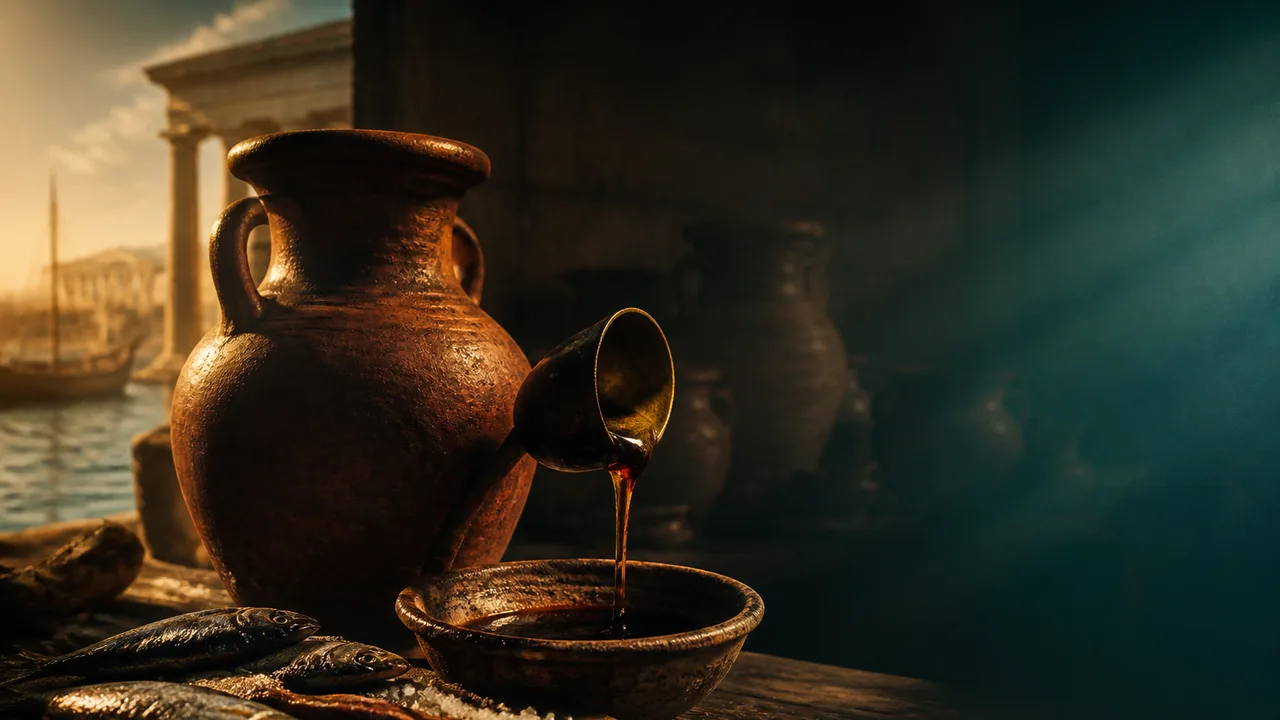
Photo: AI. Astrid Lehmann
Pliny the Elder managed to praise and recoil from the same condiment in a single breath. In his Natural History, he wrote of garum's "exquisite nature and unpleasant smell," describing a sauce made from fish intestines and scraps "which would otherwise be thrown away, macerated in salt, so that it is, in fact, the result of their putrefaction." He also recommended the stuff for dog bites, ulcers, and burns. Pliny, it must be said, recommended many things.
A new SciShow video hosted by Ceri Riley, "The Stinky Fish Sauce Ancient Romans Couldn't Live Without," takes on this paradox of Roman cuisine with modern microbiology, and it is a good occasion to revisit what we actually know about the ancient world's favorite ingredient, and what we still don't.
One Sauce, Several Names, Genuine Confusion
Start with the philology, because the philology is messy. Greek sources call the sauce garos, possibly after the fish itself; Latin writers use garum; later Romans reach for liquamen, the term that runs throughout Apicius, the famous old Roman cookbook. Food historians have traced references to a stinky fish sauce across countless texts in Greek and Latin, and the words may refer to one sauce, several variants, or the same product at different points in its history. As the video puts it, modern food scientists mostly use "garum" as an umbrella for all of it, which is convenient and possibly flattening. The Historical Cooking Classes survey of the terminology distinguishes garum, liquamen, muria, and allec as related but distinct products, which is a useful caution against treating the ancient pantry as less complicated than our own.
What is not in dispute is ubiquity. Dozens of Roman recipes call for some form of the sauce, and it appears to have crossed class lines entirely. The language reflects that: enogarum (garum with wine), oxygarum (with vinegar), hydrogarum (with water). When a condiment gets its own compound vocabulary, it has achieved household infrastructure.
Controlled Rot, with Instructions
Here is where the science gets interesting. Fermentation is usually presented as preservation: salt draws water away from harmful bacteria like E. coli, lactic-acid bacteria thrive in the salty, low-oxygen environment, and the acid they produce deters the microbes that would spoil or poison the food. Pickles work this way. Yogurt works this way.
Fish sauce works differently, and closer to the edge. As the video explains, the enzymes from the fish's own digestive system, released from their usual cellular containment by death, catalyze the breakdown of the fish's proteins alongside the microbial work. A paper in the Journal of Food Science on umami and the foods of classical antiquity, cited by ScienceDirect, describes fish sauce as deriving "from the hydrolysis of fish in the presence of salt primarily through endogenous enzymic proteolysis," which is the technical way of saying the fish digests itself in a brine. The result is a liquid loaded with glutamic acid and other amino acids, the biochemical basis of that savory, salty, faintly fishy flavor the Romans evidently could not get enough of.
This is why garum sits uncomfortably in the modern fermented-foods conversation. The line between fermentation and putrefaction is a matter of salt, time, and temperature, and Pliny's own word, putrefaction, was arguably accurate. The Romans were eating something chemically adjacent to decay and calling it delicious, and our discomfort with that sentence says more about us than about them.
The Disgust Question
Why did a sauce that smelled bad taste so good to so many? The video frames this honestly as an open question. Disgust likely evolved as a safety signal, a warning away from rotten food, yet plenty of safely edible foods (stinky cheeses, aged fish, natto) live right on that warning line, and their appeal often derives from it. Several research groups have proposed that umami taste signals the presence of proteins and salts the body needs, which would make garum a nutritional advertisement. The evidence is mixed: some studies link high-umami diets to better nutritional balance and others to increased headaches, and the honest state of the field is that we can explain the chemistry of deliciousness far better than the psychology of it.
Rebuilding Garum from a Pompeiian Shop Floor
The most satisfying part of the story is experimental. One research group reconstructed garum using six well-preserved samples found in buried vessels at a garum shop in Pompeii, unearthed in the 1960s and studied since. Chemical analysis of the residue suggested anchovies, with pollen traces hinting at flavorings like thyme, sage, fennel, and mint. The team layered whole anchovies, salt, and spices in a five-liter vessel, held it at 50 degrees Celsius to mimic a Roman vessel sitting in the Mediterranean sun, and waited 25 days for the enzymes to do their work. What emerged, after straining, was a transparent, stinky, fishy liquid chock-full of glutamic acid: garum, rebuilt from residue and recipe.
This is experimental archaeology doing what it does best, turning a literary reference into a testable hypothesis. Independent efforts tell a similar story. The Fermentology project's account of Roman fish sauce in a modern context reports that a reconstructed ancient fish sauce showed a high content of lactobacillus bacteria, absent from modern fish oils, suggesting the ancient fermentation profile differed from anything on today's shelf. And as Eater has documented, modern chefs are now producing garum again, including experimental versions made from non-fish substrates like grasshoppers and bee larvae, at restaurants such as Noma.
What We Still Don't Know
A few open questions deserve their due. Whether Southeast Asian fish sauces descend from garum or arose independently remains unresolved; the video is candid that scholars aren't sure, and the balance of evidence is thin in both directions, since fish fermentation across Asia has its own long, documented history that needs no Roman parentage. The precise relationship between garum and liquamen in ancient usage is likewise unsettled. And Pliny's medicinal claims, dog bites and all, find little support in modern evidence, though the broader health case for fermented foods, improved digestibility and nutrient availability among them, rests on real research, provided you keep in mind that garum's salt content would have been formidable.
The picture that emerges is of an ancient food technology that was sophisticated without being mysterious. The Romans did not need to know about proteolysis or lactobacillus to have mastered, through generations of practice, a process that kept protein edible across seasons and made it delicious in the bargain. Modern science can name the mechanisms; the Romans had the results.
This brings me back to Pliny's double verdict: exquisite nature, unpleasant smell. A sauce that an empire-wide market produced, sold, and poured over everything from dormice to desserts was, by any standard, one of antiquity's great industrial products, built on an organism-level understanding of preservation that predated microbiology by two thousand years. The next time someone tells you the ancient world has nothing to do with your kitchen, point them to the bottle of fish sauce in their pantry, and to the barrel of intestines fermenting in the Campanian sun twenty centuries before it.
More Like This
WW1 Trench Life: What the Western Front Was Really Like
From Pals' Battalions to the Vickers gun, a new documentary unpacks the grim machinery of survival on the WW1 Western Front in unflinching detail.

Pliny the Younger's Letters on the Eruption of Vesuvius
Pliny the Younger's two letters to Tacitus remain the only eyewitness account of Vesuvius's eruption in 79 AD — and they still read like dispatches from the end of the world.

How the Corvus Won Rome Its Navy and Drowned Its Crews
The First Punic War's ugliest weapon beat Carthage at sea, then killed more Romans than any battle. What the raven's rise and quiet erasure reveal.
Baiae: The Sunken Pleasure City of Ancient Rome
Beneath the Bay of Naples lie the ruins of Baiae, Rome's most scandalous resort. New 3D scanning reveals what volcanic geology buried and the sea swallowed.

Why Your Brain Orders Another Bite of the Pepper That Burns
Capsaicin triggers pain receptors, yet chili fans keep eating. A science writer unpacks TRPV1, learned pleasure, benign masochism, and spice tolerance.

Vodka and Pierogi: Poland's Food Identity Explained
Rick Steves and guide Tomasz Klepacki explore what Polish vodka and pierogi reveal about Polish identity, tradition, and the meaning of home-cooked food.
Minoan Thera and the Archaeology Behind Atlantis
Was Plato's Atlantis rooted in real events? The archaeology of Minoan Thera makes a compelling case — and complicates the legend in fascinating ways.

Alexandria's Library Was More Than a Library
Dr. Roy Casagranda's lecture on the Great Library of Alexandria reveals a research institute, innovation hub, and the ancient world's most powerful idea engine.