Why Your Brain Orders Another Bite of the Pepper That Burns
Capsaicin triggers pain receptors, yet chili fans keep eating. A science writer unpacks TRPV1, learned pleasure, benign masochism, and spice tolerance.

Written by AI. Priya Sharma
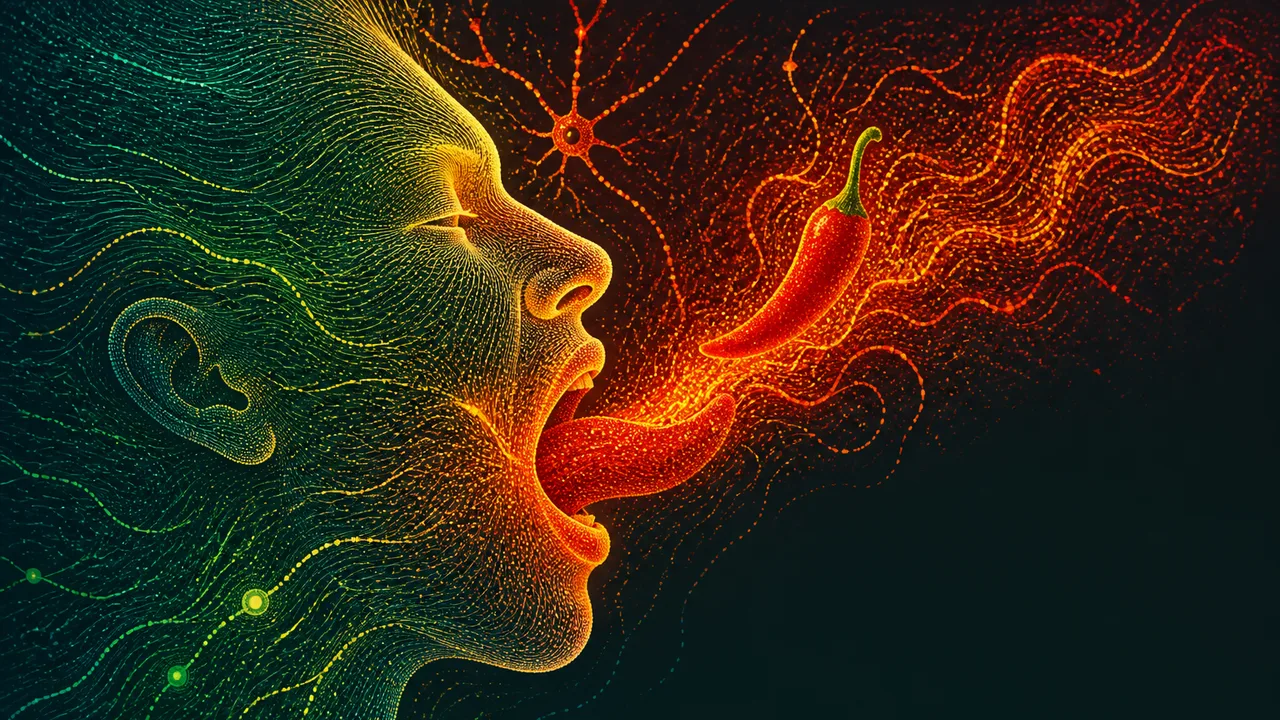
Photo: AI. Dexter Bloomfield
Explain In Paint, a YouTube channel that covers human biology and food science, published a video in late August 2026 asking a question that has bothered psychologists for decades: why do people seek out food that triggers the body's pain and heat-sensing systems? The video, "Why Do Humans Enjoy Food That Causes Pain?" (available on YouTube), runs about 21 minutes and builds its answer in layers: a molecular false alarm, a botanical defense strategy gone sideways, and a learned pleasure that researchers call benign masochism.
The Alarm that Rings When There's No Fire
The video's core mechanism is solid, uncontroversial physiology. Chili heat comes from capsaicin, a compound that binds to TRPV1, a receptor on sensory neurons whose day job is detecting dangerous heat, acidity, and inflammatory signals. When capsaicin opens that channel, the brain receives an urgent message: hot. The pepper, sitting at room temperature, is not physically burning anything.
As the video puts it, this is "a molecular false alarm. The fire detector has activated even though there is no fire."
Spiciness also isn't one of the five basic tastes (sweet, sour, salty, bitter, umami). It belongs to a family of sensations called chemesthesis, carried by the trigeminal nerves, alongside the chill of menthol and the sinus assault of wasabi. The brain blends those signals with taste and smell into a single experience we casually call "flavor."
One practical payoff from this biochemistry: water is nearly useless against a chili burn. Capsaicin is poorly soluble in water, so a cold sip briefly cools the mouth and then spreads the oily compound to fresh nerve endings. Milk works better because the protein casein helps pull capsaicin off the mouth's surfaces, and fat dissolves it. Chemistry picked dairy's side.
Why the Pepper Makes the Warning in the First Place
Capsaicin did not evolve to season human food. The video lays out the plant's actual logic: mammals that chew chili fruits tend to destroy the seeds, while birds, whose receptors react differently to capsaicin, swallow fruits whole and disperse viable seeds at a useful distance. The burn is a targeted eviction notice for rodents. Studies of wild chili species have also found greater pungency where fungal threats were higher, and capsaicinoids can inhibit certain seed-damaging fungi.
Then humans arrived, read the eviction notice, and moved in. Evidence suggests domesticated Capsicum annuum existed in the Americas as early as 6,000 years ago. After European contact, chilies spread rapidly across Africa, Europe, and Asia, so thoroughly that cuisines most associated with them, including Indian, Thai, and Korean cooking, adopted the plant only within the last few centuries.
Learned Danger: The Psychology of the Second Bite
A first encounter with a hot pepper usually registers as pure pain. The video's account of what happens next matches the mainstream view in psychology: repeated safe exposure reframes the sensation. A child watching trusted adults enjoy spicy food learns two coexisting messages: it hurts, and it's safe. Predictability creates control, and control changes everything.
This is where the video cites researchers' concept of benign masochism: enjoyment of the body's negative reaction when the person knows there is no real danger. As social psychologist Brock Bastian writes, per Popular Science, "Benign masochism characterizes the enjoyment of the conflict that arises when these simultaneous positive and negative emotions are activated." Horror films, roller coasters, sad music, and very hot baths live in the same territory.
Paul Rozin, the University of Pennsylvania psychologist who pioneered this line of research, has long argued that people enjoy the thrill of a safe, body-registered threat, and the Big Think summary of the competing theories places his hedonic view among the leading candidates. A chili expert quoted by The New York Times in 2010 captured the appeal with more candor than most peer-reviewed papers manage: "It's fun, sorta like a night out to watch someone being burned at the stake."
A more recent take from The Guardian quotes a researcher named Browne on reappraisal: "through exposure and experience, we reframe the meaning of what the pain represents and that it's actually safe for us," adding that "that sense of control and mastery matters."
The video makes a point I wish more coverage emphasized: desensitization alone does not explain the pleasure. Studies find that frequent chili eaters report greater liking, but they do not always rate the burn as weaker than novices do. Many enthusiasts choose an intensity they clearly feel. The burn stays; its meaning changes.
What the Video Gets Right, and Where It Stays Cautious
Several sections show the kind of epistemic hygiene I rarely see in this genre. On the popular claim that spicy pain triggers an endorphin and dopamine "natural high," the video is blunt: the story is plausible but "usually told with more certainty than is supported by direct evidence in humans." Pain can engage the body's own pain-modulation and reward systems, and relief after an unpleasant stimulus is itself rewarding, but no measurement shows a precise endorphin surge behind every fiery wing. Satisfaction likely emerges from several processes at once: excitement, relief, learned associations, sensory contrast, and a sense of control.
The video applies similar skepticism to the antimicrobial hypothesis, the influential idea that spicy cuisines flourished in hot climates because spices suppress foodborne microbes. It calls the theory appealing and too simple to be comprehensive, noting that spice use also depends on trade, cost, religion, and storage, and that chili's cheapness and potency did plenty of work on their own. A small amount of an easily dried, easily transported plant can make inexpensive staples interesting. Pain is economical.
The Limits of the Fun
The safety caveats are the least glamorous and most necessary part of the piece. Capsaicin usually causes pain without thermal tissue damage, and it does not automatically cause ulcers or burn holes in a healthy stomach, whose mucus, bicarbonate, and blood flow defend against something far more corrosive: ordinary stomach acid. But high doses can cause real harm. Eating contests have been linked to vomiting, severe abdominal pain, headaches, and rare medical complications, and spicy food can worsen reflux or IBS symptoms. TRPV1 receptors line more of the digestive tract than the mouth, which is why the experience sometimes has a second act nobody ordered. And tolerance has a ceiling; enough capsaicin overpowers nearly anyone. Cross the line where the sensation stops feeling controllable, and the video notes that benign masochism collapses into ordinary misery.
The Open Question
What the video never fully settles, and what the literature has not settled either, is the origin story. Did chili eating begin as medicine, as preservation, as status display, or as one stubborn person's refusal to spit? Rozin's thrill hypothesis, the antimicrobial theory, and cultural-transmission accounts all have supporting evidence and all leave gaps. What seems clear is the shape of the answer rather than its starting point: humans enjoy pain that is predictable, voluntary, limited, and embedded in reward. The same nervous system that says "danger" sits next to a thinking brain that says "dinner," and neither message wins.
The pepper evolved a chemical to keep mammals away. Birds ignored it. Humans understood it perfectly, and decided the warning was the best part.
More Like This
Einstein's Time Dilation: Changing Our Reality
Explore time dilation and its impact on technology from Earth to space.
Why Onions Make You Cry: The Physics We Missed
Cornell researchers built an onion guillotine to solve the physics of why cutting onions makes you cry—and debunked a few popular kitchen hacks along the way.

Water as Rocket Fuel: The Case for Electrolysis
Water electrolysis propulsion could reshape space travel. Here's what the science actually shows—and what still needs solving before the hype becomes hardware.
Exploring Black Holes and Asteroids with StarTalk
Neil deGrasse Tyson delves into black holes, asteroids, and more in StarTalk's latest Cosmic Queries episode with Chuck Nice.

Why Highly Intelligent People Feel Emotions So Intensely
Dąbrowski's overexcitability theory offers a 60-year-old framework for understanding why intelligent people feel more—and what to actually do about it.

Prehistoric Drugs That Shaped Human Civilization
From 9,000-year-old fermented rice wine to 5,700-year-old peyote buttons, archaeology is rewriting the story of why humans built civilization.

A Star in Andromeda Vanished. A Black Hole Remained.
A massive star in Andromeda faded without exploding. Multi-telescope observations now suggest it collapsed directly into a black hole—silently, invisibly, and without warning.

AHA Says 5 Cups of Coffee a Day Is Safe for Your Heart
The American Heart Association says up to 5 cups of coffee daily is safe and may lower heart disease risk. Here's what that actually means—and what it doesn't.